A certificate of conformance is an authenticated statement about how identified items or services meet specified requirements. For a fastener order, its value depends on connecting that statement to the ordered part, the supplied shipment and the cited requirement.
A document bearing the right title can still leave an important connection unresolved. Review what is being declared and which items the declaration covers before treating the paperwork as the record for a particular delivery.
What a certificate of conformance states
The statement identifies a subject and a requirement. The subject may be an item, a lot or a defined supply; the requirement may be an order, specification or drawing reference. Its issuer and authentication also matter to understanding whose statement is being supplied.
Y-12’s public conformance form connects an authenticated supplier statement with order-line information and cited requirements. The Los Alamos National Laboratory glossary likewise describes certification documents through their subject, authentication and specified requirements.
These institutional documents are examples of document structure and terminology. They do not make their procurement rules the requirements for an ordinary commercial fastener order.
For purchasing, begin with the actual statement. Does it identify the supplied items clearly, and does it refer to the requirements agreed on the order? A broad statement about a product family may leave those delivery-specific questions unanswered.
Start with the requirement behind the title
The purchase requirement determines which document the buyer requested. The heading on a supplier’s file is only the start of the comparison.
A supplier may use wording such as “certificate of conformity” or “certificate of conformance.” Read the actual statement, issuer and scope rather than assuming that the titles establish identical content or legal meaning.
The same approach applies to a file named “quality certificate.” It may contain useful information, but its title does not show whether it provides the particular statement, identifiers or supporting data requested on the order.
Record the requested document and the received document separately during review. This makes a missing item visible. It also avoids changing the meaning of the purchase requirement merely to match the name of the file that arrived.
If the order’s wording is unclear, clarify the required document function and content. A more specific request is easier to fulfil than a request for an unspecified certificate.
Check five connections on the document
The following map organizes useful review questions. It is an editorial reading aid, rather than a prescribed certificate format.
Order reference: connect the statement to the relevant order and line item. If the delivery is partial, identify which part of the supply the document addresses.
Item and revision: compare the part description and cited requirement references with the order. A matching part number should not hide a different drawing revision.
Lot identity: identify how the shipment, packaging and document are connected where lot or heat traceability is part of the requirement. An unexplained identifier needs clarification rather than an assumed match.
Statement scope: read what is declared and how exceptions or approved changes are identified. Y-12’s example form provides separate fields for requirement revisions and recorded exceptions, showing why those details deserve their own review.
Sign-off: identify the issuing entity, authentication and date in the applicable document. A visible signature can attribute a statement; it does not independently resolve every question about document authenticity.
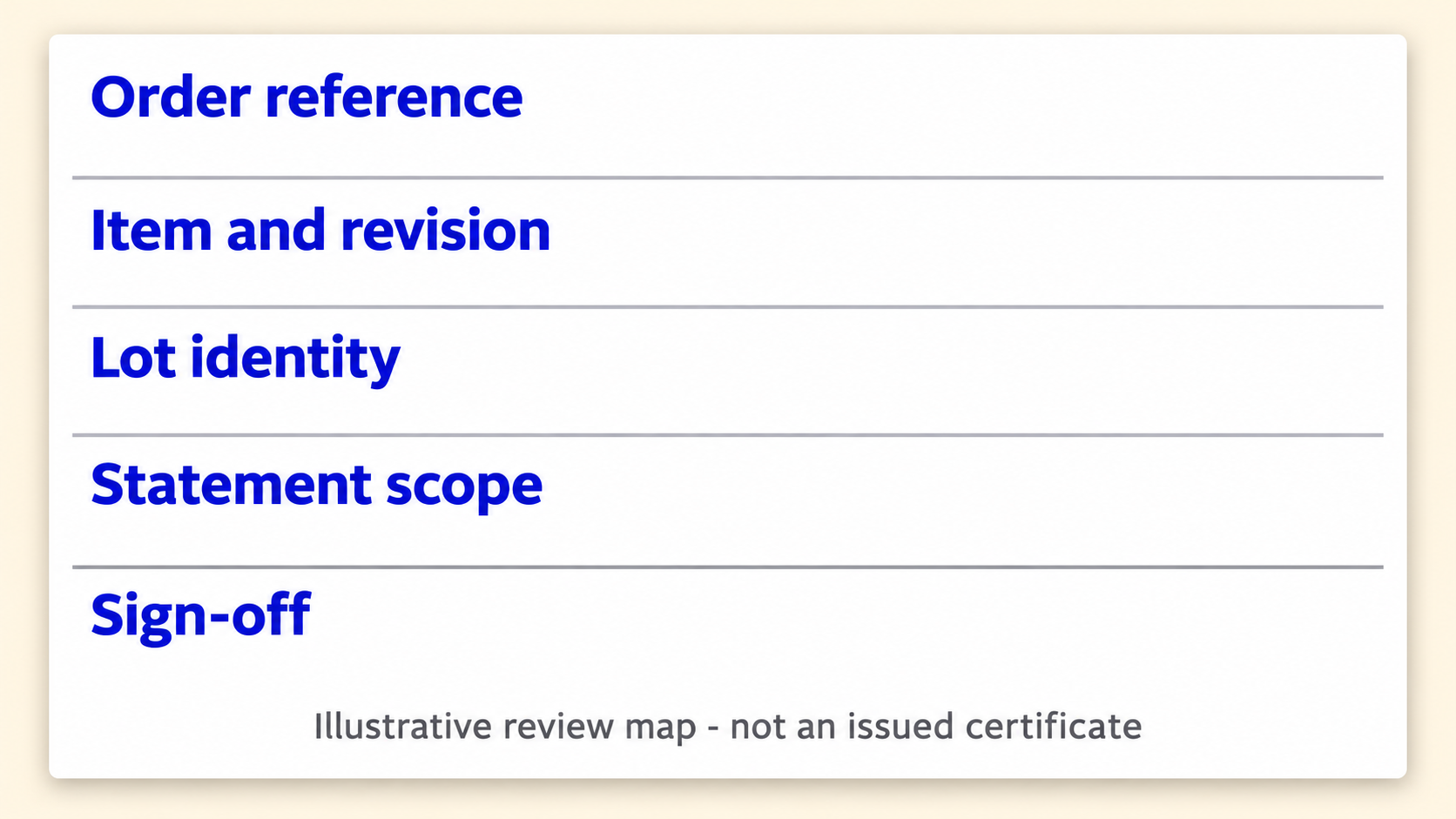
These connections should remain visible in the review record. If one is unresolved, describe that particular gap instead of giving the entire package an unexplained “paperwork problem” label.
Separate the statement from supporting records
A conformance statement and supporting test data answer different questions. A statement can declare a relationship to requirements, while a material report describes the properties or results recorded within its stated scope.
LANL’s glossary distinguishes certification documents from certified material test reports. Y-12’s March 2026 procurement terms also address lot-linked material-test records separately from a conditional conformance stamp. Those examples illustrate why document roles should not be collapsed into one label.
Material evidence: the mill test report guide explains the separate task of connecting material records with fastener supply. When that evidence is requested, identify which report and material identity support the delivery.
Inspection evidence: the AQL and lot-inspection guide addresses sampling-plan records. A sampling record should be read for the inspection activity it documents, rather than treated as interchangeable with a supplier statement.
A document package may combine several functions. Check its actual content against the order instead of assuming that every conformance certificate lacks data or that every fastener order requires the same reports.
Work through a revision mismatch
Consider a hypothetical delivery with a correct purchase-order number and part number. The order cites drawing Revision C, while the supplier’s statement cites Revision B.
The matching identifiers establish part of the connection. They do not resolve the revision difference. Two different explanations remain possible: the paperwork may be outdated, or the supplied item may relate to a different requirement than the buyer intended.
Record the discrepancy before choosing an explanation. Identify the order reference, the revision it cites and the different revision stated in the received document. Ask the supplier to connect the delivered items and their supporting records with the agreed requirement.
A revised document may close a paperwork error if the underlying supply and records support the correction. Simply changing a letter on a certificate would not, by itself, explain what was supplied.
This example is a review scenario, not a case history or an authenticity finding. Its purpose is to show why one correct reference should not outweigh a separate unresolved field.
Close the document questions before shipment
A useful document request names the intended statement, the items or delivery it should cover and the supporting records agreed for the order. It keeps requirement revisions and any proposed deviations explicit.
Ask the supplier specific questions: which delivery does the document cover, which requirements does it cite, and how are the identifiers connected? Those questions are easier to answer than a general demand for “more certification.”
The completed review should show what was received, what requirement it was compared with and how each identified discrepancy was resolved. A certificate of conformance becomes useful evidence within that connected record, rather than through its title alone.
References
Y-12: Certificate of Conformance form UCN-26580, January 2026
LANL: Conduct of Engineering Glossary, Revision 3, April 2026
Y-12: March 2026 procurement terms, packaging and document examples