A mill test report records information about the material it covers, including its identity, specification and applicable test results. For a fastener order, the key question is how that material record connects to the delivered manufacturing lot. A plausible report with no usable link to the shipment leaves that question open.
Begin with the report’s scope. Does it describe incoming bar or wire, a processed material condition, or the finished fastener? A material test report should be read for the product and condition actually reported, rather than treated as evidence of every later manufacturing operation.
Read the mill test report as a record with a defined scope
Service Metal’s description of its MTRs provides useful examples of report fields. The exact contents needed for your order depend on the specified product and requirements; the list below is a review aid, not a mandatory format for every supplier.
| Report field | Question for the receiving review |
|---|---|
| Issuer and item description | Who issued the report, and what material or product does it cover? |
| Heat or traceability reference | Which material identity is reported? |
| Specification and edition | Does the designation match the relevant order requirement? |
| Chemical and applicable mechanical results | Which results are reported, in what units and for which condition? |
| Treatment and additional tests, where applicable | What processing or testing does this document actually establish? |
Keep requirement limits and reported results in separate columns when reviewing them. A familiar specification number in the heading does not replace a comparison of the actual designation, condition and applicable results.
Connect the material heat to the production lot
FHWA’s archived High Strength Bolts for Bridges training manual distinguishes an original mill report tied to a material heat from a manufacturer’s report tied to a production lot. That historical explanation illustrates the record layers; this guide does not use its older design or test provisions as current acceptance rules.
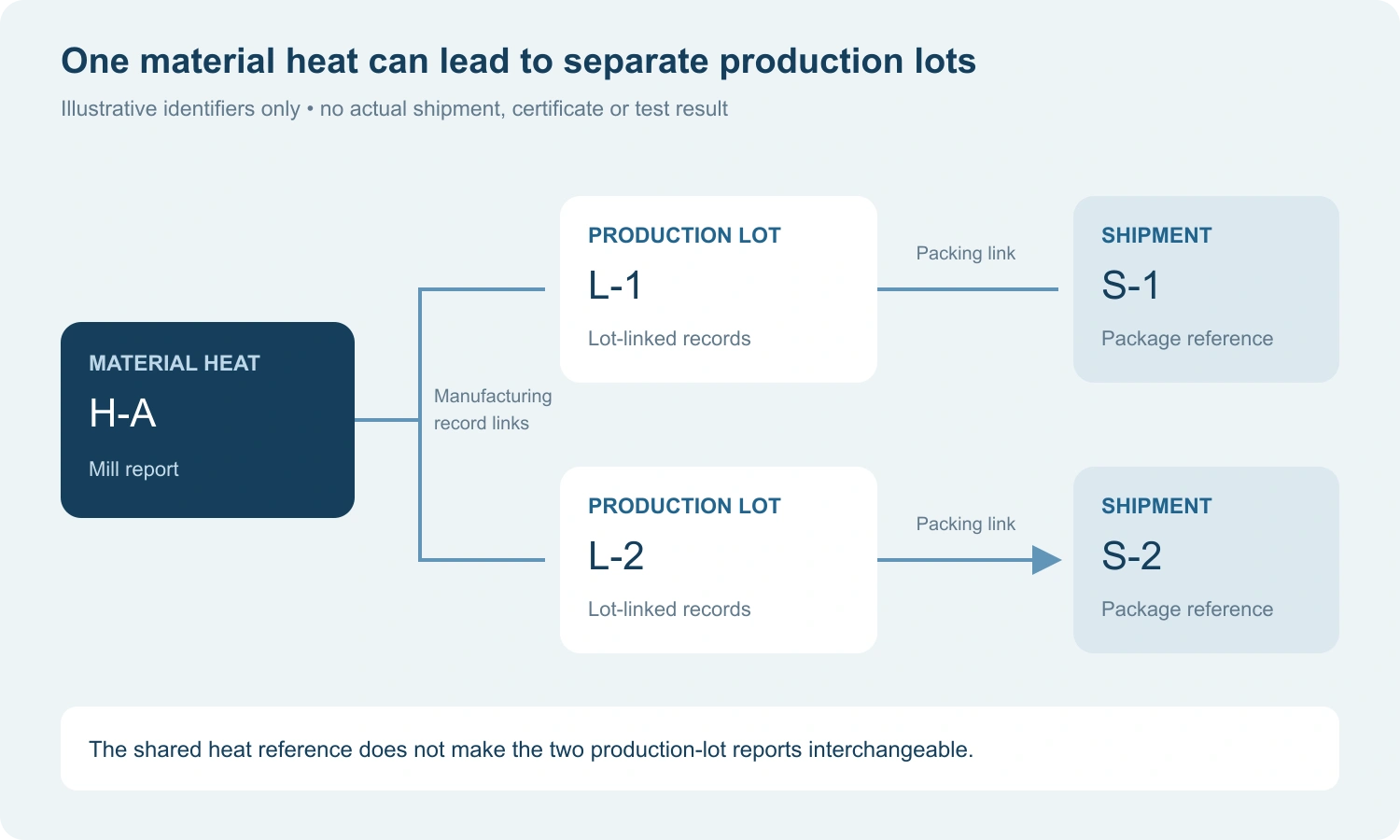
In this original example, incoming material identified as H-A feeds two production lots, L-1 and L-2. Their packing records connect them to shipments S-1 and S-2. These labels describe a teaching example, not actual QIYI records or an example certificate.
The material report for H-A answers a material-origin question. The manufacturing records provide the connection to each production lot. Any required finished-fastener results need to cover the relevant supplied lot and acceptance requirements. A shared heat reference alone does not establish that the two production lots received the same processing or have interchangeable test records.
Two mismatches that need different clarification
The report names the heat but the package names only a lot
Suppose a hypothetical delivery package identifies L-2 while the enclosed mill certificate identifies H-A. Nothing in the supplied documents connects those two references. Both identifiers may be valid, but the receiver cannot reconstruct the link from the report alone.
A useful clarification names the package, order line and two references: “Please provide the record connecting delivered lot L-2 to material heat H-A.” This directs the supplier toward the missing connection. It is more precise than asking for another copy of the same material report.
The receiver should retain the original package identification and document the supplier’s response. Filling the gap by assuming that every package in a delivery uses the same heat would remove the very distinction the review is meant to preserve.
The heat matches but the finished-lot evidence covers another lot
Now suppose the material connection to H-A is documented, but a required finished-fastener report identifies L-1 while the delivery is L-2. The heat match does not resolve the production-lot mismatch. The supplier needs to explain the supplied report’s scope and provide the required evidence for the delivered lot.
This situation does not automatically prove fraud or establish that the fasteners fail a test. It identifies an unanswered acceptance question. The buyer’s procedure should control how the lot is held, clarified or otherwise dispositioned while that question is resolved.
The same discipline applies to a report with acceptable-looking values but a different product form or condition. First identify what the document covers. Then compare it with the requirement that needs evidence. Do not copy a result into the acceptance record solely because its numerical magnitude appears suitable.
Specify the document requirement before ordering
A procurement note can be concise while remaining specific: “Identify the required material and fastener specifications, grade and condition; provide the agreed material report and any required finished-lot records; link the documents to the delivered part and lot references.” This is an illustrative request, not a universal certificate clause.
Add any project-specific document type, testing, language or supply-chain requirements explicitly. The words “send MTR” alone do not describe which evidence the receiver must obtain. A supplier’s confirmation should identify what will accompany the order and how the shipment will be identified.
QIYI’s T Bolt page provides part references and dimensional options that can help identify an enquiry. Its listing does not guarantee a particular report, traceability system or finished-fastener test result. Include the selected part drawing and document requirement so those details can be confirmed for the actual order.