An RFQ for custom washers should specify the hole size, outside profile, thickness and tolerances that matter in the assembled joint. Include the washer material, finish, quantity and a drawing that explains how those dimensions are measured. The screw designation alone cannot tell the supplier whether the washer must clear a radius, cover a slot, fit a recess or set a gap.
Before asking for a new part, compare the dimensions with a standard washer series. When a catalog washer is too wide for an enclosure, for example, the custom feature may be the outside profile, while bore size and thickness stay close to existing options. Tell the supplier which dimensions can move and which protect a critical fit.
How to Dimension Custom Washers
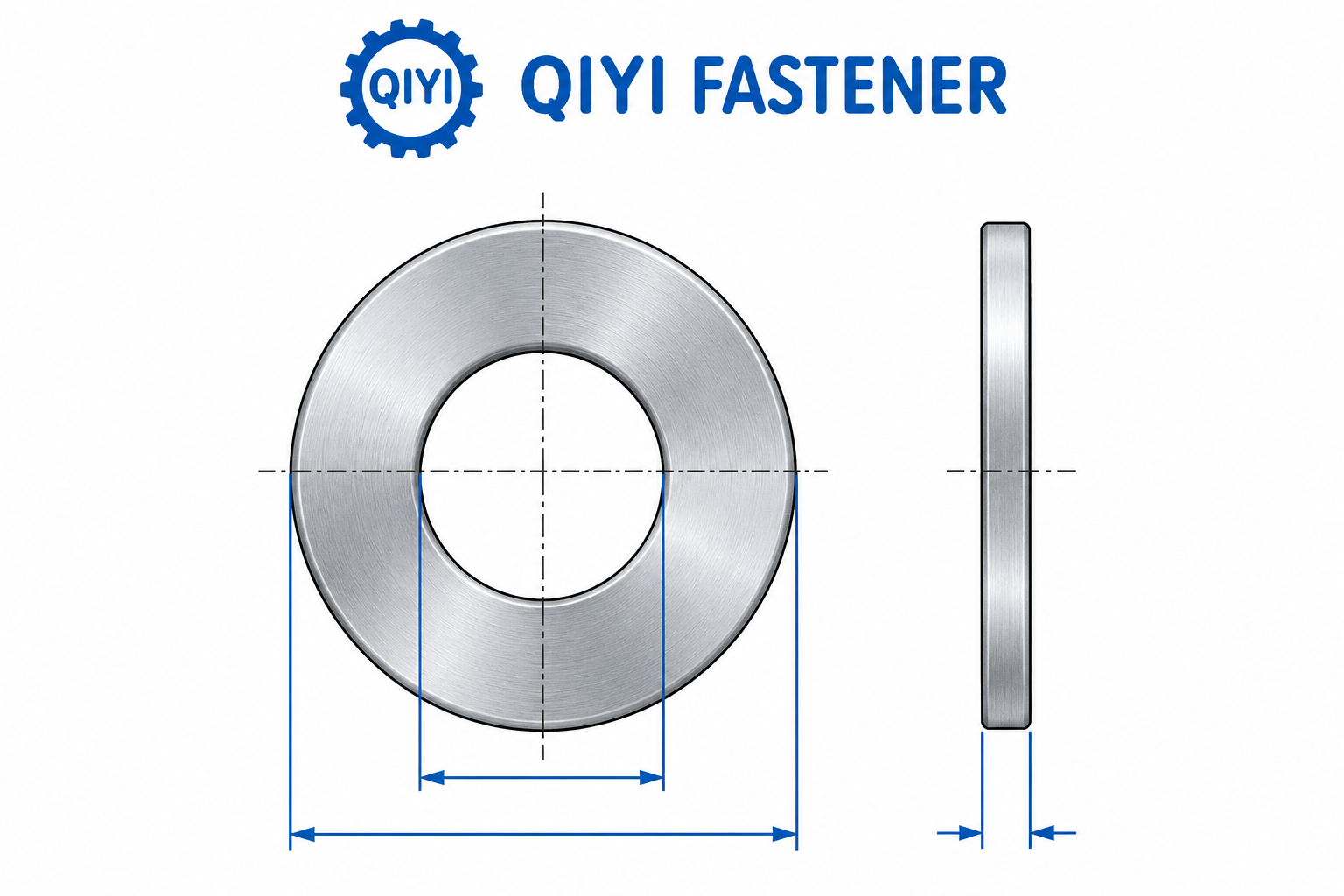
The bore clears the screw shank, thread or locating feature. The outside size defines where the washer contacts the assembly and which obstacles it must clear. Thickness changes the stack and seating position. Show them as separate dimensions and describe the relevant finished condition. If the outside profile is irregular, submit an outline with a datum and hole position instead of describing it with a single diameter.
| Dimension or condition | Why the supplier needs it | Attach or identify |
|---|---|---|
| Inside diameter or hole shape | Clears the mating part and controls where the washer can shift | Finished limits and actual mating size |
| Outside diameter or profile | Fits recesses, bridges the intended face, and clears adjacent parts | Outline, orientation or positional datum |
| Thickness and flatness | Sets the stack and bearing position | Thickness limits and any functional flatness requirement |
| Edges and coating | Can affect fit, handling and contact with sensitive finishes | Defined edge and finish requirements, plus inspection basis |
Check the worst expected fit. Compare the largest washer to the smallest available recess. For the bore, compare the smallest permitted opening to the largest mating feature it must pass. If a formed outline or offset hole must face a given direction, add a visible orientation feature or assembly note so the assembler can check it. Define the limits from the actual joint rather than tightening every tolerance by default.
Write edge and surface requirements where they matter
Include a burr or edge requirement if the washer contacts a soft panel, must slide into a narrow slot, or sits against a delicate finish. Describe which face contacts the part. Statements like “clean edges” leave the inspection method and pass condition open. Let the manufacturer identify a practical process, then agree how to verify the critical faces on samples.
State the material and specified finish together with the drawing. For a coated part, clarify which dimensions apply after finishing and whether any surfaces must remain exposed or protected. If the assembly has an electrical contact, corrosion, or structural requirement, give the supplier the underlying specification and have the design owner confirm suitability. Visual appearance alone cannot establish that the material or finish meets it.
Give estimates a consistent quantity and approval basis
List first samples, initial order and estimated repeat quantities separately. Ask whether the quote assumes an existing process or tooling for the special outline, and whether setup or inspection appears in the unit price. Suppliers can propose alternatives for cost, but ask them to identify the difference from the drawing and quote the closest compliant option as a separate line. An unchecked alternate may change fit or assembly work enough to offset the price difference.
Request evidence appropriate to the part. In a simple flat washer order it may be enough to request dimensions on first samples, with a planned check for the features that matter in production. A shape with restricted orientation or a special surface can require a different review. Tie any measurements to the part and revision, and request a retained reference or drawing note if assemblies will be repeated.
Build the request around one real fit problem
Suppose a standard washer rubs a housing wall when the bolt is fitted near the end of its slot. Reducing the entire outside diameter might clear the wall but leave less useful bearing area on the other side. Give the supplier a section and top view showing the allowable profile and how the washer must sit. Let the engineer decide whether a cutaway shape or another design is acceptable before the price is finalized.
For an initial fit comparison, check the dimensions on the QIYI flat washer catalog page. If those parts do not address the joint, send the drawing and the target quantity for review. Have the reply identify the quoted geometry, material, finish, tooling assumptions and what can be checked on a sample. Confirm actual feasibility and terms for that part.