A325 identifies a heavy-hex structural bolt grade within ASTM F3125/F3125M. The old standalone ASTM A325 standard was withdrawn in 2016, but the A325 grade name remains in use. An A325 bolt enquiry therefore needs more information than the familiar short name.
Read the designation, the specified edition and the supplied records together. A head photograph can help identify a part; it cannot establish every requirement on an order or prove that the associated documents belong to that supply.
What an A325 bolt designation tells you
The A325 name identifies a structural-bolt grade, rather than a generic description of any hex-headed steel bolt. A similar head shape or a familiar-looking finish is not a complete product identification.
ASTM’s current public F3125/F3125M catalogue includes A325 in the consolidated structural-bolting family. Its classification language distinguishes the designation from other information used to describe the bolt.
For a buyer, the practical question is what the complete order calls for. A short product title may be useful when searching a catalogue, while the purchase description needs to preserve the fields that distinguish the actual part.
Keep the original description available when requesting a quotation. Replacing a detailed drawing callout with “A325 bolts” can remove information the supplier needs to identify the intended variant. The abbreviated name should remain a route to the specification, rather than replace it.
Why F3125 appears beside A325
F3125/F3125M is the consolidated standard designation; A325 is one of the grade identifiers within that family. ASTM’s historical A325-14 catalogue entry explicitly records its withdrawal and replacement by F3125/F3125M.
As checked on November 12, 2026, ASTM lists F3125/F3125M-26 as active. Its public scope distinguishes designation by grade or group, type and style. Type concerns material composition; style identifies the product form.
Those catalogue facts explain why a quotation can contain both F3125 and A325. They do not decide which edition governs a particular project or whether a proposed product satisfies an existing contract.
When an older drawing and a newer quotation use different wording, preserve both references and resolve the document relationship. Automatically rejecting the newer wording because it includes F3125 is as incomplete as automatically accepting every product advertised with the A325 name.
A current catalogue entry is useful context. The actual order and its governing documents remain the starting point for resolving the supply description.
Read markings together with lot records
Manufacturer identification and the fastener designation communicate different information. The RCSC’s 2025 specification illustrates manufacturer identification separately and connects identifiable bolting components with supporting test reports.
For document review, preserve the link between the observed part, its package identification, the accompanying report and the order line. This is a practical record relationship, rather than a new inspection procedure.
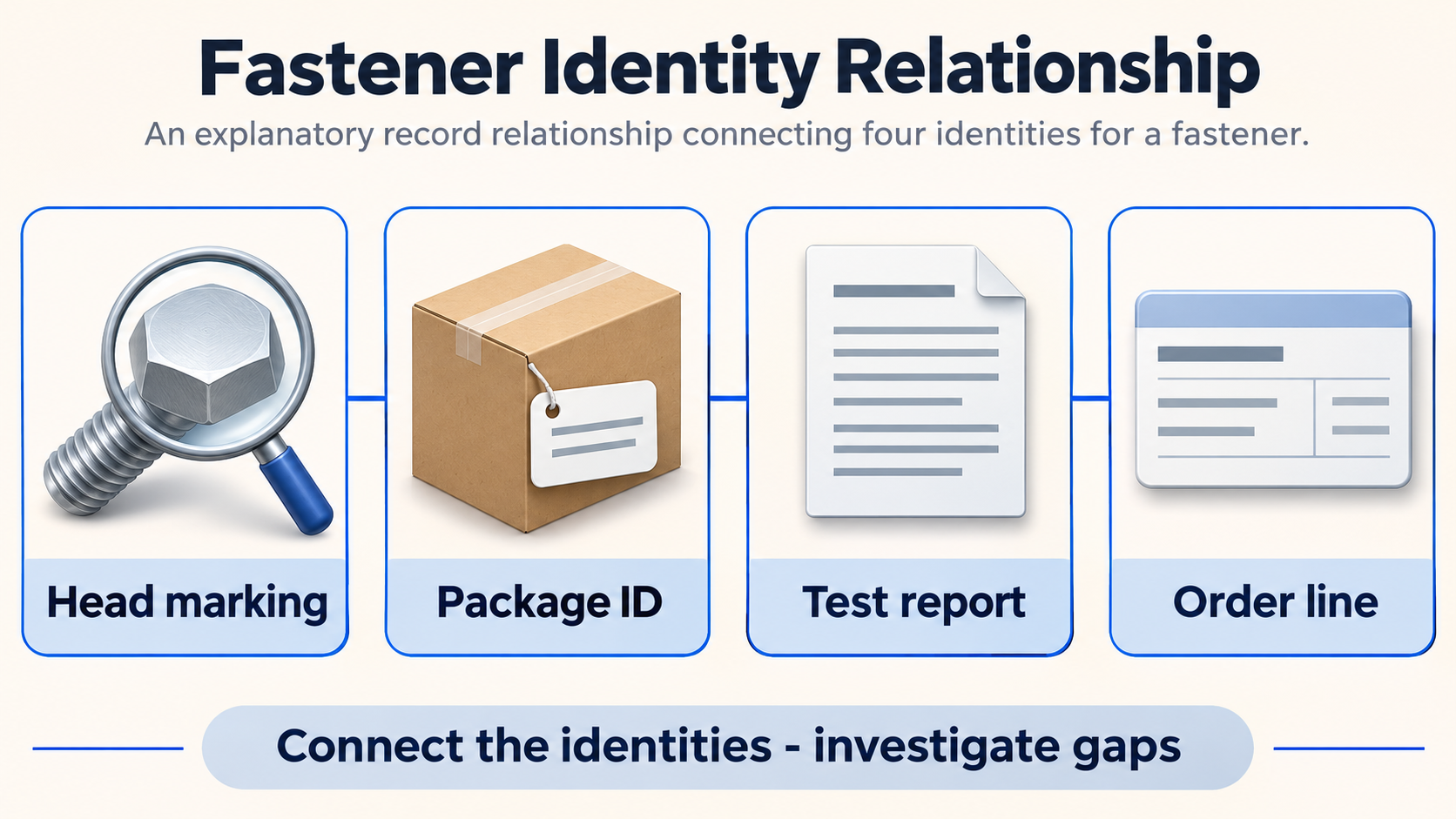
A clear head image can document what is visible. A package label can identify the supply being reviewed. A report can provide its stated results and identifiers. The order line defines what the buyer requested.
The review becomes stronger when those records can be connected. If the relationship is missing, record the specific gap: an unreadable label, a report with an unexplained identifier, or a photograph that cannot be linked to the supplied package.
Do not infer the missing relationship from appearance alone. An identifiable gap gives the supplier a question it can answer with the relevant supply records.
Review the complete supply description
A complete review keeps designation, geometry, finish and associated component identities distinct. Each field answers a different question about the proposed supply.
Designation: retain the standard reference, edition and specified grade or other designation fields. A shortened catalogue heading may omit details that remain important on the drawing.
Geometry: retain the required diameter, length and thread-related details from the order. The grade name does not replace the dimensional description.
Finish: record the finish actually proposed. A finish change should remain visible as a proposed deviation, rather than disappear inside a revised stock code.
Associated components: identify what the supplier is offering with the bolt. A photograph of loose nuts and washers is not a complete description of the supplied combination.
Records: identify which documents accompany that supply and how their identifiers relate to the parts. A document describing a product family may be useful background without being the report associated with a particular delivery.
This separation helps compare quotations. If one supplier has supplied a complete description and another has supplied only “A325,” the missing fields should be resolved before treating the two offers as technically identical.
Keep identification separate from joint acceptance
Product identification establishes what a part is described as and how it relates to the supplied records. Joint acceptance involves the actual project requirements and cannot be concluded from that identification alone.
The bolt grade chart explains broader marking and grade distinctions. It is useful background when reading identifiers from different fastener families; a similar strength description does not complete a substitution review.
The proof strength and yield strength guide addresses a separate report-reading problem: identifying which property or test a result describes. Reading that terminology correctly does not establish that the report belongs to the delivered parts.
These checks work together. The reviewer needs the right requirement, the right document meaning and the right identity relationship. A successful check in one area should not silently become acceptance of the other two.
Resolve the particular discrepancy
A legacy name appears on the drawing. If a supplier’s quotation adds F3125 wording, clarify the intended standard reference and edition. The historical relationship explains the terminology; it does not resolve the order automatically.
A designation field is missing. Ask which variant is being offered and request the omitted information. Filling the gap with a familiar default can conceal a real difference between the offer and the drawing.
A substitute is proposed. Record the proposed product and every identified deviation, then obtain the appropriate review against the order. A higher number or a similar-looking head is not a complete substitution argument.
In each example, the next action follows the actual gap. The result should be an identifiable supply description connected to its records, with unresolved project decisions left visible for the responsible reviewer.
References
ASTM: current public F3125/F3125M-26 catalogue and scope
ASTM: historical A325-14 withdrawal and replacement record
RCSC: 2025 Specification for Structural Joints Using High-Strength Bolts