A bolt grade chart connects a fastener’s marking to its strength designation. Common SAE Grade 5 bolts have three radial head lines; Grade 8 bolts have six. Metric bolts use property-class numbers such as 8.8, 10.9 and 12.9. These systems require separate interpretation.
Start with the specified standard and bolt diameter, then read the appropriate row. A familiar head mark helps identify a candidate part; it does not establish that the part is suitable for a particular joint.
SAE bolt grade chart: common inch-series markings
The selected SAE J429 values below are minimum tensile strengths, expressed in pounds per square inch. They describe resistance to failure in tension, not an allowable working load for an assembled connection.
| SAE grade | Typical grade marking | Nominal diameter | Minimum tensile strength |
|---|---|---|---|
| Grade 2 | No radial grade lines | Confirm size and length requirements | Check the applicable specification |
| Grade 5 | 3 radial lines | 1/4–1 in | 120,000 psi |
| Grade 5 | 3 radial lines | Over 1–1-1/2 in | 105,000 psi |
| Grade 8 | 6 radial lines | 1/4–1-1/2 in | 150,000 psi |
The Grade 5 and Grade 8 figures follow the selected inch-series rows in AFT Fasteners’ chart. Grade 2 is included for identification, without a single strength value that could conceal size or length conditions. A blank head alone is inconclusive: the same chart depicts both Grade 1 and Grade 2 without radial grade lines.
Keep the units attached when transferring a value into a comparison sheet. A number copied from a psi column must not be compared directly with a number copied from an MPa column.
Metric property classes: read the minimum value and diameter band
The metric examples below use Bossard’s January 2025 reference for ISO 898-1 properties at room temperature. This is a compact comparison for ordinary nonstructural carbon-steel and alloy-steel fasteners, not a structural bolting selection table. BSI identifies carbon steel and alloy steel as the material scope of the ISO 898 series.
| Property class | Diameter condition | Minimum tensile strength |
|---|---|---|
| 8.8 | d ≤ 16 mm | 800 MPa |
| 8.8 | d > 16 mm | 830 MPa |
| 10.9 | Within the applicable product and ISO 898-1 scope | 1,040 MPa |
| 12.9 | Within the applicable product and ISO 898-1 scope | 1,220 MPa |
The class number is a designation, not a substitute for the property table. In the designation system, the number before the decimal multiplied by 100 gives nominal tensile strength in MPa. The digit after the decimal, divided by ten, gives the nominal yield-to-tensile ratio.
For 10.9, that arithmetic gives 1,000 MPa nominal tensile strength and a 0.9 ratio, or 900 MPa nominal yield strength. The table’s minimum tensile strength is instead 1,040 MPa. Bossard explicitly separates nominal designation values from minimum property values. Use the specified minimum when checking a requirement; do not replace it with the easier arithmetic.
The distinction also explains why a comparison sheet needs a clearly labeled column. “Tensile strength” without “nominal” or “minimum” can mix two different kinds of value before any supplier comparison begins.
Read bolt grade markings before judging appearance
Identify the marking system before interpreting the mark. Three and six radial lines identify the common SAE grades shown here; decimal numbers identify metric property classes. Do not extend this small chart into a universal rule for every head symbol.
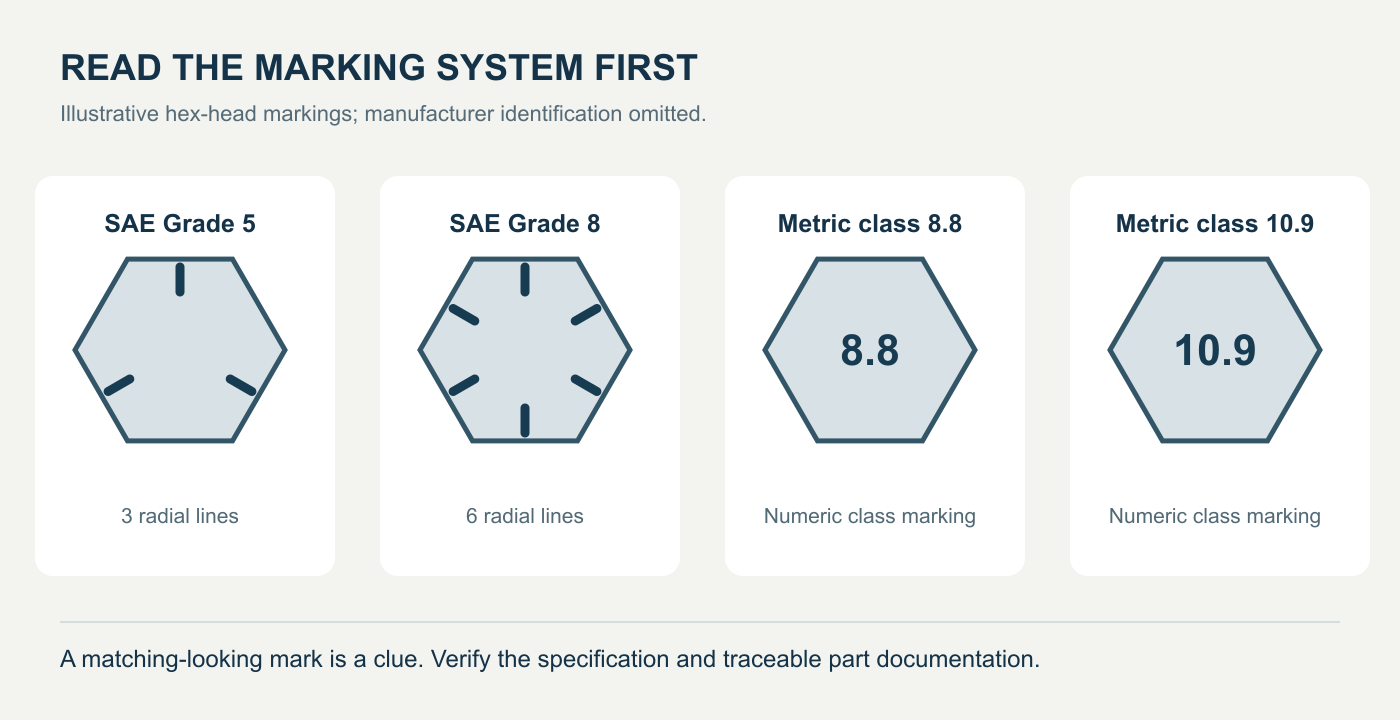
A manufacturer’s identification may appear beside the grade mark. Record all visible symbols, but keep maker identification separate from the strength designation. A phone photograph and a written transcription are useful together: the photograph preserves the arrangement, while the transcription makes an ambiguous character easy to flag.
If a mark is unreadable, record “unreadable.” If the head has no identifiable class, record “grade unconfirmed.” Guessing a higher grade from a dark finish, bright plating or a substantial-looking head adds a conclusion the observation does not support.
For a replacement request, retain the original photograph and the proposed interpretation as separate records. That allows the supplier or responsible engineer to correct the interpretation without losing the evidence that prompted it.
Similar strength does not establish an interchangeable replacement
A Grade 8 bolt is not automatically a replacement for a class 10.9 bolt. Fastenal’s engineering guidance cautions against treating fasteners in similar strength categories as interchangeable. A strength comparison answers only part of the sourcing question.
Compare the replacement with the drawing or equipment requirement field by field: standard, grade or class, thread designation, length, head geometry and finish. Add the required inspection or traceability documents to the same record. If one field is missing, leave it open rather than treating the nearest chart row as approval.
Consider two supplier replies to an illustrative inquiry for a class 10.9 bolt. “High-strength steel, same diameter” does not confirm the requested class or the remaining dimensions. A reply that identifies the exact part, applicable standard, class and requested supporting record is more useful. It gives the buyer specific statements to check against the order.
This approach also keeps responsibilities clear. The buyer can verify whether an offer matches the written requirement. A proposed change to that requirement needs review by whoever controls the design or equipment specification.
Use the product listing to identify the part, then confirm its grade
QIYI’s T-bolt product page provides material and finish options, dimensions and part numbers. Those details help identify a requested item, but the listing does not establish a property class for the selected part.
For that inquiry, send the exact part number and required grade or class together. Ask the supplier to confirm the applicable specification and the documentation required by your purchase order. Do not infer 8.8 or 10.9 from the words “carbon steel,” or assume every size in one product family carries the same class.
The useful output of a bolt grades chart is a precise, checkable designation. Carry that designation through the quotation, order and received-part records so an unconfirmed assumption does not become an accepted specification.
References
- AFT Fasteners — Bolt grade markings and strength chart. Selected SAE J429 tensile values and head-marking examples.
- Bossard — Screws, property classes 4.6 to 12.9, January 2025, page 12. Metric minimum and nominal properties.
- Fastenal — Four general strength categories. Class interpretation, SAE markings and substitution limits.
- BSI — ISO 898 series: mechanical properties of fasteners. Material and testing scope.