ASTM A193 is a bolting specification, not a single material grade. B7 identifies an alloy-steel grade, while B8 and B8M identify stainless grades associated with 304 and 316 respectively. For the B8 and B8M entries discussed here, Class 1 and Class 2 distinguish treatment conditions. A description such as “316 stainless bolt” therefore leaves important specification questions unanswered.
The useful first check is whether the description keeps the standard, grade and applicable class separate. Those fields explain different things. They should not disappear when a drawing, quotation or document is shortened into a stock description.
This guide explains designation reading and document questions. It does not select bolting for an operating pressure or temperature, approve a substitution, or establish that a particular lot meets A193. ASTM’s public catalogue lists A193/A193M-26 as active at the time of this review; the edition required by an order remains a separate question.
B7, B8 and B8M identify different grade families
The official A193 scope covers alloy-steel and stainless-steel bolting materials and components for specified service categories. That broad scope does not make its grades interchangeable. A grade name narrows the identity within the specification; a familiar alloy nickname does not replace the specification requirements.
| A193 designation | Concise material description | What still needs attention |
|---|---|---|
| B7 | Quenched-and-tempered alloy steel | The complete ordered designation, dimensions and supporting records |
| B8 | Stainless grade associated with 304 | The applicable class and the complete item description |
| B8M | Stainless grade associated with 316 | The applicable class and the complete item description |
These are concise identifiers from Portland Bolt’s technical grade summary, not chemical acceptance criteria or a substitution table. That manufacturer page is dated 2020; the current ASTM public scope is used separately for the standard’s scope. Numerical tables and hardware recommendations from the older summary are not reproduced here.
For the broader difference between the material families, see alloy-steel versus stainless-steel fasteners. Material-family selection and reading an A193 designation are related questions, but they do not establish the same facts.
Why B8 and B8M class designations must stay visible
In the named stainless entries, Class 1 is carbide solution treated; Class 2 is carbide solution treated and strain hardened. The additional treatment is part of the distinction. “Class 2” is not simply a longer way of writing “stainless steel.”
ASTM’s current public scope recognizes both solution-treated and solution-treated-and-strain-hardened austenitic stainless material. It also directs purchasers of strain-hardened material to the specification’s relevant appendix. The public scope is useful context, but it is not the complete set of grade, class and size requirements.
A document that changes “B8M Class 2” to “316” has dropped information. It has not necessarily identified a different physical item, but it no longer states the same designation. The missing class requires clarification rather than an assumption based on the alloy name.
This comparison concerns the B8 and B8M Class 1 and Class 2 entries. It does not establish a universal class system for every A193 grade. In particular, it provides no basis for attaching these class labels to B7 or treating a class number as a general quality rating.
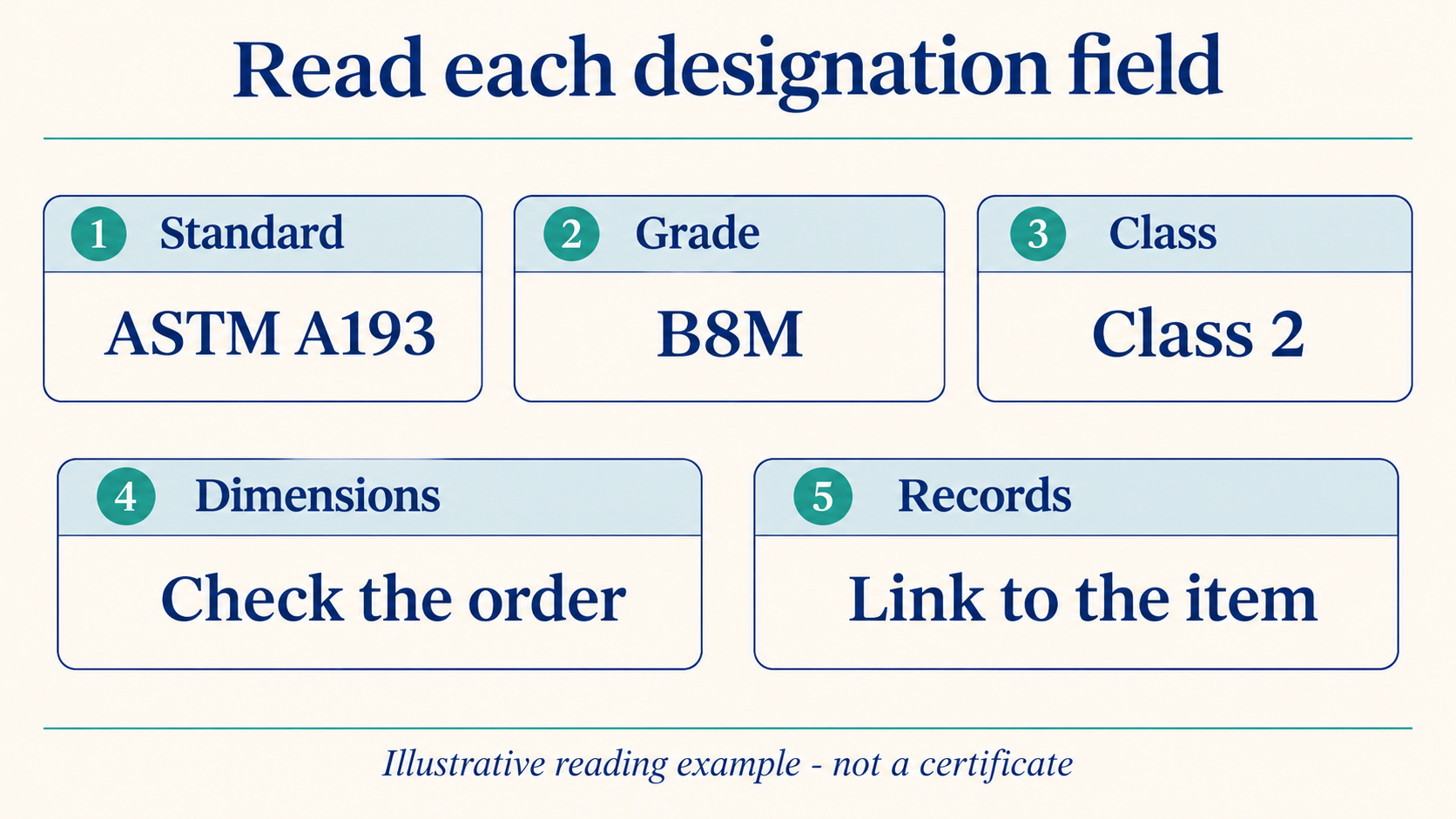
Read an ASTM A193 description field by field
An effective reading worksheet separates what a line actually states from what the reader is supplying by assumption. The following fields are an editorial aid, not an ASTM certificate template or an exhaustive purchasing specification.
- Standard: Which specification and edition does the document identify? “ASTM A193” names the specification family; check the order for the required edition.
- Grade: Does the line say B7, B8, B8M or another grade? Keep the literal designation alongside any material nickname.
- Class: Where the ordered grade uses a class, is it stated consistently? Do not reconstruct a missing class from “304” or “316.”
- Dimensions: Does the description identify the ordered item, including its size and thread description? A grade label does not resolve dimensions.
- Records: Which item or lot do the supplied documents describe? A familiar standard number on an unrelated document cannot close an identity gap.
Record the uncertainty against the field that caused it. A missing class needs a designation clarification; an unmatched lot needs a traceability clarification. Asking only for “the A193 certificate” can leave the original question unresolved. Our guide to mill test reports and fastener traceability explains the separate connection between a material record and the supplied items.
Three incomplete descriptions and the question each raises
The following examples are fictional document-reading situations, not QIYI customer cases or acceptance decisions.
“316 stainless studs”
This identifies a material description but does not state A193, B8M or a class. If the order calls for B8M Class 2, ask for the complete offered designation and its supporting item records. Do not silently expand the shorter phrase into the ordered specification.
“ASTM A193 B8M” beside an order for Class 2
The standard and grade agree at the level written, while the class remains unstated. Ask whether the supplier’s description includes the ordered class and where that condition is documented. The omission alone does not prove conformity or nonconformity; it identifies an unresolved field.
A matching designation on a record with no item connection
The wording may be complete while the relationship to the shipment is unclear. Ask which item, production lot or material identity connects the record to the supplied hardware. Repeating the grade name does not answer that question. Keep the designation check and the record-link check separate so the reply addresses the actual gap.
Keep nut specifications and unit systems separate
A193’s public scope points to its own section on nuts. ASTM A194 is a separate specification covering specified steel nuts. Seeing A193 on a bolt description and A194 on a nut description does not, by itself, establish that the particular grades form an approved assembly. This article supplies no pairing approval.
The A193 scope also treats inch-pound and SI values as separate systems. A unit conversion is not a substitute for identifying the ordered specification designation and requirements. Keep that issue visible when comparing documents with different units.
A useful description preserves the fields needed to identify the item. A useful follow-up request names the missing field and asks for the record that resolves it. Neither a material nickname nor a polished document can supply information that has not been established.
References
- ASTM A193/A193M-26: official public scope and catalogue status.
- Portland Bolt: A193 grade and class summary, dated 2020; used for concise nomenclature only.
- ASTM A194/A194M-26: official public scope for nuts.