303 stainless steel favors machining, while 304 offers a different balance of formability, weldability and corrosion resistance. Sulfur additions help 303 machine readily, but they also create tradeoffs compared with 304. Neither grade number, by itself, states the strength of a finished fastener.
That is the useful starting point for a 303 vs 304 stainless comparison. A turned component and a formed component may need different fabrication characteristics. A material datasheet can explain those characteristics, but its property table also has a product form, condition and reporting basis.
For fastener readers, the important distinction is between identifying an alloy and establishing a finished part’s requirements. Keeping those questions separate makes the comparison useful without turning a general material description into a replacement approval.
303 vs 304 stainless: the main tradeoffs
303’s machining advantage comes with reduced formability, weldability and corrosion resistance relative to 304. The comparison is a tradeoff between characteristics, rather than a single ranking from good to bad.
| Comparison | 303 | 304 |
|---|---|---|
| Machining emphasis | Free-machining grade associated with extensive machining | General-purpose grade; improved-machinability variants also exist |
| Forming and welding | Less favorable than 304 | Strong forming and welding characteristics |
| Corrosion comparison | Sulfur-related inclusions reduce resistance relative to 304 | Better resistance in this comparison; not suitable for every exposure |
| Finished fastener strength | Not established by the grade name alone | Not established by the grade name alone |
The table describes material tendencies. It does not identify the alloy in an unmarked part or establish whether a particular bolt can serve a particular joint. Those questions require the relevant product information.
Machining and forming ask different things of the material
A machining-focused comparison concerns how material is removed to make a shape. A forming-focused comparison concerns how the material takes a shape. Those are different fabrication demands, so an advantage in one does not automatically become an advantage in the other.
A component made from bar may involve turning, drilling and other cutting operations. A component formed from another starting shape presents a different manufacturing question. The final outline alone may not reveal which operations were used or which material condition remains.
This is why “303 machines well” should not be shortened to “303 is easier to manufacture” without qualification. The latter statement hides the route. It may be useful for a heavily machined component while saying little about a part that needs substantial deformation.
The opposite shortcut is also misleading. Good formability does not mean that 304 cannot be machined. The Atlas material literature discusses improved-machinability versions of 304. A comparison should preserve the exact material description rather than assuming every supply form has identical processing behavior.
Consider a fictional change request for a small cylindrical component. The original description emphasizes a machined shape, and a proposed revision adds a formed feature. The reader now has two fabrication questions to examine. Repeating the original alloy preference does not answer the new forming question.
For a different component, the proposed revision may remove the formed feature and add more machining. That change can alter the priorities again. Neither fictional example selects a material; both show why the manufacturing description belongs beside the alloy name.
Fasteners also vary in shape and production route. It would be inaccurate to conclude that every 303 fastener is machined or every 304 fastener is formed. The appropriate record describes the actual part rather than assigning its history from the grade label.
Corrosion resistance and welding need their own comparison
304’s better corrosion resistance relative to 303 does not make 304 immune to corrosion. It means that the sulfur-related machining tradeoff in 303 matters when comparing the two materials.
The relevant exposure belongs to the actual component location. A broad description such as “indoors” or “outdoors” may leave moisture, contaminants and local retention conditions unspecified. A material comparison can flag the issue; it cannot supply missing information about the environment.
Welding is another separate fabrication requirement. The material sources describe 303 as less favorable for welding than 304. That distinction should remain visible when a part description changes to include a weld, rather than being treated as an incidental detail after the alloy is chosen.
No welding settings or corrosion lifetime follow from that comparison. The useful output is a clearly identified requirement that needs evaluation for the actual material and part. A catalogue statement about a general grade does not establish the result of a particular fabrication process.
If the main question is chloride exposure within the 304/316 comparison, our 304 versus 316 stainless steel fastener guide addresses that different material relationship. The present comparison concerns 303’s machining tradeoff against 304’s broader fabrication balance.
Read the property-table notes before ranking strength
A strength number is meaningful only with its reporting basis. A typical value and a specified minimum are not the same kind of statement, and values for different product forms should not silently become finished-fastener ratings.
The adopted Atlas 303 sheet provides a concrete example. Its property discussion concerns bar products, and the note identifies the tensile properties shown as informational rather than guaranteed. The 304 sheet places its specified-property table in the context of flat-rolled products such as plate, sheet and coil.
Putting a tensile entry from each sheet into a simple “which is stronger?” chart would hide those differences. The comparison would mix reporting bases and product forms before it had even considered the finished component. A larger displayed number would not resolve that mismatch.
A careful reading starts with the heading above the table and the notes below it. What material form does the table describe? Is the value typical, a minimum or a maximum? Which condition does it represent? Those questions determine what the number actually says.
Next comes the object being discussed. A bar-property statement concerns bar material within its stated scope. A finished bolt has its own geometry, product requirements and condition. Moving a number from one object to the other requires evidence; the shared alloy label does not supply it.
This distinction also improves communication. Instead of asking a supplier to confirm that one grade is “stronger,” the reader can identify the required property and the part to which it applies. A reply can then be compared with a defined requirement rather than a vague ranking.
Our bolt grade and property-class chart explains why fastener markings and performance designations need their own interpretation. A material grade and a finished-product property designation answer related but different questions.
Material condition connects the alloy to the finished part
Material condition describes more than the alloy’s name. ASSDA notes that cold working changes 304’s properties and can change its magnetic response. A grade label therefore does not erase processing history.
This also limits visual identification. A polished surface does not establish a material condition, and a photograph does not establish a strength result. Even a familiar material description needs a traceable connection to the part being discussed.
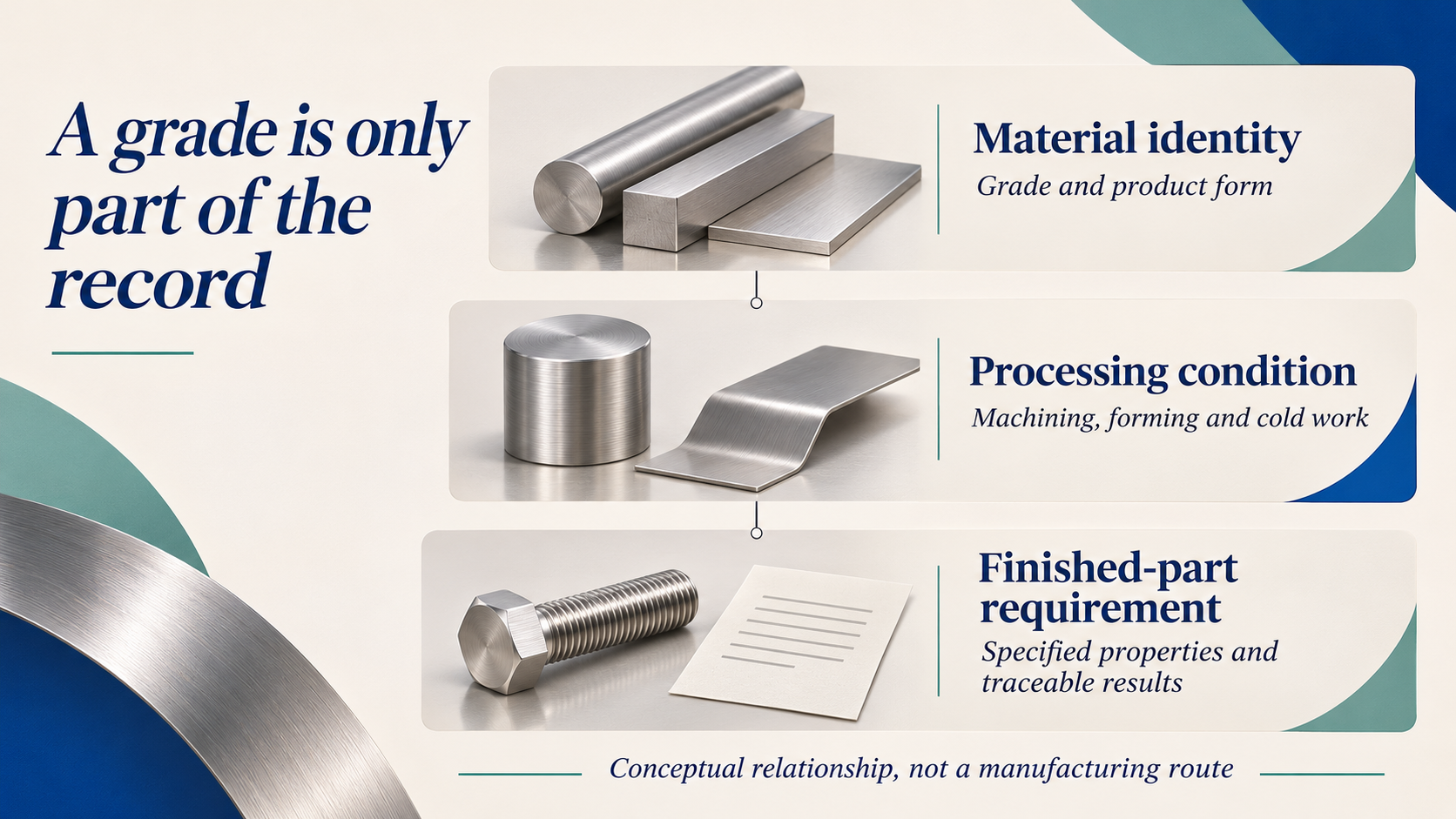
The map separates three records. Material identity says what material is described. Processing condition adds the relevant state or history. The finished-part requirement identifies what must be demonstrated for the actual component. None of those records substitutes automatically for the others.
A machined spacer described only as stainless steel
In a fictional enquiry, a spacer has a detailed drawing but the material line says only “stainless steel.” A supplier proposes 303 because machining is prominent in the shape. That proposal explains one possible manufacturing priority, but it leaves the requested material identity unresolved.
The useful discussion concerns the drawing’s actual requirements: the material, fabrication demands and intended exposure. A machining argument belongs in that discussion. It does not remove a corrosion or forming requirement that the drawing may also contain.
A bolt offer described as 304 without a property requirement
A second fictional enquiry identifies 304 but asks only for a “high-strength bolt.” Here the alloy field is clearer, while the finished-part performance field remains vague. Adding another general-purpose material datasheet would not complete that requirement.
The buyer needs the relevant finished-product description and supporting documentation. The supplier’s response should identify what it actually demonstrates. A chemistry statement, a generic table and a test result are different forms of information, even when all mention the same grade.
Compare the whole description, then the commercial offer
A useful 303 versus 304 comparison keeps the fabrication route, environment and finished-product requirement in view. Machinability may be important, but it is one priority among several.
When two offers use different alloys, the comparison should state which requirement each offer is intended to meet. It should also retain any change in material form, condition or proposed processing. Otherwise, a price difference may be attached to descriptions that do not resolve the same task.
303’s machining emphasis and 304’s forming, welding and corrosion balance explain why the materials are discussed together. The grade names provide the beginning of that discussion. The relevant part description and evidence determine how far the comparison can go.
References
- Atlas Steels: 303 and 303Se grade datasheet, including fabrication tradeoffs and the bar-property reporting notes.
- Atlas Steels: 304, 304L and 304H grade datasheet, including fabrication characteristics and product-form scope.
- ASSDA: 304 material characteristics and condition.