Passivation of stainless steel refers to a passive surface condition and, in manufacturing language, to a treatment that helps establish that condition. Clean stainless steel can naturally develop a chromium-rich oxide film when enough oxygen is available. A deliberate passivation treatment addresses surface contamination and supports the passive surface.
Those two meanings explain why a fastener may be described as passive without a statement that every part received the same chemical treatment. Surface condition, processing history and test evidence are related, but they are different claims.
For a fastener buyer, the useful question is therefore specific: does a finish description identify the surface state, an operation performed on the parts, or the result of an examination? This guide explains those distinctions and how to read the accompanying wording.
What is passivation of stainless steel doing at the surface?
Passivation concerns the stainless steel surface. It does not turn an unspecified alloy into a different grade or provide a finished fastener’s mechanical rating.
The natural passive film is associated with stainless steel’s corrosion resistance. The BSSA explanation places an important condition beside that mechanism: the surface must be clean, and its environment must provide enough oxygen for the film to form. “Stainless” is not a promise that every contaminated surface remains unaffected in every exposure.
A chemical treatment and natural self-passivation should therefore not be confused. One describes an intentional operation; the other describes a surface process that can occur under suitable conditions. Both belong in an explanation of passivation, but neither word alone documents what happened to a particular shipment.
Passivation also differs from depositing a layer of another metal onto a part. A reader comparing finish descriptions should not interpret it as a plated coating with a visible thickness. The appearance of a shiny screw is not proof of the passive condition or of a particular treatment history.
Cleaning, pickling and passivation address different conditions
The terms describe different surface tasks. Cleaning addresses contamination such as grease or oil; pickling addresses scale and affected surface metal; passivation treatments address contaminants and promote a passive surface.
| Term | Main distinction in this guide | What the word alone does not establish |
|---|---|---|
| Cleaning | Removal of relevant surface dirt or contamination | That scale removal or a specified passivation treatment occurred |
| Pickling | Removal of high-temperature scale and adjacent affected metal | That it is interchangeable with a passivation treatment |
| Passivation treatment | Contamination control and support for the passive surface | The exact process or result for an unidentified lot |
| Passive condition | A description of the surface state | That every part underwent an identical processing operation |
ASSDA notes that pickling and passivation treatments do not remove grease or oil. Calling a part “acid treated” therefore does not resolve every cleanliness question. The contaminant and the purpose of the operation still matter.
Pickling can involve metal removal and a change in visual brightness. Passivation usually does not produce a marked appearance change. These observations explain why an appearance-only comparison is weak evidence for identifying the treatment.
For example, two visually similar fasteners may arrive with different process descriptions. Their similar shine does not reconcile those descriptions. Conversely, a change in brightness should not be assigned automatically to passivation without the relevant record.
The table is a terminology guide, not a sequence of operations for every component. The actual surface condition and processing requirement determine the relevant work. No universal chemical recipe or acceptance method follows from these definitions.
Separate the surface state, treatment record and test evidence
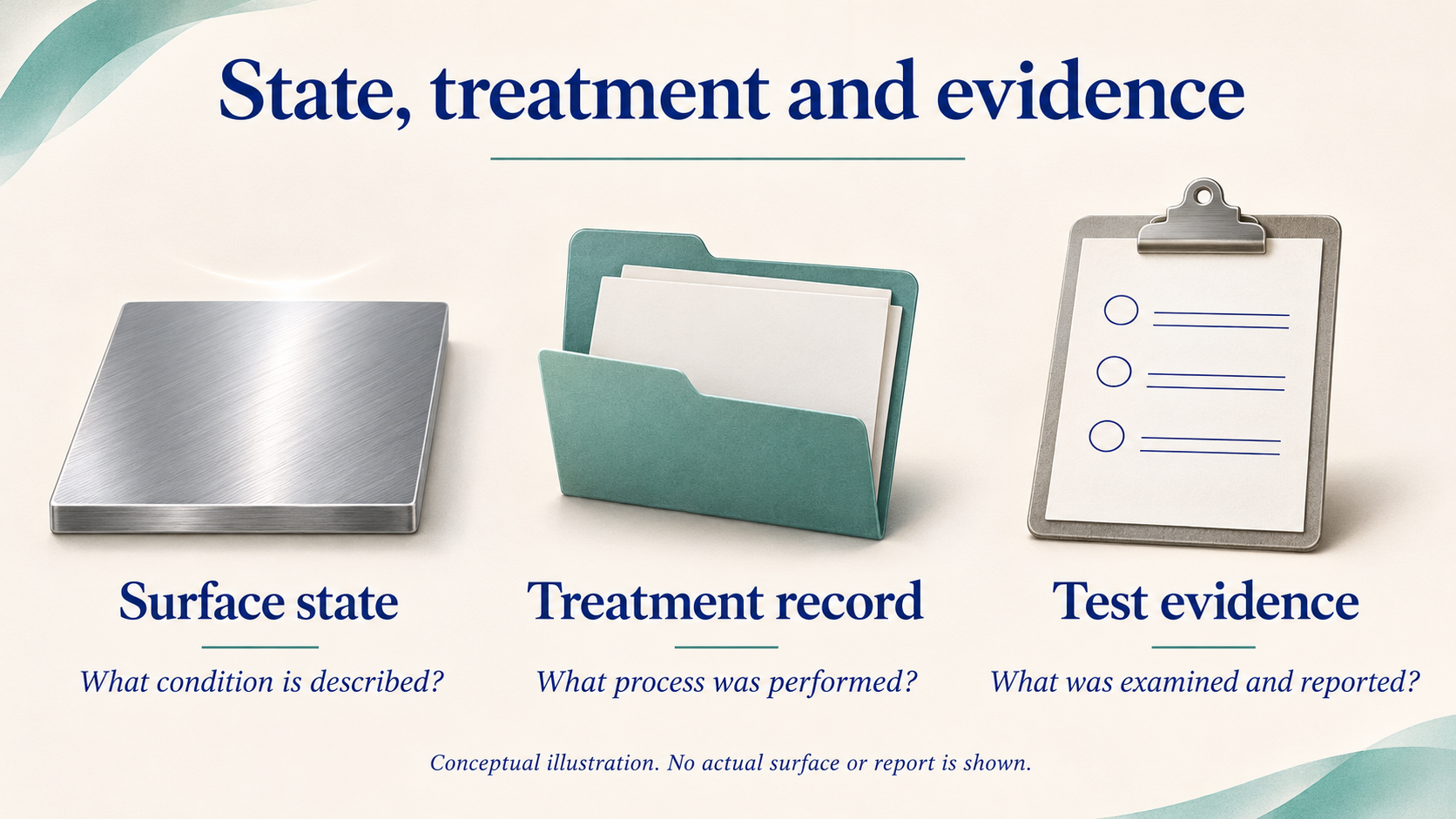
A useful document review asks three different questions. What condition is described? What operation was performed? What was examined and reported? A clear answer to one question should not be stretched into answers to the others.
Surface state: A statement that a surface is passive describes a condition. The reader still needs to know the basis and scope of that statement when it is used for a particular part or lot.
Treatment record: A processing statement describes an operation performed. Its usefulness depends on identifying the applicable parts and the referenced requirement. A general process description is different from a record tied to a shipment.
Test evidence: An examination report describes what was checked and what was found within its stated scope. It should be read for that purpose, rather than treated as a universal prediction of future corrosion behavior.
Consider the fictional wording “passivated and/or tested.” As a matter of language, it leaves more than one route in the statement. It does not say that every identified part received one identical operation.
Removing “and/or tested” when summarizing that statement changes its meaning. A buyer who needs a record of a particular operation needs evidence addressing that operation. This is an interpretation of the example wording, not a description of any supplier’s processing policy.
Read the wording without adding an unstated claim
The following fictional examples illustrate document interpretation. They are not real certificates, passivation approvals or records of supplied QIYI fasteners.
A finish line says “stainless steel, passivated”
This line supplies a material-family description and a treatment-related word. It does not necessarily provide the full alloy identity, the processing requirement, the lot connection or a test result. Those fields should not be invented to make the short description look complete.
The useful clarification depends on the unresolved question. If the question concerns the material, a clearer treatment description will not settle the alloy. If it concerns the processing operation, a generic alloy datasheet will not document that operation.
A response can be organized around the existing part or drawing reference. The reader can then identify which statement concerns the material and which concerns the finish. Keeping the two together supports communication; treating them as interchangeable removes information.
A report says “tested” without a processing statement
This second document identifies an examination but does not say that a passivation treatment was performed. That omission should remain visible. A test record may be relevant evidence, but it does not acquire an unstated processing history simply because the outcome is favorable.
The report should be read for its named examination, its identified parts and its reported result. If the order separately calls for a treatment record, that requirement is a different documentary question. The reader can request the missing record without dismissing the evidence already supplied.
The reverse situation is possible too: a processing statement may be available while a requested examination result is absent. Repeating that the parts were treated does not supply the missing result. Distinguishing these cases produces a more useful request than asking generally for a “better certificate.”
The same discipline applies to summaries in email or a quotation. Preserve qualifying words and the document’s actual scope. A short paraphrase should make a record easier to understand, not broaden what it claims.
A surface record does not replace material or fastener evidence
Passivation describes a surface topic. It should remain separate from the alloy identity, finished-product mechanical properties and suitability for the actual environment.
A material report may identify a heat and material properties. A treatment record may identify an operation. A surface examination may report a particular observation. Each can contribute information about a shipment, but the name of one record does not establish the contents of the others.
Our mill test report and fastener traceability guide explains the connection between material records and orders. That connection matters when several documents refer to the same components: their identifiers should make the relationship understandable.
A generic brochure is different from a lot-specific record. It can explain a manufacturer’s terminology or available process, while leaving the treatment history of a particular order unresolved. This is a scope distinction, not a judgment that the brochure is useless.
Similarly, a passivation statement does not establish that corrosion is impossible. Surface contamination and service exposure still matter. Our discussion of why stainless steel screws can rust addresses the broader corrosion question.
The practical benefit is that an incomplete record can be described accurately. The reader may know the material but not the treatment history, or know that a treatment was reported but lack a requested test record. Those are different gaps and should lead to different clarifications.
A clear finish description keeps the questions distinct
A useful finish description says what it actually covers and connects that statement to the relevant parts. It preserves the distinction between a passive surface, a deliberate passivation treatment and examination evidence.
When comparing documents, keep the original part identification and qualifying words visible. Then read the process statement and the reported examination for their respective purposes. This avoids turning “treated,” “tested” and “passive” into synonyms.
The answer to “what is passivation?” begins with stainless steel’s passive surface film. For fastener documentation, the explanation becomes more useful when it also identifies which claim is being made. Surface state, processing history and evidence can support the same discussion while remaining separate records.
References
- BSSA: passivation of stainless steels, for natural self-passivation and surface-condition distinctions.
- ASSDA: pickling and passivation, for the different surface tasks and appearance limitations.