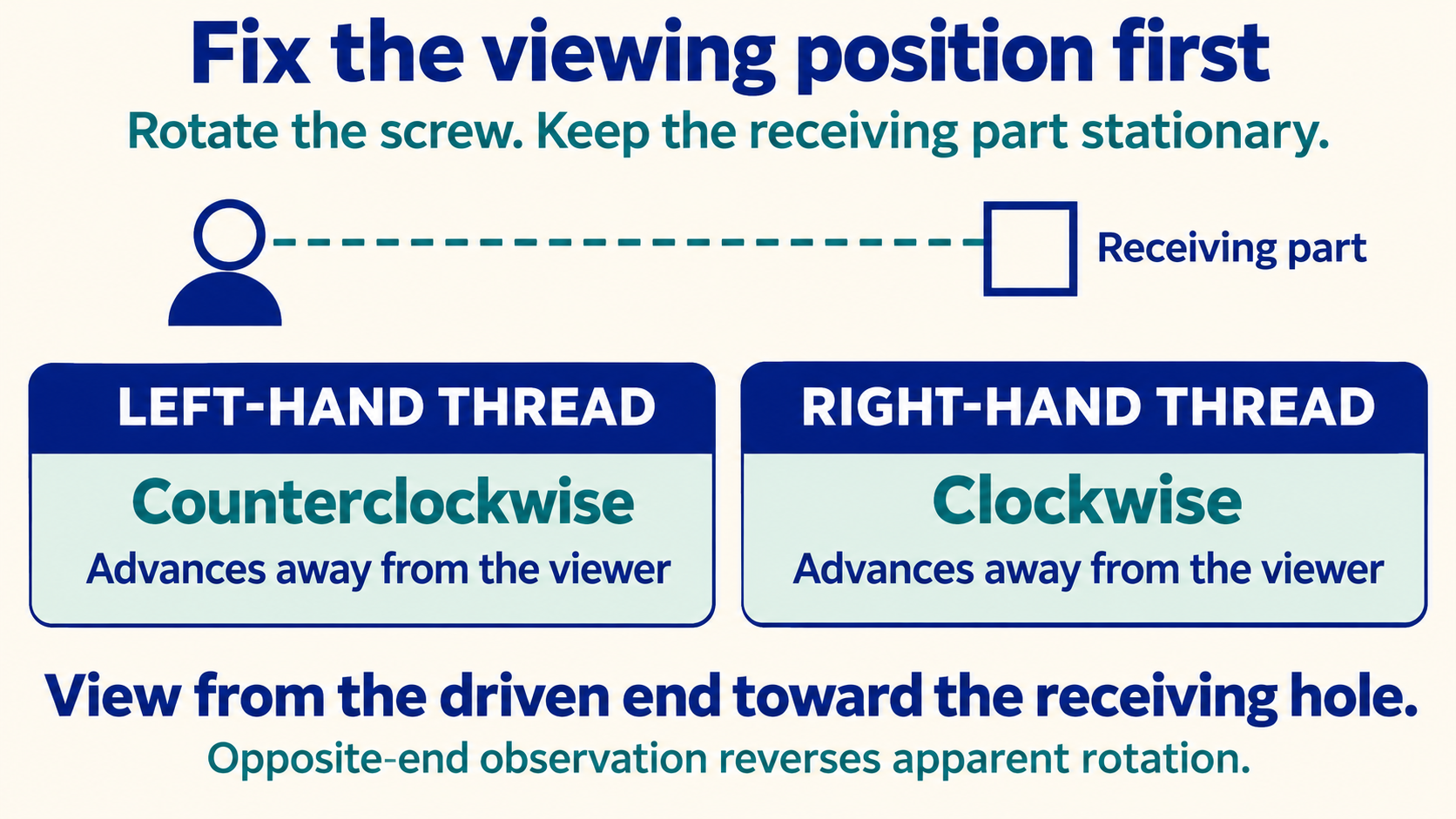
A left-hand thread advances counterclockwise when a screw is viewed from its driven end toward a stationary receiving hole. A right-hand thread advances clockwise from that same position. The viewing position matters: the same physical rotation looks reversed when observed from the opposite end.
“Reverse thread” commonly means left-hand thread. It describes the direction of the helix, not a different head shape, a smaller pitch or a higher strength level. The useful comparison is therefore more precise than “turn it left”: identify the moving member, the viewing end and the direction of axial travel.
This guide uses one consistent arrangement. The screw rotates, the receiving part remains stationary, and advancing means that the screw moves farther into that part. It explains identification and terminology rather than a removal procedure for an unknown assembly.
Left hand thread direction depends on a stated viewpoint
From the driven end, counterclockwise rotation advances a left-hand screw into its matching stationary internal thread. Reversing that rotation withdraws it. A right-hand screw behaves the opposite way in the same arrangement.
The driven end is the end where the screw is turned, such as its head. The observer looks along the screw toward the receiving part. “Away from the observer” then describes advancement into the hole, rather than movement toward the person’s face.
That definition fixes several things that a casual instruction leaves unstated. It does not assume that the observer can see the far end, that the screw is vertical, or that a photograph has been presented without mirroring. It also does not assume that a nut, rather than the screw, is the part being rotated.
| Observation of the same advancing screw | Left-hand thread | Right-hand thread |
|---|---|---|
| From the driven end toward the receiving hole | Counterclockwise; advances away from this observer | Clockwise; advances away from this observer |
| From the opposite end, looking back toward the driven end | Appears clockwise; advances toward this observer | Appears counterclockwise; advances toward this observer |
Both rows describe the same screw movement from different observation positions. Moving the observer does not change a left-hand helix into a right-hand helix. It changes the apparent rotation and the observer’s description of axial travel.
Why two photographs can suggest opposite directions
A clockwise description belongs to a view, while handedness belongs to the thread geometry. Confusing those two facts explains many apparently contradictory sketches.
Imagine a transparent receiving part so that two people can observe the same screw from opposite ends. The person beside the head sees the screw advancing away. The person beyond the receiving part sees it approaching. The rotation also appears opposite, even though nobody has changed the thread or reversed the motion.
This thought experiment is a geometry explanation, not an instruction to inspect a moving machine. Its purpose is to make the missing viewpoint visible. A direction arrow in an image needs an observation frame before it can describe the intended movement clearly.
A mirrored photograph introduces a different problem. Reflection changes the apparent orientation of a helix in the image. Rotating an ordinary photograph on the page does not have that same effect. A mirrored image should therefore not be treated as independent evidence that the photographed product has the opposite handedness.
Image provenance matters when identifying an unfamiliar part. A catalogue photograph may be generic, reused across variants or edited for layout. A product drawing and the relevant designation provide a better basis for resolving the proposed thread than a thumbnail alone.
Handedness is one thread attribute, not the whole identity
A left-hand label resolves direction. It leaves diameter, pitch, thread form and other matching requirements to be established separately. Two parts described as left-hand are not necessarily a matching pair.
Pitch describes the spacing of the thread. Handedness describes which way its helix runs. Changing the direction of a thread does not, by itself, say whether its pitch is coarse or fine. Our thread pitch and TPI guide explains the spacing question separately.
The same separation applies to diameter. A measured outside diameter may narrow the identification, but it does not settle the internal thread’s system, form or fit. A nominal size without its surrounding designation can leave several possibilities open.
Thread starts are another attribute. The number of starts concerns the helices present, rather than whether those helices run left or right. It should not be inferred from a rotation mnemonic. When a technical description includes several thread attributes, preserve them instead of reducing the entry to “reverse thread.”
Where LH appears in a product description, it commonly indicates left-hand direction. Its absence from an unidentified part is weaker evidence. It may reflect an incomplete record, rather than a confirmed right-hand specification. Nor should an unfamiliar groove or notch be assigned a universal meaning without the applicable product documentation.
The distinction is especially useful when comparing a drawing with a supplier’s abbreviated line item. The short line may identify direction correctly while omitting a pitch or fit requirement shown elsewhere. Matching only the visible abbreviation can therefore leave the original technical question unresolved.
Our coarse versus fine thread guide addresses pitch choice. That is a different decision from identifying whether an existing thread is left-hand or right-hand.
Two identification records with different levels of certainty
The following fictional records show how to separate an observation from a confirmed description. They are not customer cases or examples of an approved replacement.
A close-up photograph without the original callout
A buyer receives a photograph of a threaded part and a message saying that it turns “the wrong way.” The image shows no drawing reference, no clear moving member and no stated viewing end. It suggests an identification question, but it does not answer it.
The phrase “wrong way” could mean counterclockwise advancement from the head end. It could also describe someone looking from the opposite end, turning the mating member, or interpreting a reflected image. Those possibilities should remain distinct rather than being collapsed into a confident left-hand label.
A useful record would describe what is actually known: the source of the image, which end is visible and whether the original documentation specifies direction. The unresolved fields remain unresolved. Neither an assumed handedness nor an assumed standard becomes more reliable by being repeated in a quotation.
The next useful evidence is the applicable drawing or product identification, including the thread callout. This makes the request specific without suggesting that the reader force an unknown pair together to discover its direction.
A drawing that explicitly identifies left-hand direction
A second record includes a drawing revision and a thread entry explicitly identifying LH. Here, handedness has a documentary basis. The remaining task is to preserve the rest of the thread description and establish what the mating component requires.
If a supplier’s reply repeats the nominal diameter and LH but omits other specified fields, the reply is incomplete. It has not necessarily proposed the wrong direction; it has failed to resolve the complete identity. That difference helps the buyer request the missing information clearly.
Photographs can still support this record by showing the part and its condition. They should remain supplementary to the applicable specification. A convincing image cannot replace a missing dimensional requirement, and a complete direction statement cannot replace the other matching fields.
Why left-hand threads exist, and what the label cannot prove
Left-hand threads provide an alternative relationship between rotation and axial movement. Manufacturer literature describes their use in selected rotating assemblies and components combining opposite thread directions. Those uses depend on the particular mechanism.
The existence of such applications does not make left-hand direction a universal locking feature. An unfamiliar joint cannot be assessed from handedness alone. Its operating movement, connection design and specified parts remain relevant; a broad application example is not permission to substitute a different thread.
Likewise, “reverse thread” does not mean stronger, corrosion resistant or interchangeable with a right-hand counterpart. Those are separate material, performance and compatibility questions. Keeping them separate prevents a correct direction label from carrying conclusions it cannot support.
The most useful identification statement names the thread direction and its frame of reference, then preserves the complete documented callout. From the driven end, a left-hand screw advances counterclockwise into its matching stationary receiving part. Once that observation is fixed, pitch, size, form and fit can be addressed as their own questions.
References
- Siemens: fundamentals of thread types and threading, for thread attributes, axial motion and left-hand terminology.
- BAER: left-hand thread identification and application context. Cutting instructions are outside this guide’s scope.