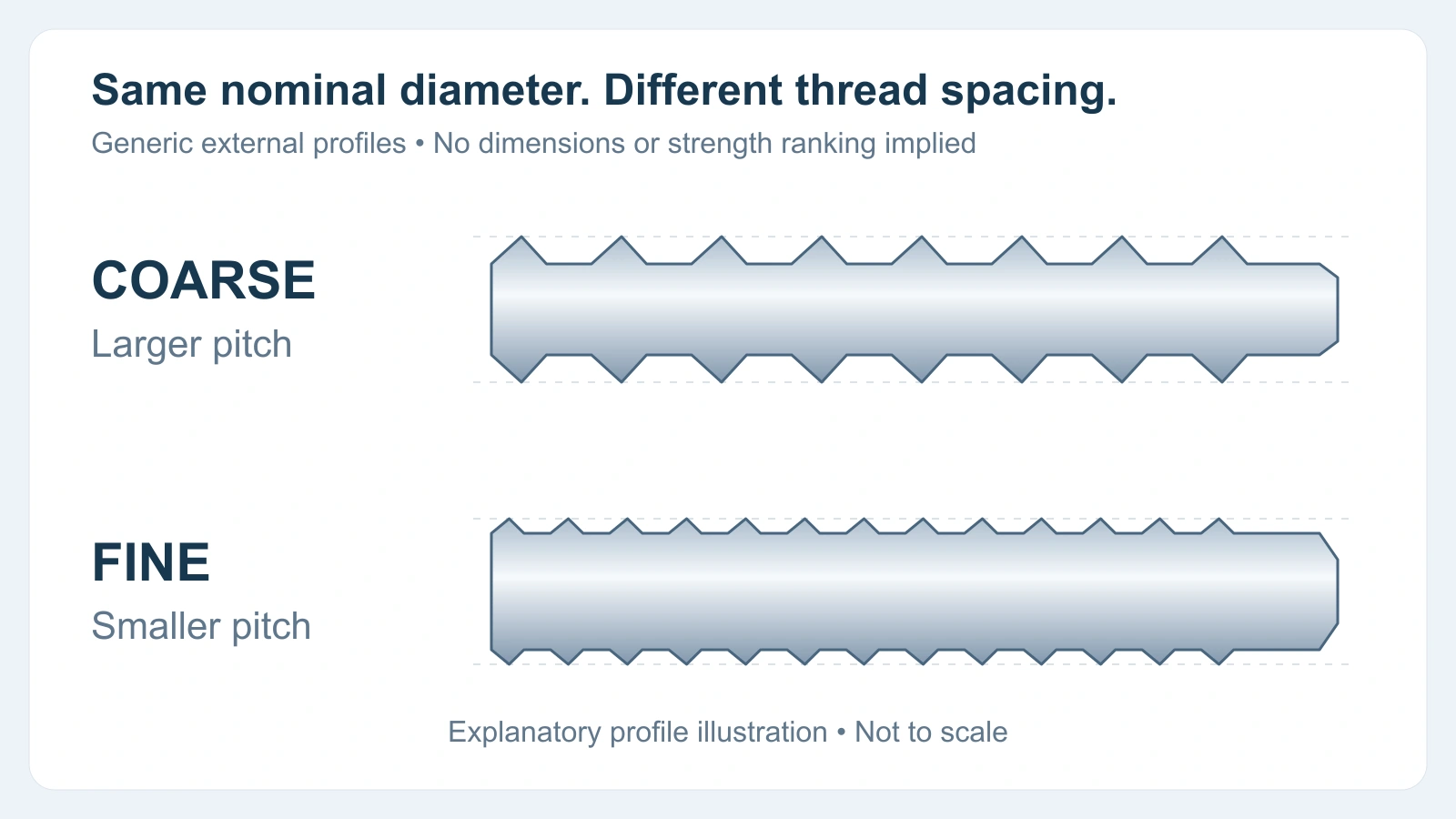
Coarse threads have wider spacing than fine threads at the same nominal diameter. For a replacement fastener, match the existing mating thread before considering either option. For a new design, coarse thread is a common general-purpose starting point; fine thread becomes useful when the assembly needs finer adjustment or another verified design benefit.
The coarse vs fine thread decision depends on the complete connection: bolt, nut or tapped hole, material, engagement and assembly conditions. A finer pitch can change the bolt’s geometry without automatically making the whole joint stronger.
Coarse vs fine thread: what pitch changes
Pitch is the distance parallel to the thread axis between corresponding points on adjacent threads. Metric specifications express that spacing in millimeters. Unified inch specifications use threads per inch, or TPI: a higher thread count means closer spacing.
UNC identifies the Unified coarse series; UNF identifies the fine series. These series describe thread combinations, while a thread’s fit also depends on its dimensional allowances and tolerances. A “fine” thread and a “tight” fit therefore describe different properties.
For a metric example, the cited Albany County Fasteners chart lists M8 × 1.25 as coarse and M8 × 1.0 as a fine combination. Both share the M8 nominal diameter, but their thread spacing differs. Selecting the same diameter does not make the two mating specifications interchangeable.
Choose from the assembly requirement
Start with the condition that controls the decision. A replacement has an existing interface to match; a new design has more freedom to compare pitches. The following matrix separates those decisions so an adjustment preference does not override a required thread match.
| Assembly condition | Starting decision | Required verification |
|---|---|---|
| Replacing a screw or nut | Retain the specified mating thread | Diameter, pitch or TPI, thread system and fit |
| General assembly with no special adjustment need | Evaluate coarse thread first | Joint design and assembly process still govern |
| Finer positional adjustment is needed | Evaluate a fine-pitch combination | Mating part specification and adjustment requirement |
| An insert or tapped component controls the connection | Check the receiving thread | Exact drawing, material and engagement requirements |
A purchasing team can use the same matrix to separate confirmed requirements from unresolved details. If a drawing states the diameter but omits pitch, the supplier needs clarification. Choosing whichever threaded part looks similar does not resolve the missing specification.
Assembly convenience and fine adjustment serve different needs
Coarse thread is often the practical candidate when straightforward assembly and disassembly matter. The manufacturer references describe fine threads as more sensitive to damage and fouling. Their smaller pitch supports finer adjustment, but the handling and assembly process must suit that choice.
Consider the decision in terms of the work being done. A general assembly station may prioritize consistent installation of matching parts. An adjustment mechanism may place more value on the finer setting available from a smaller pitch. Record that reason before comparing suppliers or changing the drawing.
Fine threads also warrant attention to galling and seizing during assembly. A pitch choice does not establish a suitable material, finish or lubrication procedure. Those requirements belong with the assembly specification rather than an assumed rule that one thread series solves every installation problem.
Compare bolt strength with the mating thread in view
Fine threads can provide a larger tensile stress area than coarse threads at a comparable nominal diameter. That geometric advantage concerns the threaded bolt section. It does not establish the capacity of the receiving thread or approve a complete assembly.
Fastenal’s technical reference also identifies thread engagement as an important strength consideration. A comparison of fine-thread bolts with coarse-thread bolts should therefore retain the same material and design conditions. Otherwise, a statement about thread geometry can hide a change elsewhere in the connection.
For selection, keep bolt strength and mating-thread adequacy as separate checks. Request the relevant drawing and design verification when joint capacity controls the choice. This comparison supplies no allowable load, tightening torque or universal minimum engagement length.
What a threaded-insert order still needs to specify
QIYI’s Threaded Insert product page lists M5, M6 and M8 options, with carbon steel or stainless steel materials and listed nickel, zinc or black finishes. Its published size table does not state the pitch. An M8 listing alone therefore does not confirm an M8 × 1.0 fine-thread option.
Use the insert page when the assembly requires that product type, then send the exact mating-thread callout and the part drawing. Keep the required thread system, diameter, pitch, fit and engagement requirement together. Where the component has more than one threaded interface, identify which interface each callout describes.
A useful request distinguishes the specified part from a proposed alternative. State whether the drawing already fixes the thread or whether the supplier is being asked to evaluate a change. Include the material and finish requirements without treating the available catalog choices as automatic equivalents.
Confirm the complete thread designation on the order acknowledgment before releasing a replacement. The selection decision is complete when the mating requirements and design conditions agree with the chosen part, rather than when its diameter or apparent thread fineness looks right.
References
Fastenal: Screw Thread Design — pitch, fit, thread series and engagement; pages 1–3.
Nord-Lock Group: fine or coarse threaded bolts — assembly and adjustment considerations.
Albany County Fasteners: metric machine screw chart — the M8 diameter/pitch example.