Self-tapping screws create their own mating thread. Self-drilling screws add a drill point that can create the starting hole as well. That is the central difference when comparing self tapping vs self drilling screws. In conventional metal fastening, a non-drilling self-tapper normally follows a separately prepared hole; a self-driller combines hole creation and thread formation in the same fastener.
The terms overlap. A self-drilling screw also performs a tapping function, so “self-tapping” on a quotation does not, by itself, settle whether the proposed screw can drill. Nor does a sharp point establish drilling capacity. The receiving material, its thickness and the exact fastener design still matter.
A useful comparison therefore starts with the assembly: what hole exists, where the mating thread will be formed, and which parts the screw must bring together. Head style and overall length come after those questions. This guide explains those distinctions without supplying a universal installation setting or a thickness limit.
Self tapping vs self drilling screws: compare the functions
Drilling makes a hole. Tapping creates a helical mating thread in the receiving material. A self-drilling screw carries a point designed to perform the first function before its threaded portion performs the second. A conventional self-tapper relies on an appropriate starting hole in a metal application.
The comparison below describes functions, rather than declaring one family better. The relevant question is which functions the particular assembly needs from the fastener.
| Question | Conventional non-drilling self-tapper | Self-drilling screw |
|---|---|---|
| Who creates the starting hole? | A separate hole-making operation in the metal application | The screw’s drill point, within its specified application range |
| Who creates the mating thread? | The screw as it enters the receiving material | The screw after the drill point creates the hole |
| What should the point show? | A locating point, which may be sharp or blunt depending on the design | A drill-point feature, rather than merely a pointed end |
| What does the family name leave unresolved? | The appropriate starting hole and receiving material | The product’s drilling range and receiving material |
| What remains necessary for either route? | A complete description of the fastener and intended joint | |
This distinction also separates these families from a machine screw entering an already tapped hole. In that route, the receiving thread is prepared beforehand. Our broader guide to types of screws by receiving thread and joint explains why that difference comes before choosing a head or drive.
A pointed tip is a clue, not a complete identification
A conventional sharp-point tapping screw and a conventional drill-point screw can look similar in a small catalogue photograph. Enlarge the point before relying on the picture. A drilling feature is different from an end that simply narrows to a point.
There is also variation within the self-tapping family. Manufacturer illustrations include pointed and dog-point forms, while supplier descriptions include sharp and blunt locating ends. “All self-tappers have a sharp tip” is therefore an unreliable identification rule. The product designation and technical drawing should agree with the photograph.
A photograph can help resolve a naming question, but it does not provide a drilling range. Likewise, a screw called a “metal screw” has not yet been identified as a self-driller. The phrase describes a broad intended material context; it leaves the hole-making function open.
When two offers use different names for apparently similar screws, compare the actual point and product description first. One supplier may be using “self-tapping” as a broad family label. Another may use it specifically for the non-drilling type. Clarifying the physical function prevents a terminology difference from becoming an unnoticed substitution.
Separate hole creation, thread formation and clamping
These three actions provide a practical way to read a screw description. They explain what the assembly needs, without turning a catalogue label into an installation procedure.
Hole creation: Establish whether the receiving metal already has a starting hole. If it does not, identify which operation or product feature is intended to create it. “The screw goes into the metal” does not answer that question.
Mating-thread formation: Establish whether the receiving part already contains a thread or whether the installed screw will create it. A plain hole and a tapped hole are different starting conditions even when their locations match.
Clamping: Establish which parts the fastener is intended to hold together. A proposed hole-making method does not, on its own, describe the completed joint. Keep the connection requirement visible while comparing screw families.
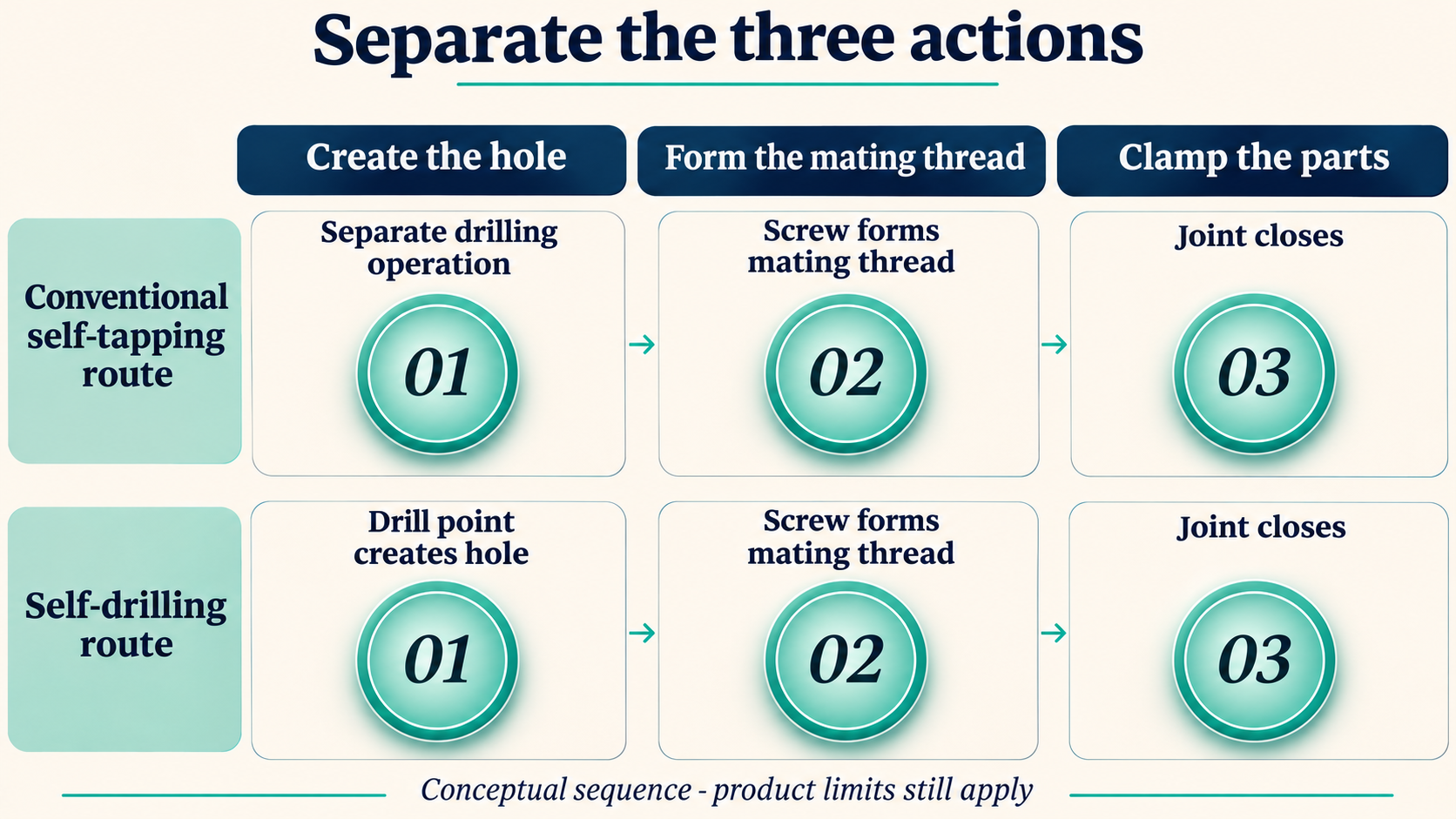
The benefit of this model is that a missing answer stays attached to the correct action. An unknown starting hole is a hole-preparation question. An unknown receiving thread is a thread-formation question. Neither uncertainty is resolved by changing the head style.
Material and hole details limit what the name tells you
Self-drilling does not mean capable of drilling through any metal section. The EJOT brochure lists product-specific drilling capacities, while SFS directs readers to product data for pilot holes and performance. Those details do not transfer automatically between designs. The relevant information belongs to the exact screw design, not to the word “self-drilling” in isolation.
Overall screw length and drilling capacity answer different questions. A longer screw may have a longer threaded body while retaining a particular point design. Its length therefore does not establish that its point can create a hole through a thicker receiving section. Compare the product’s technical description with the material that the point must actually penetrate.
The word “stainless” needs the same care. It describes a material family; it is not a drilling-capacity statement. A corrosion-related material description cannot replace the manufacturer’s explanation of the point and its intended receiving material.
An existing hole also needs a description. “Pre-drilled” confirms that a hole-making operation has occurred, but does not establish that the resulting hole is appropriate for the proposed self-tapper. Hole requirements should come from the technical information for that screw and application.
A tap drill size chart for cutting taps serves a different purpose: it relates a hole to a later tapping operation for a specified thread. It should not be treated as a universal pilot-hole table for self-tapping screws. Identifying the intended hole function is the first step in choosing the relevant reference.
Two assembly descriptions show why the distinction matters
The following examples are fictional comparisons. They illustrate missing information in a request, rather than approving either assembly.
A cover panel with a separately prepared receiving hole
A buyer requests a pointed screw for a metal cover and says that the receiving holes are already prepared. The initial question is whether those holes are plain or tapped. That answer determines whether the proposal concerns a self-tapping route or a machine screw entering an existing thread.
If the holes are plain and the installed screw is intended to create the mating thread, a conventional self-tapping description may be relevant. The prepared-hole details still need to match the exact proposed screw. The fact that a hole exists does not settle that match.
Suppose an alternative offer includes a drill-point screw. Its point is an additional feature, but that does not automatically make it an improvement for the existing arrangement. The buyer should establish why the alternate design is being proposed and whether its technical information covers the stated receiving condition.
The useful clarification is specific: identify the hole state, receiving material and proposed product together. Asking only for a “stronger screw” or a “better metal screw” leaves the original uncertainty in place.
A cover attached to an unperforated metal support
A second request looks similar in a photograph, but the receiving support has no starting hole. This changes the hole-creation question. A non-drilling self-tapper does not acquire a drilling function merely because its end looks sharp.
A self-drilling proposal addresses the missing operation only when the exact product is intended for the receiving material and section. The description must therefore identify that material and the part the point must penetrate. “Metal frame” is too broad to establish the product’s stated range.
The support thickness and the complete connection description should remain separate fields. A photograph of the outer cover does not reveal everything about the material underneath it. Similarly, an overall screw-length entry does not disclose a drilling limit.
These two requests can use similar-looking hardware while presenting different starting conditions. Comparing price and head style before clarifying those conditions risks comparing products for different tasks. The first offer may assume separate hole preparation; the second may include a drilling function. The difference belongs in the comparison itself.
Make the missing field visible in the product request
A clear request does not need to predict every engineering detail. It does need to distinguish the facts already known from the information being requested. The following worksheet organizes that discussion; it is not a universal purchasing specification.
| Field | What to establish | What does not settle it |
|---|---|---|
| Hole state | No hole, plain prepared hole or existing tapped hole | A general “metal screw” description |
| Receiving material | The actual material and section encountered by the screw | The visible cover alone |
| Required function | Drilling plus thread formation, or thread formation in a prepared hole | A sharp-looking point |
| Exact proposed product | The designation, drawing and applicable technical information | A family name or generic photograph |
| Completed connection | The parts being joined and the requirements that remain to be checked | Drilling capability by itself |
Keep the supplier’s reply against the field it resolves. A clearer photograph may resolve point identification. A technical sheet may clarify the stated application range. A revised assembly description may explain whether the receiving hole is prepared. Each reply contributes different information.
Once those fields agree, head style, drive, length, finish and purchasing details can be compared within a defined fastener route. The central decision is then clear: does this assembly need the screw to create only its mating thread, or also to create the starting hole?
References
- EJOT: original self-drilling screw technical brochure, used for functional distinctions and generic point examples.
- SFS: self-tapping metal screw guide, point variation and product-specific hole data.
- Fastenright: self-tapping screw functions and alternative point forms.