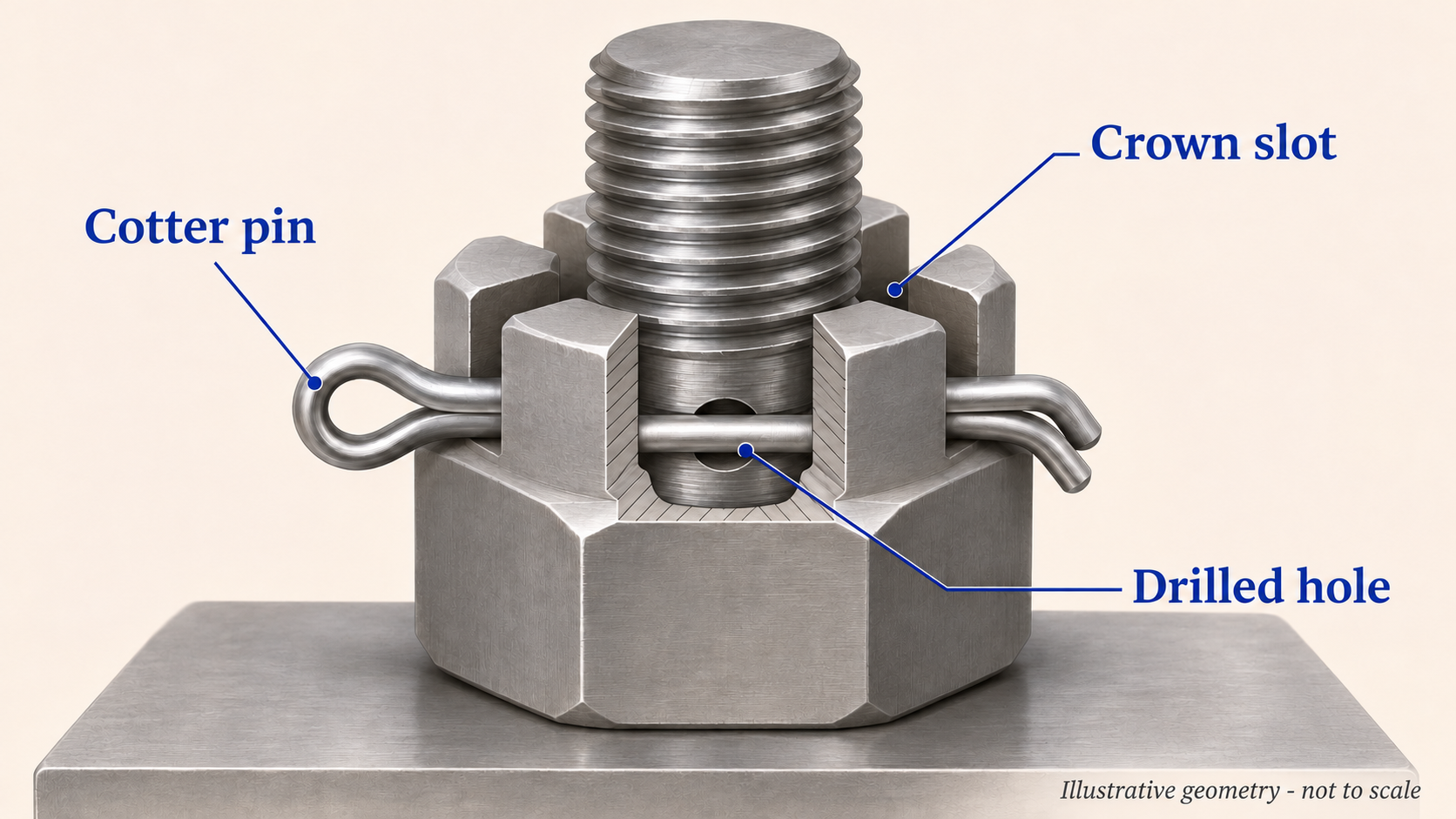
A castle nut is a threaded nut with slots in its crown that accept a cotter pin through a drilled mating fastener. The pin provides a physical restraint against rotation. A complete selection therefore needs more than a nut that looks right: the mating thread, cross-hole, crown and specified pin must work together.
The easiest identification clue is the cut-out upper edge. However, a photograph cannot confirm thread compatibility or show whether the fastener has a correctly positioned hole. Those details determine whether the arrangement can be assembled as intended.
Identify the nut and its mating parts
The hexagonal portion provides wrench flats; the slots above it provide a path for the pin. In the arrangement described by Packer Fastener, the mating bolt has a drilled hole. The cotter pin passes through that hole and the corresponding slots.
This separates two questions that can otherwise become confused during purchasing. “Is this a castle nut?” concerns its form. “Will it fit this assembly?” concerns the relationship between several parts. A plain threaded fastener does not become suitable for this retention method simply because the nut screws onto it.
When identifying an existing part, record the complete assembly before requesting a replacement. A side view of the crown, a view of the mating fastener and the assembly drawing are more useful together than a top-down nut photograph alone.
How the cotter pin restrains rotation
The cotter pin crosses the fastener and occupies the crown-slot path. That physical interference restrains nut rotation. It is a separate function from bringing the joint to its prescribed assembled condition.
For example, MOOG’s steering and suspension guidance treats correct component fit and the manufacturer’s tightening instructions as prerequisites to installing the cotter pin. The useful distinction is between establishing the joint condition and retaining the nut afterward. Inserting a pin does not prove that the preceding work was correct.
This distinction also helps when reading maintenance instructions. A visible pin tells an inspector something about the retention arrangement; it does not independently establish tightening, correct part identity or the condition of the joint beneath the nut. Those checks need the relevant assembly requirements.
Castle nut, castellated nut or slotted nut?
These names describe related crown forms, but the name alone is not a complete specification. Packer Fastener distinguishes a slotted hex form from a castle form with a reduced upper crown. Hanshin Neji’s catalogue also illustrates differences in crown form and height.
A reduced crown and a crown that follows the hex body may look different while using a similar pin-retention principle. Their appearance does not establish that their threads, overall height or installation envelope match. An illustration of one design should not become the purchasing specification for another.
For replacement work, retain the original drawing or part reference. For a new design, state the required form and dimensions explicitly. Calling two parts “castellated” leaves unanswered whether the pin path sits at the right height and whether the surrounding components provide enough space.
Check three interfaces before choosing parts
A useful selection review separates the thread connection, the pin path and the surrounding space. This avoids approving an entire assembly on the strength of one successful check.
| Interface | Information to confirm | What that check does not establish |
|---|---|---|
| Nut to mating thread | Thread designation and the specified mating fastener | That the cross-hole and crown align |
| Crown to hole and pin | Nut geometry, hole position and specified cotter-pin details | That the required assembled joint condition has been achieved |
| Assembly to surrounding space | Space for the crown, pin arrangement and intended assembly access | That a different crown shape is an approved substitute |
This matrix is a selection framework, rather than a dimensional standard. Each row directs a different drawing or component check. If the thread matches but the hole remains below the crown, the first row can pass while the second remains unresolved.
The nut size chart explains why thread size, wrench width and nut thickness are separate descriptions. Those distinctions help organize a specification; they do not replace the required castle-nut drawing.
When the hole does not line up
An alignment problem deserves a part-and-assembly check before an improvised adjustment. Confirm that the nut, mating fastener and specified washers or other stack components are the intended ones.
MOOG’s automotive examples show why this matters: incorrect fit or an incorrect assembly stack can place the stud hole at an unsuitable height relative to the crown. That observation supports checking component identity and fit. It does not supply a universal correction for every castle-nut application.
The governing tightening and alignment method must come from the equipment or assembly instructions. Different instructions can address different joints. A steering-joint bulletin should not be treated as a bearing-adjustment procedure or a general rule for every drilled bolt.
A useful question for the responsible engineer or equipment supplier is specific: “With the prescribed parts and assembled condition, where should the cross-hole sit relative to the slots?” That question exposes the missing requirement more clearly than asking how far the nut can be turned.
Compare the retention task before changing nut type
A castellated arrangement uses a pin and a drilled mating fastener. Other nut-retention methods use different features and require a separate assessment. Choosing among them begins with the joint’s requirements, rather than a general claim that one nut is always better.
For readers comparing a nylon-insert design, the nyloc nut guide explains that separate mechanism. It is a useful comparison of how retention is provided, not permission to replace a specified castle nut.
Before approving a change, the responsible designer needs to resolve the mating components, assembly method and inspection requirements for the proposed arrangement. A change that removes the pin also changes what can be checked visually. That difference belongs in the review, even when both choices are described broadly as locking nuts.
What a useful specification should contain
A clear purchase enquiry identifies the drawing or approved part reference, thread designation, crown form and required nut geometry. It also identifies the mating drilled fastener and the specified cotter pin, rather than treating them as unrelated accessories.
Separate confirmed requirements from unresolved information. If the drawing does not show the hole position, record that omission and seek clarification. If only a sample is available, avoid converting its appearance into an assumed standard or an unverified material designation.
The practical result should be a matched specification: which nut, on which fastener, with which pin, under which assembly instructions. That record gives purchasing, assembly and inspection teams the same basis for checking the retention arrangement.
References
Packer Fastener: slotted and castle nut technical guide
MOOG: cotter-pin installation considerations for steering and suspension joints
Hanshin Neji: castle-nut crown forms