Summary: Choose a Nyloc nut for through-bolt joints needing prevailing torque within its limits; choose a spring nut for repositionable hardware in a profile channel. ISO 2320 covers prevailing-torque performance; slot fit is a product dimension to verify. Nylon inserts lock—not replace correct preload—and spring retention ≠ thread locking. Qiyi Fastener focuses on spring nuts, so start with slot geometry, thread size, access and reconfiguration needs. NASA treats torque as indirect preload control, so installation verification is essential.
How does a nyloc nut differ from a spring nut in the joint?
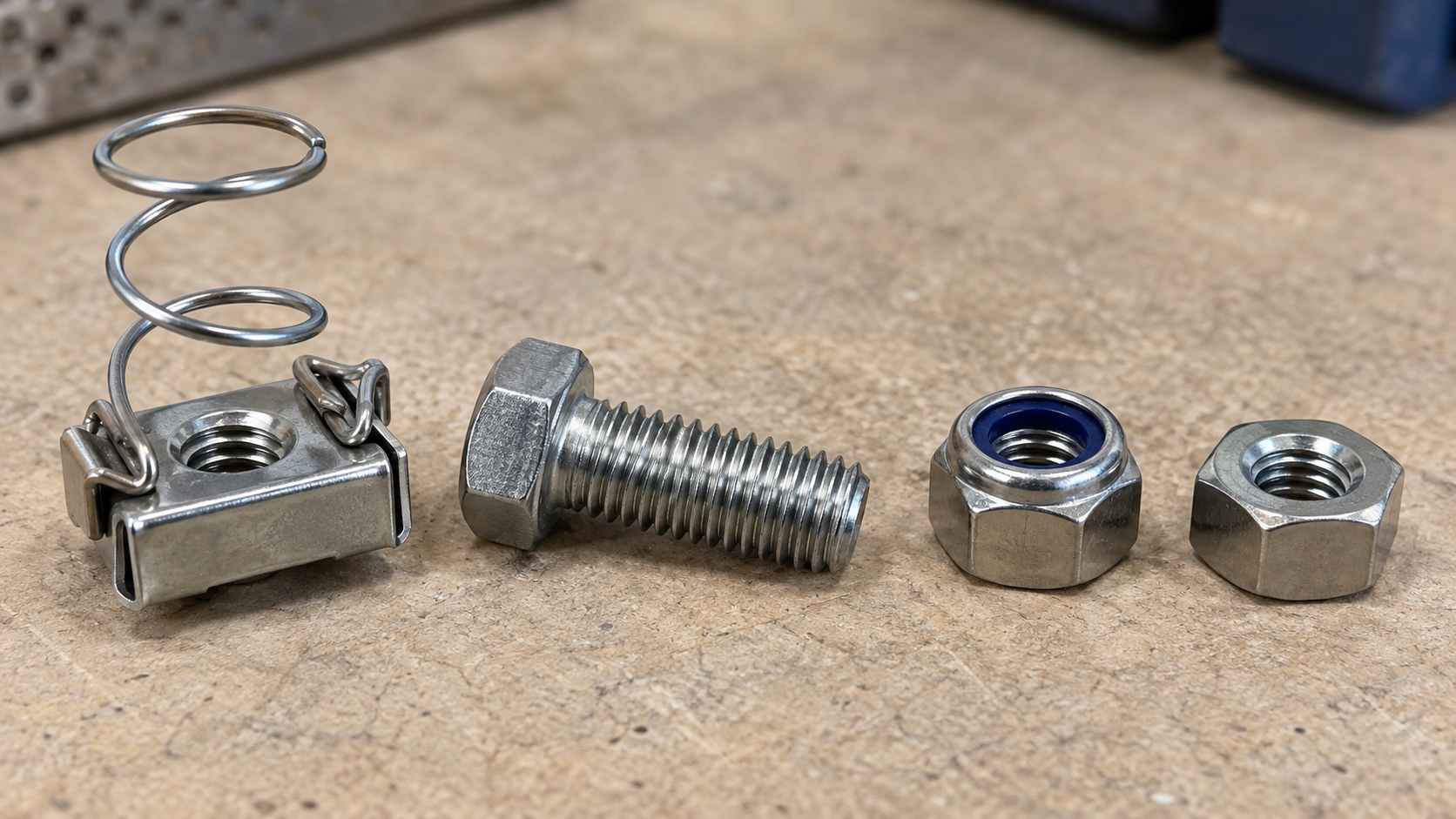
A nyloc nut, also called a prevailing-torque nut, uses a nylon insert that interferes with the mating thread. The interference resists rotation after the nut is run down, but it does not create a measured clamp load by itself. The joint still needs a defined bolt grade, thread engagement, bearing surface, and tightening method. Reuse limits, temperature, solvents, and the condition of the insert all affect whether the locking effect remains acceptable.
A spring nut has a formed spring or clip that holds a threaded nut in an extrusion slot, channel, or other constrained access area. It solves a positioning and retention problem: an installer can place the nut without reaching the back of the frame, then slide it to the required coordinate before tightening. The spring feature may speed assembly and protect against a loose nut falling out, but the finished joint still depends on the bolt, profile wall, washer, and specified torque.
When should a nylon insert nut be selected for a through-bolt assembly?
Select a nylon insert nut when the joint has a normal bolt-and-nut path, the fastener can be reached from both sides, and resistance to casual vibration-induced rotation is needed. Typical examples include guards, brackets, vehicle subassemblies, and equipment covers where the nut is not expected to be repositioned during installation. Check the nut’s prevailing-torque requirement in the applicable product standard and measure the finished joint rather than assuming a catalog torque value transfers across coatings or lubricants.
The insert has boundaries. Nylon can lose stiffness at elevated temperature, swell or degrade in some chemicals, and become contaminated during repeated installation. A Nyloc nut also consumes part of the available thread length, so confirm that the bolt protrusion remains adequate after the insert is engaged. If the design needs frequent disassembly, specify a replacement policy or a different locking method; do not count on an old insert to deliver its original resistance.
Why is a spring nut useful in modular frames and extrusion profiles?
A spring nut is useful when access is limited to the open face of a T-slot, when a panel must be moved during commissioning, or when a frame may be expanded later. The spring keeps the nut aligned while the installer brings in the bolt, reducing the chance of a nut dropping into a closed section. It can also reduce handling steps compared with inserting a loose square nut from an end of the profile.
Fit is dimensional, not generic. Verify the profile slot opening, internal neck, nut width, spring height, thread diameter, and the available bearing area under the bolt head or washer. A spring that is too tall may prevent the nut from turning into the channel; one that is too short may not hold position during assembly. For a broader explanation of profile hardware, see Qiyi’s guide to sliding T-nuts for extrusion profiles and compare the retention behavior with the chosen spring style.
Qiyi’s relevant product focus is spring nuts for these configurable assemblies, not Nyloc products. The practical recommendation therefore returns to the application: use a spring nut where channel access and repositioning drive the design, and reserve a Nyloc nut for a compatible through-bolt joint that needs prevailing torque.
Which performance and cost dimensions separate a nyloc nut from a spring nut?
The lowest unit price is not necessarily the lowest installed cost. A Nyloc nut can be efficient where both sides of a joint are already accessible; a spring nut can reduce labor when a frame has many repeated slot locations or must be adjusted on site. Illustrative total-cost calculations should include handling, access equipment, rework, lost hardware, and planned replacement rather than only the nut price.
| Dimension | Nyloc nut | Spring nut | Decision check |
|---|---|---|---|
| Primary function | Prevailing torque on a conventional thread | Retention and positioning in a slot or channel | Define whether the problem is rotation or access |
| Installation access | Usually needs bolt and nut access from opposite sides | Can be loaded from an open profile face | Map tool clearance and the assembly sequence |
| Repositioning | Must be removed and refitted to move the joint | Slides to a new coordinate before tightening | Allow for commissioning and future changes |
| Vibration behavior | Insert adds resistance to rotation | Retention helps hold location; locking depends on the joint | Validate preload and any separate locking requirement |
| Temperature and chemicals | Limited by nylon insert compatibility | Depends on spring and nut material plus profile environment | Check the full material stack and service temperature |
| Unit-cost tendency | Often economical for standard through-bolt work | May cost more per piece but reduce access labor | Use supplier quotations and a complete labor estimate |
| Maintenance and returns | Plan insert replacement after repeated removal | Inspect spring retention, slot damage, and thread wear | Write a replacement and inspection rule into the work instruction |
| Total cost of ownership | Strong for stable, accessible joints | Strong for configurable frames and repeated adjustments | Compare installation minutes, downtime, and inventory |
 Incoming and in-process checks should confirm slot fit, spring retention, thread engagement, and the approved tightening method.
For buyers who need configurable dimensions and a documented sourcing process, Qiyi Fastener can support a spring-nut review alongside its industrial fastener manufacturers guide. Review the spring nut product configuration against the profile drawing before approval. The recommendation should remain tied to the frame drawing and installation evidence rather than to a broad “locking nut” label.
Frequently Asked Questions
What is a Nyloc nut?
A Nyloc nut, also called a nylon-insert lock nut, is a hexagonal nut with a nylon collar inside. The collar grips the bolt threads, increasing friction and preventing the nut from loosening due to vibration.
How does a nylon insert nut work?
As the bolt enters the insert, the nylon creates controlled thread interference that adds resistance to turning. The resistance changes with temperature, lubrication, thread condition, and prior installation cycles, so a joint should be validated using the specified product test or installation audit. Keep enough bolt protrusion for full engagement without damaging the insert.
What is a spring nut used for?
A spring nut holds a threaded nut in an extrusion slot, channel, or other constrained location while the bolt is installed from an accessible face. It is used for modular frames, panels, brackets, and assemblies that may need adjustment or expansion. Verify slot dimensions and spring orientation in the actual profile before releasing the part.
What is the difference between a Nyloc nut and a spring nut?
A Nyloc nut primarily resists rotation on a conventional threaded joint through a nylon insert. A spring nut primarily retains and positions a nut in a channel; its spring does not automatically provide the same prevailing-torque function. Choose based on whether the dominant requirement is thread locking or accessible, repositionable assembly.
References
The right fastener is the one whose locking method, access geometry, and installation evidence agree with the joint you will actually service.
For spring-nut applications, contact Qiyi Fastener with the profile, thread, material, environment, and documentation requirements for the next sourcing review.