Socket head cap screw specifications should define both the part that fits the assembly and the part the supplier must deliver. A matching thread size and catalog photograph leave material, property class, finish and acceptance requirements unresolved. Before releasing a purchase order, connect the dimensional description to a drawing revision and an agreed supply specification. This makes competing quotations comparable and gives receiving inspection a clear basis for checking the delivered batch.
Keep geometry and supply requirements separate
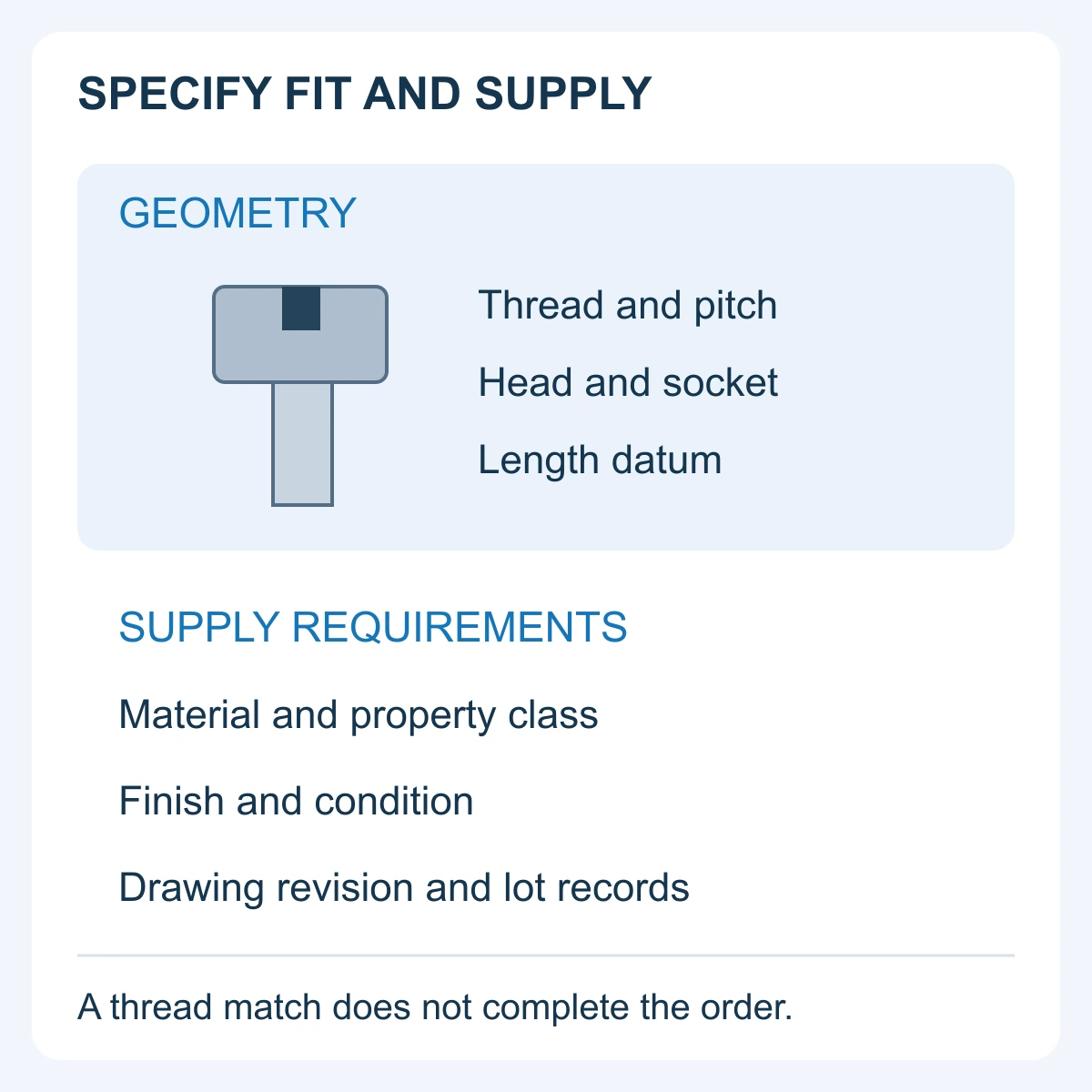
A conventional socket head cap screw has a cylindrical head with a recessed hex drive. The head may sit above the mating surface or within a counterbore. Fit therefore involves more than thread diameter: the head envelope, socket access and under-head length also matter.
Supply requirements answer a different question. They identify the required material and mechanical properties, finish, delivery condition and supporting records. Two screws can share nominal dimensions while the quoted supply requirements differ. The diagram separates these checks so neither disappears behind a short product name.
ISO 4762 identifies a coarse metric hexagon socket head cap screw family. Its public scope helps identify the product; it does not establish that a particular quotation meets every ordered requirement. Name the applicable standard and edition, then resolve any drawing requirements or agreed deviations. A DIN 912 description should receive the same check before acceptance as an equivalent.
Read socket head cap screw dimensions as scoped data
The following metric socket head cap screw dimensions come from QIYI’s published product listing. They provide a useful starting point for a size comparison. All values are in millimeters; dk is head diameter, k is head height and s is nominal hex key size.
| Nominal thread | Head diameter dk | Head height k | Hex key s |
|---|---|---|---|
| M5 | 8.5 | 5 | 4 |
| M6 | 10 | 6 | 5 |
| M8 | 13 | 8 | 6 |
These are catalog reference values, not minimum and maximum limits, a counterbore machining specification or a declaration of ISO conformity. For a confined assembly, obtain the applicable head and socket limits before approving the surrounding features. The conventional screw length is measured beneath the head; the purchase line should make that datum clear.
A catalog row also does not establish which length, pitch, material and finish combination is being quoted. Confirm the complete configuration rather than treating the size table as a finished order description.
Complete the socket head cap screw specifications
The drawing or purchase specification should identify the thread system, nominal diameter, pitch and required length. Record the length datum and any head, socket or clearance requirement that controls assembly. If the drawing and standard differ, the supplier needs a written resolution of which requirement governs.
Specify material and mechanical requirements separately from dimensional conformity. A description such as steel or stainless steel does not identify every alloy or property class. Likewise, a black or bright appearance does not demonstrate mechanical performance. Request the exact designation required by the application and obtain confirmation that the quoted configuration matches it.
Finish and delivery condition belong on the same controlled purchase line. The engineering guide cited below explains that seating torque guidance depends on lubrication, surface finish, mating material and joint conditions. A catalog size match therefore cannot supply an application-specific tightening instruction. Use the instruction approved for the actual joint.
Complete the socket head cap screw specs with quantity, drawing revision and the inspection or lot records needed for acceptance. State those requirements when requesting the quotation so the supplier can identify exceptions before commercial approval.
Audit the quotation against one purchase line
Consider a hypothetical request reading “M6 × 20 socket cap screw, black.” It identifies a nominal thread, length number, head family and appearance, but leaves several decisions open. It does not explicitly settle pitch, the length datum, material or property class. Nor does it identify a dimensional standard, finish specification or drawing revision.
The buyer can resolve this by attaching the controlled drawing and asking the supplier to confirm each missing field in writing. The supplier should identify deviations individually. A general reply of “same size” does not answer whether the head limits, mechanical requirements and finish match the order.
At receipt, compare the batch against the approved purchase description and the agreed records. A dimensional sample can address the measured features; it cannot by itself establish an unverified material or property class. Keep the approved quotation and deviations linked to the order so receiving staff do not have to reconstruct the technical agreement from a product photograph.
Request the exact configuration from QIYI
QIYI’s Socket Head Cap Screw listing includes steel and stainless steel descriptions and natural, nickel-plated and black finish options. Use that listing to begin the inquiry, then request confirmation of the precise combination your assembly requires.
Send the thread and pitch, under-head length, drawing revision, applicable standard and edition, material or property-class requirement, finish, quantity and required records. Ask QIYI to confirm the configuration and any deviations in its quotation. The published options do not establish a specific alloy, class, available batch or compliance status for your order.
References
EN ISO 4762:2004 — public scope and contents
Unbrako Socket Products Engineering Guide
Packer Fastener — socket head cap screw technical reference