The key difference in 304 vs 316 stainless steel fasteners is molybdenum. Both grades are austenitic stainless steels; 304 is a chromium-nickel grade, while 316 includes molybdenum to improve corrosion resistance, particularly against localized attack. That makes 316 worth evaluating when chlorides are present. It does not establish that every 316 screw is suitable for every coastal or chemical exposure.
For a buyer comparing two otherwise similar fasteners, the useful question is what happens at the joint: where moisture collects, what reaches the surface, and whether deposits can be removed. Alloy identity and mechanical requirements must then be checked separately.
304 vs 316 stainless steel: what molybdenum changes
Stainless steel relies on a passive surface film for corrosion resistance. Molybdenum helps improve resistance to pitting and crevice corrosion, but it does not make the surface immune to attack. Chlorides, temperature and local chemistry still matter.
Outokumpu describes 304 within its chromium-nickel austenitic family and 316 within its chromium-nickel-molybdenum range. These descriptions establish the material distinction. They do not certify the finished fastener, its strength class or its suitability for a particular assembly.
A substitution therefore needs two decisions: whether the candidate alloy fits the exposure, and whether the supplied fastener meets the joint specification. A purchase line that changes only “304” to “316” leaves the second decision unresolved.
Evaluate the joint location, not just the site address
A component described as “outdoors” may be sheltered, regularly washed, or positioned where salt and dirt accumulate. These are different conditions. Tight gaps beneath heads, washers and overlapping parts can restrict oxygen access and retain contaminants. The visible face of a bracket may not represent the concealed fastener interface.
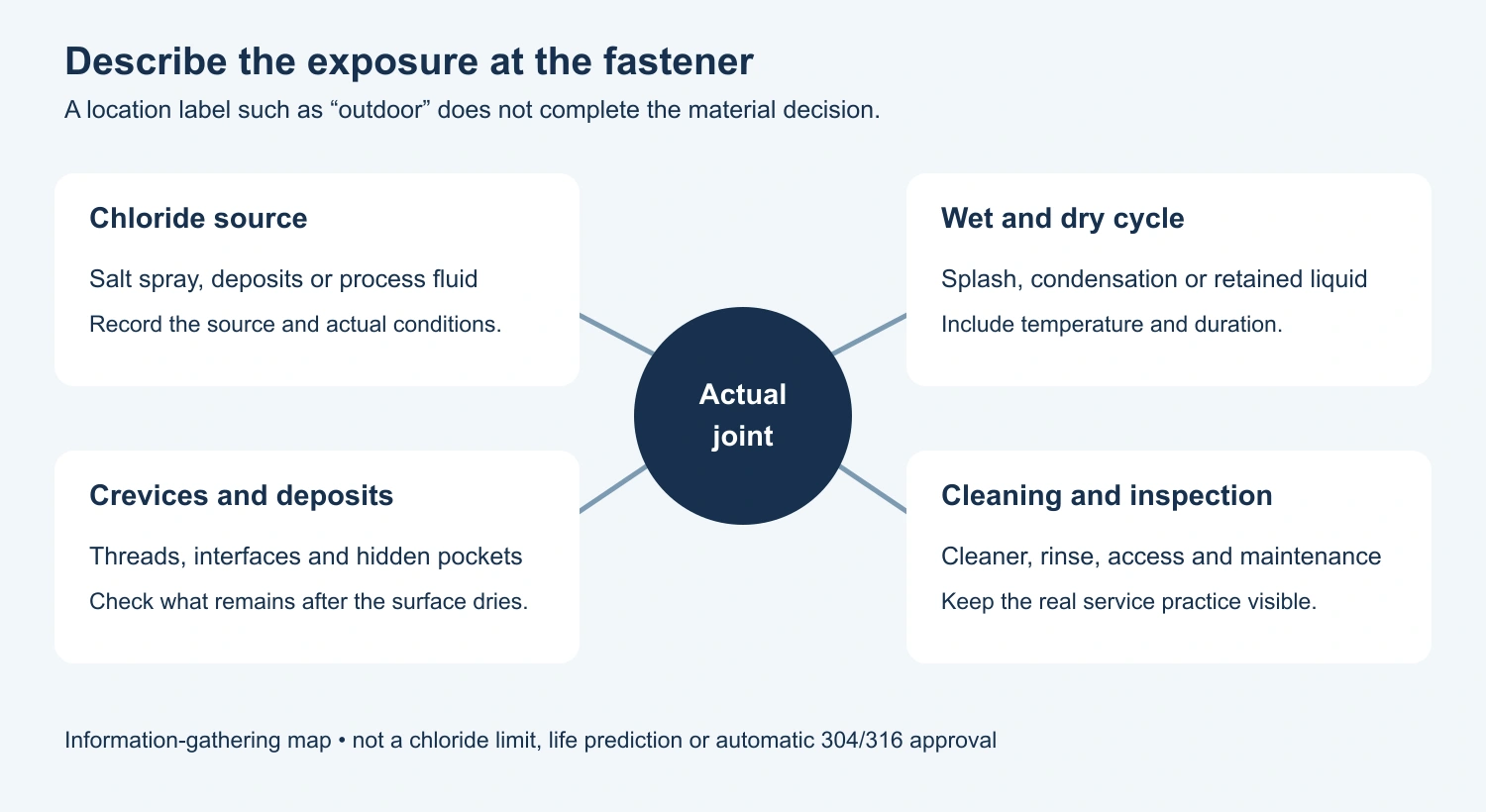
The four fields in the diagram create a practical exposure record. Name the chloride source, describe wetting and drying, identify concealed gaps, and state how cleaning or inspection can actually reach the fastener. Record temperature and chemical conditions alongside these fields when relevant. An unknown condition should remain an open question in the specification.
Hypothetical case: a sheltered equipment bracket
Consider a bracket inside a sheltered enclosure. The buyer has confirmed that process fluids and salt spray do not reach it, and the maintenance team can inspect the attachment. This information gives the engineer a defined basis for evaluating a 304 candidate. It is more useful than a general “indoor” label.
The next step is to verify that the candidate also meets the required mechanical and dimensional specification. This example does not approve 304 for all enclosures; it shows how the buyer can replace an ambiguous location description with facts.
Hypothetical case: a bracket that retains salt deposits
Now consider a bracket exposed to salt-bearing moisture, with a washer interface that remains difficult to clean. The same purchasing description is no longer enough. A 316 candidate deserves consideration, but the review must also address the retained deposits and concealed interface.
The engineer may need to assess joint geometry, inspection access or another material option. Ordering 316 without resolving those conditions would turn a useful alloy comparison into an unsupported approval. Neither hypothetical case supplies a service-life estimate or a universal chloride threshold.
Keep alloy identity separate from A2, A4 and property class
Stainless fasteners are often described using designations such as A2-70 or A4-70. The group designation and property class communicate different information. Bossard’s stainless-fastener guide shows that groups can include multiple material numbers; the designation is not a one-to-one proof of an exact 304 or 316 alloy.
A2 is associated with chromium-nickel austenitic steels, while A4 includes molybdenum-bearing austenitic steels. If a drawing specifically requires 316, accepting an A4 label alone skips the exact material confirmation. Likewise, the “70” portion concerns mechanical properties, not a corrosion rating.
This distinction prevents two common procurement mistakes: approving an alloy substitution without checking strength requirements, and treating a strength-class marking as evidence of environmental suitability. The responsible reviewer needs both parts of the specification before accepting the replacement.
What the purchase record should establish
Record the exact material designation required by the drawing, the applicable fastener standard and property class, and the dimensions of the selected part. State what material documentation is required and how it must be tied to the delivered goods. If an alternative is proposed, identify which requirement changes and who must approve it.
QIYI’s socket-head cap screw page is a starting point for selecting the product form. Its generic stainless-steel description does not confirm a particular 304 or 316 variant in stock. Ask for confirmation against the selected drawing and material requirements before treating a quotation as an approved substitute.
Appearance and a magnet cannot settle the choice
A clean silver surface does not distinguish 304 from 316. A simple magnet check is also insufficient: some austenitic stainless grades can become magnetic after cold working. Use documented material identification rather than appearance or magnetic response to accept a specified alloy.
Nor does the number 316 mean that a fastener is automatically stronger than a 304 alternative. For the joint, compare the documented mechanical requirements of the actual products. For corrosion, compare the recorded exposure. Keeping those decisions separate makes the final material choice traceable.