Choosing carbon steel vs stainless steel fasteners requires two complete specifications. A carbon-steel option may suit a protected assembly when its mechanical grade and finish meet the service conditions. A suitable stainless grade may reduce dependence on a protective coating, but “stainless” does not guarantee corrosion immunity or higher strength.
The comparison should identify the alloy or material group, fastener property class, surface condition and intended environment. It should also account for installation and maintenance. Two screws with the same thread and head shape can differ in several of these requirements, even when their photographs look similar.
Carbon steel vs stainless steel: compare these fields
| Decision field | Carbon-steel option | Stainless-steel option |
|---|---|---|
| Corrosion protection | Specify the finish and service exposure | Select an alloy suited to the exposure |
| Mechanical performance | Confirm grade and part requirements | Confirm material group and property class |
| Assembly | Retain specified coating and friction conditions | Address friction and possible thread galling |
| Cost comparison | Include finishing and maintenance | Include grade, installation and maintenance |
| Approval evidence | Drawing and material/finish documentation | Drawing and material/property-class documentation |
The table is a comparison method, not a ranking. A purchasing team needs the missing fields completed before it can judge whether either option satisfies the joint. The lowest quoted unit price is useful only after the offered parts meet the same approved requirements.
Start with exposure and the protection system
Stainless steel relies on a thin passive surface film associated with its chromium-containing alloy. Outokumpu explains that the film can reform in a suitable oxidizing environment. Its protection still depends on alloy composition and local conditions; chlorides, deposits, temperature and confined crevices can change corrosion behavior.
That makes “outdoor” an incomplete specification. A sheltered inland bracket, a salt-exposed frame and a joint repeatedly wetted with cleaning solution can present different conditions. The reviewer needs to know what reaches the fastener and whether moisture or deposits remain around the threads and bearing surfaces.
For a carbon-steel fastener, the selected finish is part of the option being evaluated. “Steel” and “zinc plated steel” are not equally complete purchase descriptions. NASA’s fastener manual discusses protective finishes alongside material selection; it does not make a finish label a universal service-life guarantee.
A useful finish specification identifies the required system and acceptance criteria, rather than relying on silver or black appearance. The assembly review should also consider the mating materials and whether the planned installation could compromise the chosen surface condition. Any changed exposure should trigger a new suitability check.
Strength depends on the actual fastener designation
Carbon steel and stainless steel each cover multiple mechanical conditions. A material-family name cannot answer whether a specific bolt meets the joint’s required tensile, proof-load or other mechanical properties. That answer belongs to the applicable fastener specification and supporting documentation.
Bossard’s stainless-fastener guide separates material groups from property classes. In a designation such as A2-70, the material group and the property class perform different roles. Replacing a steel fastener with one labeled only “stainless” discards information needed for a meaningful comparison.
Nor does changing from A2 to A4 automatically establish a higher strength class. The complete designation still matters. The buyer should compare the required properties for the actual fastener type and size, instead of treating a corrosion-oriented material choice as a mechanical upgrade.
Carbon steel and alloy steel should also retain their specified identities. Suppliers may group them together commercially, but a substitution must preserve the drawing’s requirements. A generic material category cannot replace a grade, heat-treatment condition or approved part specification.
Include assembly behavior in the decision
Austenitic stainless threads can gall under some contact and sliding conditions. The British Stainless Steel Association describes galling as adhesive wear that can progress to seizure. Corrosion resistance and galling resistance are separate properties, so a corrosion-driven material change may still require an assembly review.
The approved process should address the mating pair, surface condition and any lubricant or coating. Changing lubrication also changes an assembly input; the installer should not add a different compound while assuming the original tightening specification remains valid. Use the documented conditions for the selected fastener and joint.
This does not mean every stainless joint will seize, or that every coated-steel joint is trouble-free. It means the comparison must include how the parts will be installed and removed, particularly where maintenance requires repeated disassembly.
Compare cost over the intended service task
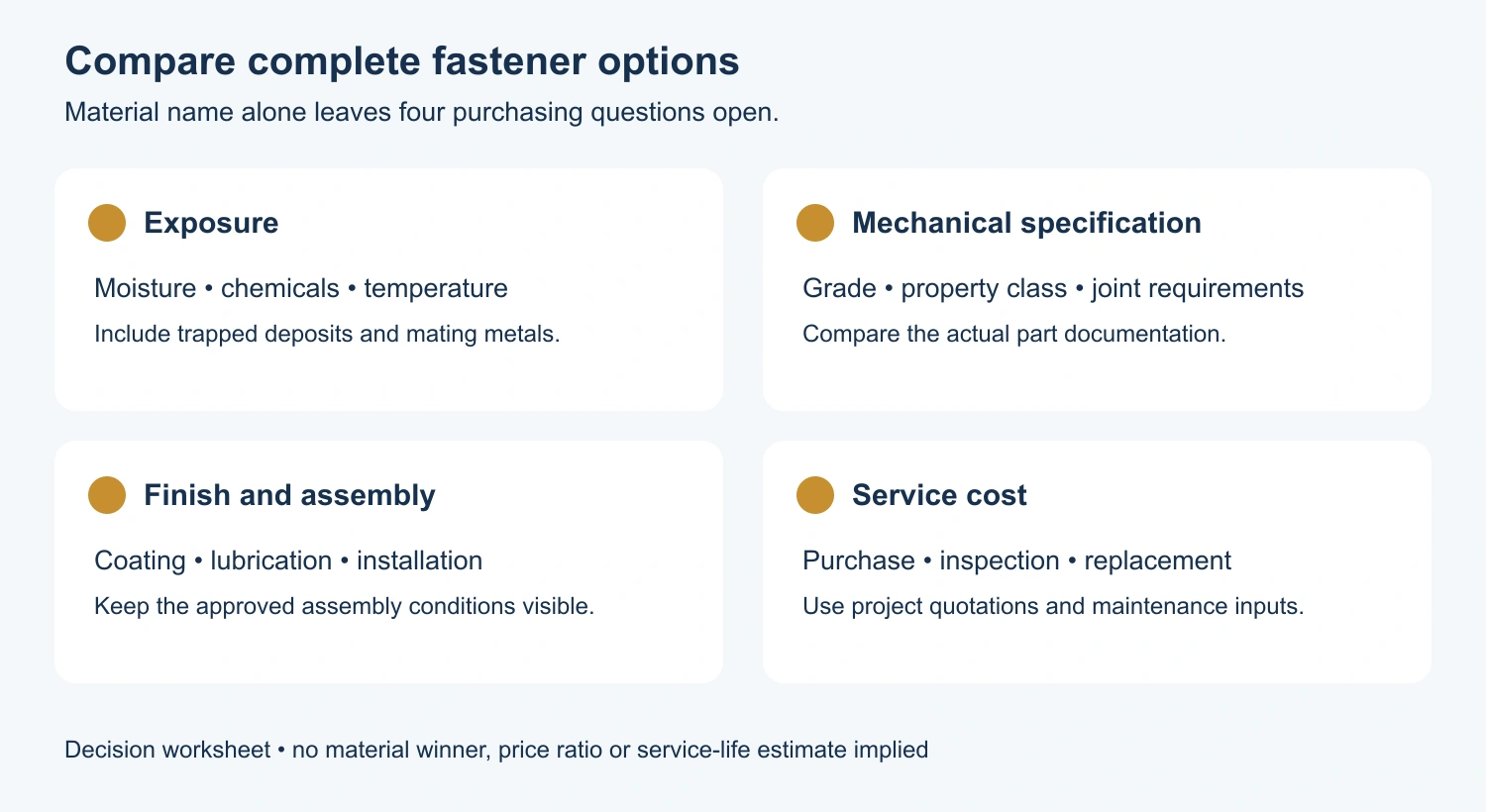
For a practical quotation comparison, create one column for each candidate and complete the same fields. Record the purchased part and finish, installation requirements, inspection access and expected maintenance tasks. Use supplier quotations and the project’s maintenance assumptions rather than a universal stainless-to-steel price multiplier.
Consider a hypothetical machine bracket in a controlled indoor space. A specified coated-steel option may remain a candidate when its protection and mechanical requirements fit that environment. The decision should document those conditions, rather than describe carbon steel as suitable for every indoor application.
Now consider a similar bracket exposed to frequent wet cleaning. The review needs the cleaner, concentration, temperature, rinse practice and retained moisture conditions. A stainless option may deserve consideration, but the material name alone does not complete that review. The two brackets can share a drawing outline while needing different material-and-finish decisions.
Maintenance access can change the economics as well. Replacing a small fastener may require equipment downtime or removal of surrounding parts. Those project-specific costs belong in the comparison, even when the unit-price difference appears small. No single material wins without the operating assumptions.
Make the quotation technically comparable
For a socket-drive assembly, QIYI’s socket-head cap screw page is a starting point for a drawing-based inquiry. Its generic steel/stainless and finish descriptions do not establish every alloy, property class or stocked combination. Specify the required thread, length, head geometry, material, class and finish together.
The quotation review should identify any difference between the requested and offered specification. When both candidates meet the approved joint requirements, compare their actual purchase, assembly and service costs. That produces a usable material decision without relying on appearance or an unsupported claim that one family is always better.
References
- Outokumpu: Corrosion Resistance of Stainless Steel — passive film and exposure conditions.
- Bossard: Stainless Steel Fasteners — material groups and property classes, January 2025.
- NASA: Fastener Design Manual — material, finish and assembly considerations, 1990.
- BSSA: Galling Resistance of Stainless Steels — adhesive wear and seizure mechanisms.