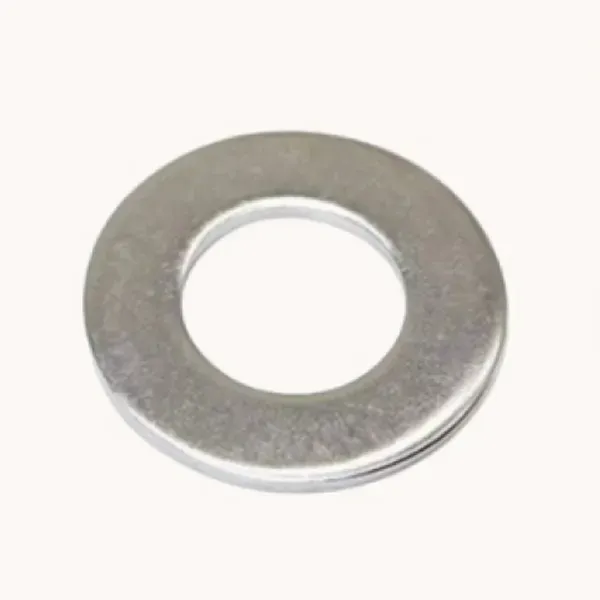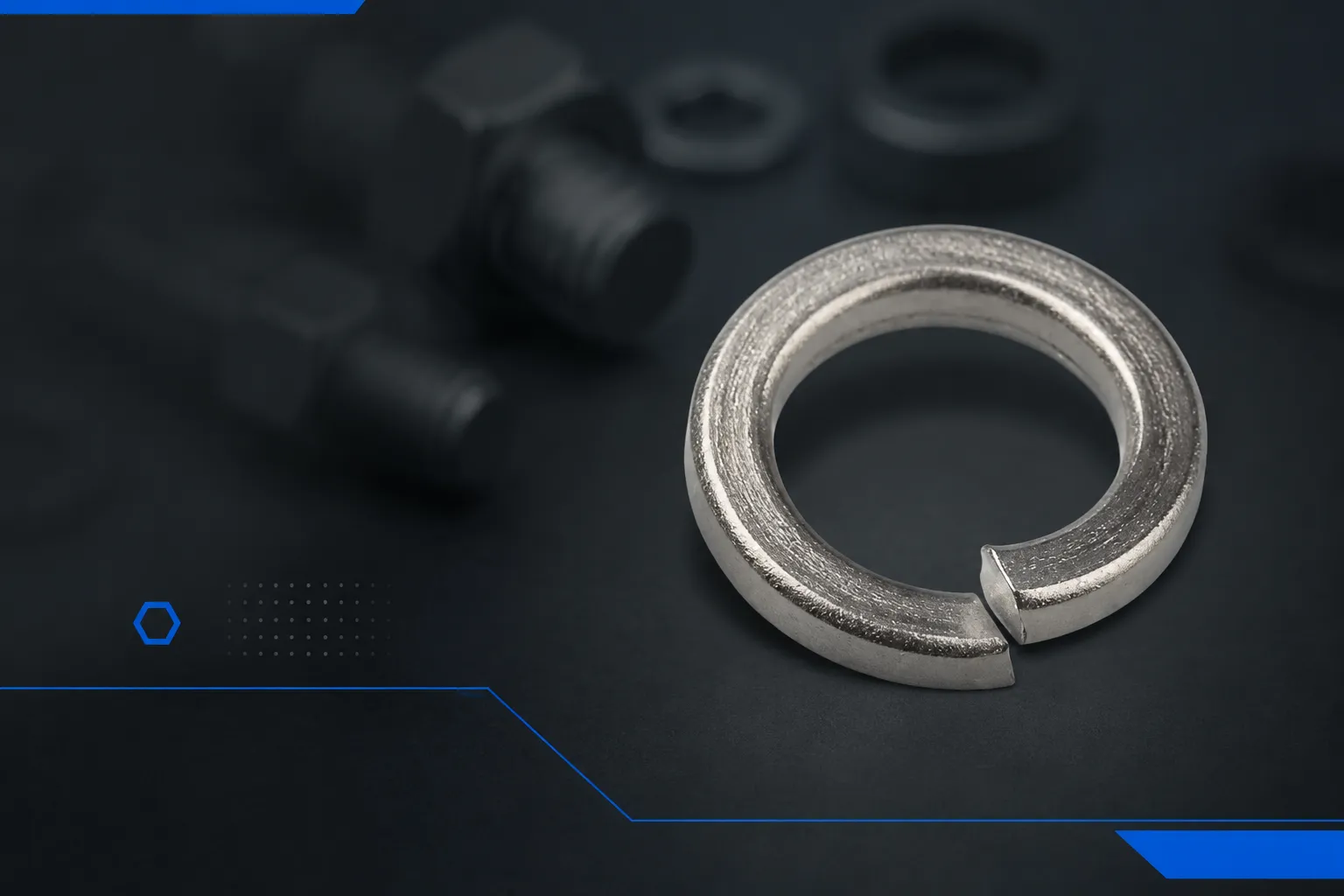
When a mechanical engineer in Bavaria received a new pump-skid fastening kit after reviewing a familiar tutorial and a competitive quotation, he installed the conical parts with confidence; the stack looked like the spring washers used on earlier jobs. Two shifts into vibration testing, clamp load fell, a flange joint began to fret, and the crew had to stop the line for rework. The parts were not defective—the underlying mistake was treating a disc spring selected for a defined load–deflection curve as though it were an ordinary locking washer, while also arranging its stack in the wrong direction.
Belleville washers and spring washers solve different preload problems
A disc spring is a conical annular spring. Under axial compression, its conical shape produces a non-linear force–deflection curve; that stored elastic energy can offset settlement, thermal movement, and limited service deflection in a bolted joint. A split or helical spring washer is a different component with an open coil form, commonly chosen for simpler general fastening duties rather than for a tightly specified spring curve.
For readers comparing catalog terminology, belleville washers, disc springs, and a belleville spring washer often describe the same conical spring family; the drawing and the governing standard—not the sales label—should settle the requirement. The global market is tracked as a discrete industrial component segment by Verified Market Reports, but the selection decision remains application-specific.
DIN EN 16983 superseded the legacy DIN 2093 dimensional specification for disc springs. Its standardized product range covers outside diameters from 6 mm to 600 mm; this makes catalogue interchange practical only when the stated dimensions, thickness group, material, and characteristic values are equivalent. A buyer looking across a broader washer product range should keep that distinction visible in the bill of materials.
Belleville washer geometry, stacking, and preload loss must be evaluated together
Which dimensions govern the spring characteristic?
The essential inputs are outside diameter (De), inside diameter (Di), thickness (t), free cone height (h0), material modulus, and the intended deflection (s). DIN 2092 uses these values with geometry correction factors to calculate the force curve and stresses; changing t or h0 changes far more than a nominal “washer size.”
For standardized disc springs, DIN EN 16983 separates products into three thickness groups: below 1.25 mm, from 1.25 mm to 6 mm, and above 6 mm to 14 mm. The grouping matters because manufacturing route, tolerances, contact flats, and inspection expectations are not interchangeable across thin stamped discs and thicker formed discs.
How does a stack change force and travel?
Identically oriented discs act in parallel: their force capacities add while the usable deflection remains approximately that of one disc. Alternating the orientation puts discs in series: usable deflection adds while the force at a matched per-disc deflection remains approximately that of one disc. Friction, tolerance accumulation, and seating prevent these simple relationships from being a final release calculation.
Parallel:  F_stack ≈ n × F_single     s_stack ≈ s_single
Series:    F_stack ≈ F_single         s_stack ≈ n × s_single
Combined:  calculate each parallel packet, then place packets in series
For example, a two-disc parallel packet has roughly twice the force of one disc at the same per-disc deflection; two such packets in series provide roughly twice the travel of one packet. DIN 2092 calculations should be applied to the actual selected geometry, and the assembly drawing must show orientation rather than relying on an installer’s interpretation. Engineers can compare that notation with this guide to disc-spring stacking engineering principles.
Where is the useful working point?
Disc-spring catalogues commonly state force values at 75% of the free cone height, written as s = 0.75 h0; DIN 2092 provides the calculation framework behind this widely used point. It is a reference condition, not permission to flatten every spring in service. Stress, fatigue duty, relaxation, corrosion, and stack friction must still be checked for the actual cycle profile.
A practical joint model begins with the remaining clamp load rather than the installation torque alone. The installation method, bearing-face friction, thread friction, embedment, and differential thermal expansion all influence the reserve that the spring system can protect.
Why is a conventional spring washer not a smaller disc spring?
A conventional helical spring washer can increase local contact pressure and provide limited elastic compliance, but it does not supply the controlled high-load, short-travel characteristic of a correctly specified belleville washer. Its suitability must be assessed with the bolt grade, joint hardness, coating system, vibration spectrum, and any prevailing-torque or locking feature already in the assembly.
Where a joint needs measurable spring force or compensation for predictable loss of preload, a disc spring calculation is usually the more defensible route. Where the requirement is a standard general-purpose spring washer, the part standard and installation method should be specified directly rather than assuming that a conical disc is a substitute.
Belleville washer performance should be compared against the joint requirement, not the unit price
The apparent saving from an under-specified washer can be erased by one retorque visit, a rejected inspection record, or unplanned access to a remote assembly. The comparison below is intentionally functional; actual values depend on the selected size, material, surface treatment, bolt stiffness, and clamped-part stiffness.
| Decision factor | Disc spring to DIN EN 16983 / DIN 2092 | Helical spring washer | Procurement implication |
|---|---|---|---|
| Load–deflection control | Calculated from De, Di, t, h0, and s | Usually not selected from a disc-spring force curve | Request the characteristic curve for critical joints. |
| Force adjustment | Parallel stacking increases force approximately by the disc count | No equivalent modular stacking rule | Specify stack orientation and quantity on the drawing. |
| Travel adjustment | Series stacking increases travel approximately by the disc count | Limited by the washer form and installation condition | Use a stack only after checking guide, clearance, and fatigue duty. |
| Traceability | Can be ordered by standardized dimensions and quality requirements | Depends on its own product standard and grade | Match certificate scope to the purchase specification. |
| Total cost of ownership | Higher engineering input; can reduce preload-loss risk | Lower part complexity; may be unsuitable for critical preload reserve | Price the inspection, rework, and downtime exposure—not only pieces. |
Application conditions determine the disc-spring configuration and hidden cost drivers
A single component may work well in one joint and fail economically in another because service temperature, corrosion, assembly access, and inspection burden vary. The matrix below converts selection variables into a purchase-specification action rather than a generic product recommendation.
| Application condition | Primary technical concern | Configuration or control to review | Cost driver if missed |
|---|---|---|---|
| Vibrating gearboxes and pump skids | Settlement and cyclic loss of clamp load | Load curve at working deflection; stack orientation; seating faces | Retorque labour and unplanned shutdown. |
| High-temperature flanges | Differential expansion and relaxation | Material capability, finish, temperature exposure, and required spring travel | Leak testing, access equipment, and replacement work. |
| Electrical switchgear and busbar joints | Contact-pressure retention within a confined space | Compact force requirement, insulation clearances, and approved assembly sequence | Hot-spot investigation and compliance risk. |
| Large custom assemblies | Non-standard envelope or target curve | Drawing-controlled De, Di, t, h0; prototype load test | Late redesign and schedule slip. |
The ROI question is therefore narrow but consequential: does the selected spring deliver enough controlled travel to keep the joint above its minimum clamp load throughout service? If the answer depends on an assumed curve, an undocumented stack, or a missing material declaration, the lowest quoted piece price is not the lowest project cost.
DIN EN 16983 and ISO requirements make disc-spring conformity auditable
DIN EN 16983:2017-03, “Disc springs — Quality specifications — Dimensions,” is the current European dimensional and quality reference that replaced DIN 2093. DIN 2092:2006-11, “Disc springs — Calculation,” remains important where the designer needs the load–deflection relationship and stress calculation rather than a catalogue comparison alone.
ISO 19690-2 covers technical specifications for disc springs and is useful when the purchasing specification must travel across supply chains. ISO 9001 certification demonstrates that a supplier operates a quality-management system; it does not, by itself, prove that a particular spring meets a designated dimensional, material, load, or fatigue requirement.
| Reference | What it supports | Commercial risk of omission |
|---|---|---|
| DIN EN 16983 | Dimensions, quality specifications, and standardized disc-spring range | Nominally similar parts with mismatched tolerances or manufacturing expectations. |
| DIN 2092 | Force, deflection, and stress calculation methodology | Unsupported preload reserve or an impractical stack design. |
| ISO 19690-2 | Technical specification framework for international sourcing | Ambiguous inspection and acceptance criteria across parties. |
| ISO 9001 | Quality-management-system controls | Weak traceability or inconsistent document control. |
For an ANSI-based assembly, the buyer should not assume dimensional equivalence merely because the bolt is inch-sized. The disc spring should still be released against its declared De, Di, t, h0, force point, material, and applicable standard; the bolt, nut, and assembly torque requirements must be controlled under their own applicable specifications.
A controlled selection process prevents the common disc-spring mistakes
- Start with the joint, not the washer. Establish bolt diameter and grade, installed preload, minimum service clamp load, available axial space, temperature, corrosion exposure, and expected movement before choosing a profile.
- State a calculation point. Put De × Di × t × h0, target force, target deflection, and allowable tolerance on the engineering request. If 0.75 h0 is used as the reference force point, say so explicitly.
- Draw the stack as assembled. Record disc count, orientation, guides, and lubrication or coating condition. A correct individual disc installed as an undocumented stack can still produce the wrong force and travel.
- Separate standard from custom. Use DIN EN 16983 dimensions where they satisfy the envelope; for a non-standard curve or space claim, request drawing control, material confirmation, and a sample load–deflection verification before volume release.
- Make verification proportional to consequence. Critical joints should have incoming identification, dimensional checks, and document review tied to the drawing. QIYI Fastener provides Belleville washers, spring washers, bolts, nuts, screws, and custom engineered fastening components with ISO 9001 quality-system certification; the relevant product conformity requirements should still be defined for each order.
For standard helical forms, engineers can also review the available spring washer product details before deciding whether the joint needs a simple resilient washer or a calculated disc-spring system. The honest answer is often that both parts belong in a fastening programme, but not in the same specification line.
Frequently asked questions clarify disc-spring selection in real assemblies
What is the difference between a Belleville washer and a spring washer?
A conical disc spring is selected for a defined axial force–deflection response and, when needed, a configurable stack. A helical spring washer has a different geometry and is normally specified for different fastening duties; the correct choice comes from the joint-load requirement, not from their shared “spring washer” name.
How do disc springs work in a stack?
Discs facing the same way act in parallel and raise force approximately in proportion to the number of discs; alternating discs act in series and increase available deflection approximately in proportion to the number of discs. The release drawing should show the arrangement, and the final design should account for tolerance, friction, guides, and fatigue.
Can a disc spring stop a bolt from loosening?
It can help preserve clamp load by adding controlled compliance to the joint, but it is not an automatic cure for every loosening mechanism. Review transverse vibration, thread fit, joint stiffness, surface embedment, torque method, and any separate locking requirement; see the related disc-spring application guide for application context.
What does DIN EN 16983 replace?
DIN EN 16983 replaced the former DIN 2093 dimensional and quality specification for disc springs. DIN 2092 remains relevant for calculations, so purchase documents should identify whether the need is standardized dimensions and quality, a calculated characteristic curve, or both.
When should a buyer request a custom disc spring?
Request a custom design when the available standard outside diameter, inside diameter, thickness, free height, force curve, material, or coating cannot meet the installation envelope and service load. The request should include the operating deflection range, cycles, temperature, corrosion environment, mating-part geometry, and required inspection records.
References and the final fastening decision
- Schnorr: Disc-spring engineering and technical background.
- ISO Online Browsing Platform: ISO 19690-2, Disc springs — Technical specifications.
- ISO: ISO 9001 quality management.
QIYI Fastener builds Belleville washers and engineered fastening solutions for that moment, when a drawing must become a reliable joint. Review the QIYI Fastener washer range or contact the technical team with the joint load, envelope, and operating conditions for a specification-led recommendation.