Summary: A dependable belleville washer stack begins with the required load window and movement, not a washer diameter. Parallel discs multiply load; series discs multiply travel; a mixed arrangement balances both. Geometry, especially the cone-height-to-thickness ratio, shapes the nonlinear force curve. DIN EN 16984 governs calculation, DIN EN 16983 governs disc-spring quality and dimensions, and DIN 6796 applies to conical spring washers for bolted connections. For critical joints, calculate the complete tolerance envelope, derate the material at temperature, account for friction, and validate the assembled stack at its working height.
What does a Belleville washer do in a loaded joint?
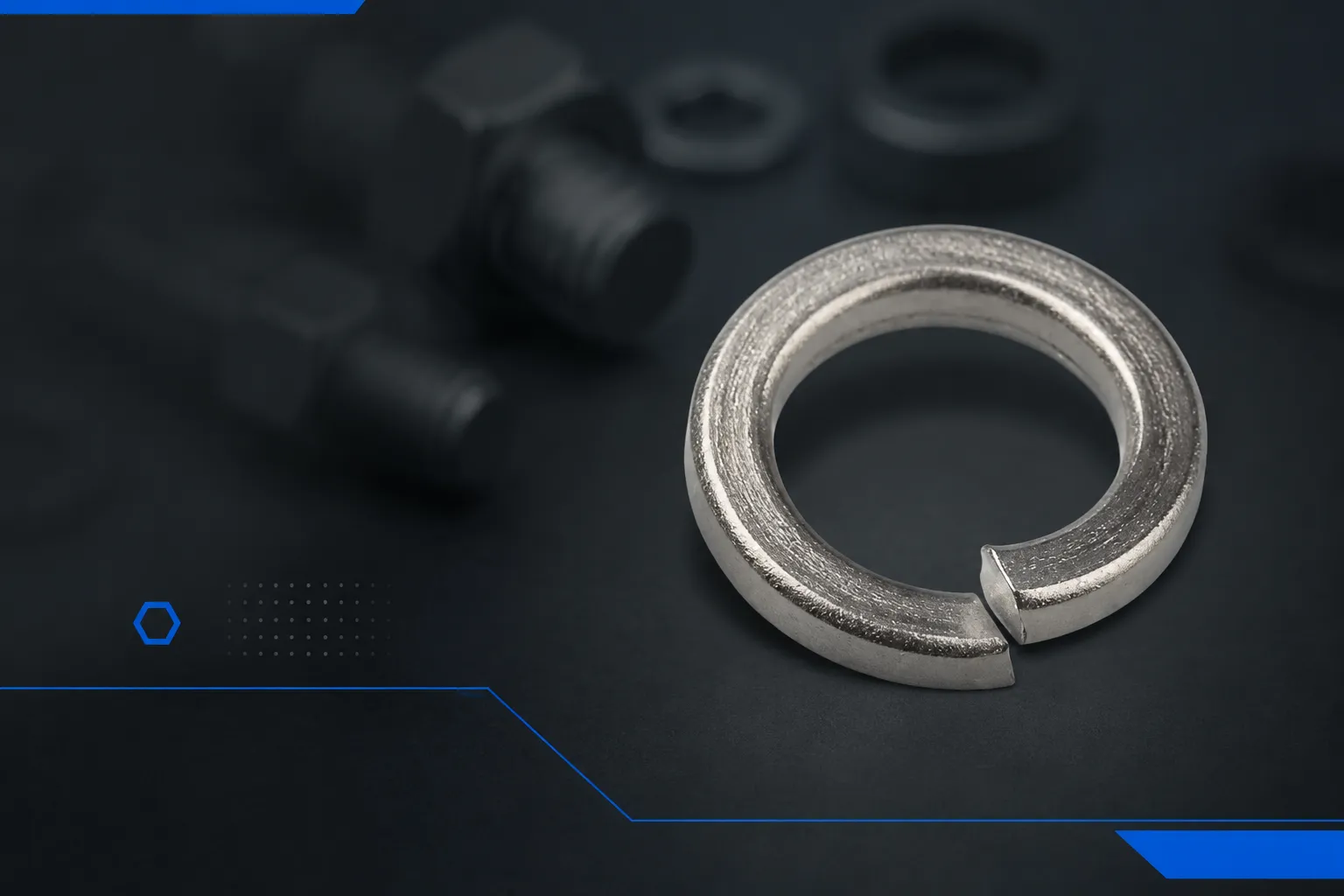
A Belleville element is a conical annular spring that produces a high axial force through a short stroke. In practical belleville spring design, the component is treated as a spring with a nonlinear load-deflection curve rather than as a flat bearing washer. Its purpose may be to maintain bolt preload, compensate for wear or thermal movement, preload a bearing, return an actuator, or protect an assembly from a short overload.
The distinction matters commercially as well as mechanically. The Insight Partners’ 2026 report values the global disc spring market at US$613.91 million in 2025 and projects US$884.32 million by 2034, a 4.14% CAGR; its application segments include fastener preloading, thrust-bearing preload, tolerance-stack mitigation, transportation, construction, aerospace, and energy. That breadth explains why a catalog diameter alone is not a sufficient purchasing specification.
A rigorous belleville washer design defines at least two operating points: minimum force after settlement and maximum force at the hottest or most compressed condition. Both must remain inside the allowable force, stress, travel, and fatigue envelope.
How do geometry and the h0/t ratio shape the force curve?
The four dimensions determine more than whether the washer fits.The essential dimensions are outside diameter De, inside diameter Di, thickness t, and free cone height h0; free overall height is approximately l0 = h0 + t. DIN EN 16984:2017-09 governs calculation, while DIN EN 16983:2017-09 controls quality and dimensions. A sound belleville spring design uses actual toleranced dimensions and material properties.
- Greater thickness raises load capacity sharply, material volume, forming force, and cost.
- The outside-to-inside diameter relationship changes leverage, stress, and guide clearance.
- A larger h0/t ratio increases available travel and makes the load curve more nonlinear.
- A smaller h0/t ratio produces less travel and a stiffer, more nearly linear response.
Ratios near 0.4, 0.75, and 1.3 are useful geometry screens because they illustrate progressively greater cone height; they are not universal limits. Final belleville washer design must use the selected part’s curve and current standard tables. Comparing force at 25%, 50%, and 75% of cone deflection reveals slope changes hidden by one “rated load.”
The working point must avoid both instability and over-flattening.The useful quantity is spring rate around the operating point, k = dF/ds, not merely peak force. Selection near s = 0.75h0 is a common catalog comparison point, not permission to operate there under every cycle, temperature, or material. DIN EN 16984 calculations and DIN EN 16983 fatigue and relaxation requirements set the limit for belleville spring design.For a preload application, the honest answer is that more force is not always safer. An overly stiff belleville washer stack may barely move as the joint settles, while excessive installed deflection may consume the reserve travel needed during thermal cycling. Both errors can produce the same field symptom: insufficient residual clamp load.
How should Belleville washers be stacked in series, parallel, or mixed arrangements?
Parallel stacking raises force without multiplying travel.Parallel discs face the same direction and nest together. For np identical discs, the ideal relationships are Fstack = npFsingle, sstack = ssingle, and kstack = npksingle. Thus, three identical discs in parallel ideally provide three times the single-disc load at the same deflection. This form of belleville washer stack is appropriate when axial space is short and the required load is high.
Nested surfaces slide; friction adds hysteresis and can prevent equal load sharing. DIN EN 16984 provides the calculation framework, while assembly trials should verify force at installed height. A parallel pack saves axial space but may add test time, lubrication control, and guide wear.
Series stacking raises travel without multiplying load.Series discs alternate direction. For ns identical discs, the ideal relationships are Fstack = Fsingle, sstack = nsssingle, and kstack = ksingle/ns. Four discs in series ideally provide four times the travel at the same load. This belleville spring design is useful when the joint must absorb settlement, wear, or thermal growth without a steep load change.
Series columns require guidance against lateral displacement. The drawing should define one concentric guide system, surface finish, diametral clearance, and maximum compressed height; clearance for the belleville washer stack should come from DIN EN 16983 tables and the supplier drawing.
Mixed stacking tunes force and travel together.A mixed configuration uses np discs per parallel packet and ns packets in series. Ideally, Fstack = npFsingle, sstack = nsssingle, and kstack = (np/ns)ksingle. A 2-by-3 arrangement contains six discs, doubles force, and triples travel. Each packet in a mixed belleville washer stack should be identical unless a progressive curve is modeled and tested.
Why do friction, temperature, and tolerances change the calculated result?
DIN EN 16983 addresses dimensional and force tolerances, relaxation, and fatigue because nominal geometry cannot describe a production population. With six discs, thickness and free-height variation can accumulate before temperature and settlement are considered. This tolerance envelope belongs in every belleville washer design and every production belleville washer stack.
- Friction: nested contacts and end seats create different loading and unloading curves; parallel interfaces add hysteresis.
- Temperature: modulus, yield strength, coating behavior, and relaxation change. A room-temperature curve is not a 200°C guarantee.
- Material: 65Mn suits controlled general-industrial use; 51CrV4 under EN 10089 is a stronger cyclic-duty candidate; SS301/302 improves corrosion resistance but still requires temper and temperature review.
- Surface condition: phosphate-and-oil, zinc, passivation, or special coatings alter corrosion and friction. Electrolytic coating of high-strength steel requires hydrogen-embrittlement control.
- Seats and guides: nonparallel seats, burrs, or a tight guide create edge loading.
The hidden cost in belleville washer design is rarely one disc; it is tolerance error, repeated torque checks, leakage, guide damage, or shutdown. ROI is avoided intervention over the service interval, measured against validation cost, inspection labor, lost production, and failure consequence.
Which washer arrangement provides the best engineering value?
| Arrangement | Load and travel | Space efficiency | Compatibility and risk | Cost and TCO implication |
|---|---|---|---|---|
| Single disc | Baseline load and travel | Shortest package | Low friction; limited tuning | Lowest cost when one curve fits |
| Parallel, same direction | Load multiplied; travel unchanged | High load, short space | Sliding friction and hysteresis | Smaller envelope; closer test control |
| Series, alternating | Travel multiplied; load unchanged | Long package | Needs column guidance | Can reduce settlement-related maintenance |
| Mixed | Packets set load and travel | Flexible tuning | Highest assembly-control burden | More engineering; potentially lower TCO |
| Flat washer | No spring travel | Minimal thickness | Distributes pressure; no preload compensation | Low price; unsuitable for elastic compensation |
How do application, material, and cost drivers change the specification?
| Application | Primary design target | Likely arrangement | Standards and material screen | Major cost driver |
|---|---|---|---|---|
| Static flange or pressure-vessel bolting | Clamp load after embedment and heat | Single, parallel, or mixed | DIN 6796; verify temperature and corrosion | Traceability, coating, hot-load validation |
| Valve, brake, or actuator | Repeatable force, stroke, and cycle life | Series or mixed | DIN EN 16984 calculation and DIN EN 16983 quality; screen 51CrV4 | Fatigue tests, presetting, shot peening |
| Bearing preload or automation mechanism | Force despite tolerance and wear | Series | DIN EN 16983 tolerances; screen SS301/302 for corrosion | Force precision and guide finish |
| High-temperature joint | Hot relaxation resistance | Application-specific | DIN EN 16983 plus material hot-data | Alloy, heat treatment, hot-load test |
A purchase drawing should state load at test height, free height, De, Di, thickness, material, heat treatment, finish, temperature, cycle target, orientation, and inspection method. “M20 Belleville washer” leaves too many variables open for reliable interchangeability and is not a complete belleville spring design specification.
Which standards govern disc springs and conical spring washers?
- DIN EN 16983:2017-09 covers disc-spring quality and dimensions, including materials, manufacturing, force tolerances, relaxation, and fatigue. It supersedes DIN 2093 for current European procurement.
- DIN EN 16984:2017-09 governs the force, deflection, and stress model used in belleville spring design.
- DIN 6796:2009-08 covers conical washers for bolted connections and replaced the 1987 edition; it is not a general dynamic disc-spring specification.
- ISO, DIN, and ANSI fastener standards may govern mating hardware and threads; they do not replace spring-specific standards.
Noncompliance can mean an unverified load curve, relaxation, fatigue, interference, traceability gaps, and warranty exposure. The drawing should name the standard and edition; “DIN compliant” without a document number is not a testable requirement for belleville washer design.
How should an engineering team select a Belleville washer stack?
- Define the joint window. Record minimum preload, maximum load, settlement, thermal movement, vibration, and available space.
- Select the single-disc curve. Use DIN EN 16984 and supplier data; keep both operating points within stress, deflection, relaxation, and fatigue limits.
- Build the stack mathematically. Add parallel discs for load and series groups for travel, then include friction, tolerances, seat compliance, and guide clearance in the belleville spring design.
- Match material and finish. Specify temperature, chemicals, salt exposure, coating, lubrication, and hydrogen-embrittlement controls.
- Validate at assembled height. Load and unload the complete belleville washer stack; record force at installed and limit heights.
QIYI Fastener provides belleville washer design and washer manufacturing support for standard and custom-engineered fastening assemblies from its 3,000 m² production facility in Zhejiang, China, backed by more than 20 years of industry experience and end-to-end quality control. Public company information states alignment with ISO, DIN, and ANSI requirements; because no public certificate number is disclosed, buyers should request the current conformity and inspection documents applicable to the quoted part rather than assume a blanket certification.
What do engineers ask before specifying Belleville washers?
What is the difference between a Belleville washer and a disc spring?
The specification decides the function. A DIN 6796 conical spring washer serves bolted connections, usually under static or infrequently varying load; a DIN EN 16983 disc spring carries defined force tolerances, relaxation, and fatigue provisions. Dynamic applications need validated belleville spring design, not selection by bolt size.
How do you stack Belleville washers?
Place discs in the same direction to increase force, alternate them to increase travel, or combine equal parallel packets in series to obtain both. Every belleville washer stack should have controlled orientation, flat seats, suitable guidance, and a verified force-height curve.
How many Belleville washers can be stacked?
There is no universal maximum. Column stability, guide friction, tolerances, heat, and package length set the limit. Ten series discs ideally provide ten times one disc’s travel, but the column still requires an application-specific belleville washer design review and test.
Can Belleville washers prevent bolts from loosening?
They help retain clamp force when settlement or thermal movement unloads a joint, but do not alone prevent rotational loosening under transverse vibration. Correct preload, prevailing-torque hardware, or positive locking may also be required; belleville washer design belongs to the entire joint.
What information is needed for a custom Belleville washer quote?
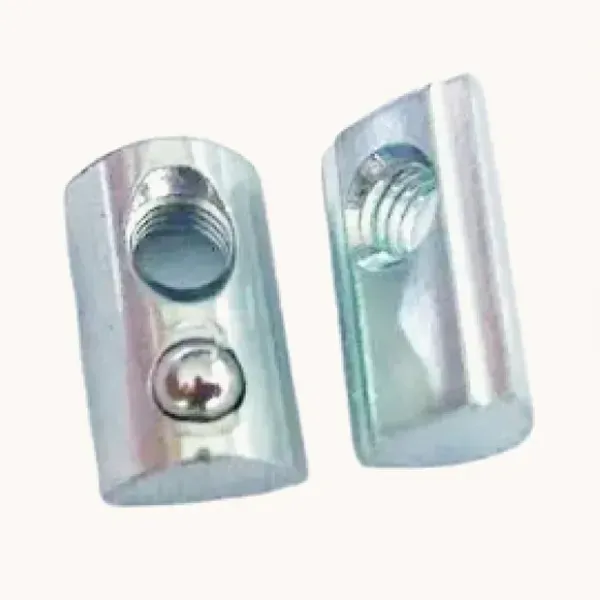
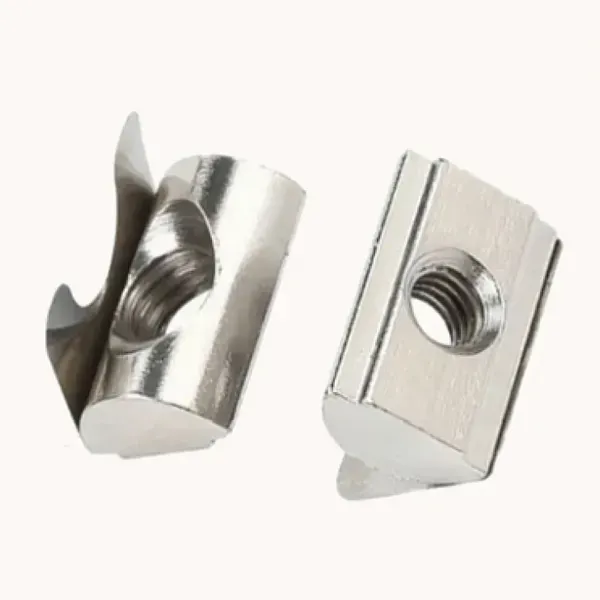
The minimum useful package includes dimensions, force at defined heights, stack arrangement, material and finish, temperature and media, static or dynamic duty, cycle target, quantity, applicable standard, and inspection documents. QIYI Fastener’s standard and custom fastening portfolio also covers bolts, nuts, screws, washers, T-nuts, hammer nuts, spring-ball T-nuts, pivot joints, corner connectors, and base plates for industrial automation assemblies.
Which sources support these engineering and market conclusions?
- DIN Media, DIN EN 16983:2017-09, Disc springs – Quality specifications – Dimensions.
- DIN Media, DIN EN 16984:2017-09, Disc springs – Calculation.
- DIN Media, DIN 6796:2009-08, Conical spring washers for bolted connections.
- The Insight Partners, Disc Spring Market Size, Growth & Trends by 2034.
- DIResearch, Global Disc Springs Competitive Landscape Professional Research Report 2025.
QIYI Fastener builds standard washers and custom-engineered fastening components for that moment. Review the washer product range and contact the engineering team with the required load window, working height, environment, and stack configuration for a manufacturability and quotation review.