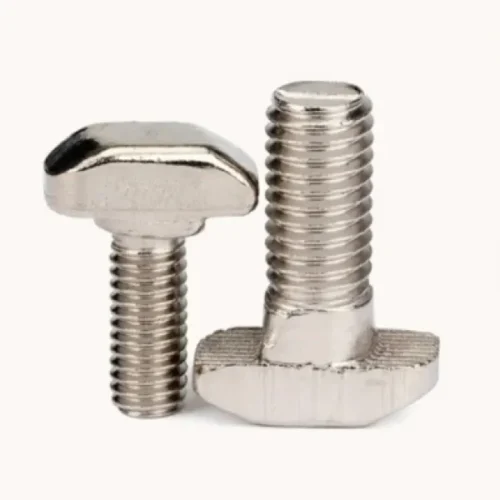
T-slot hammer nuts must match the aluminum profile slot width, the profile series, and the assembly thread before a purchase order is released. A hammer nut that fits the slot but uses the wrong thread, or a correct thread in the wrong slot geometry, will not create a controlled frame joint.
Part 1. What must be confirmed first?
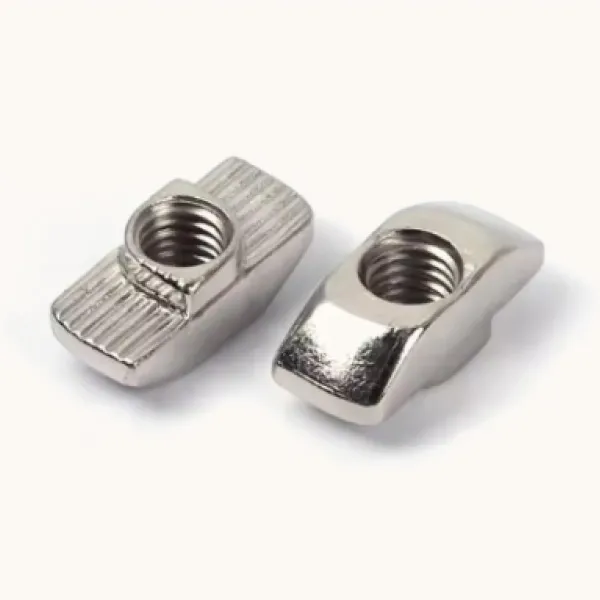
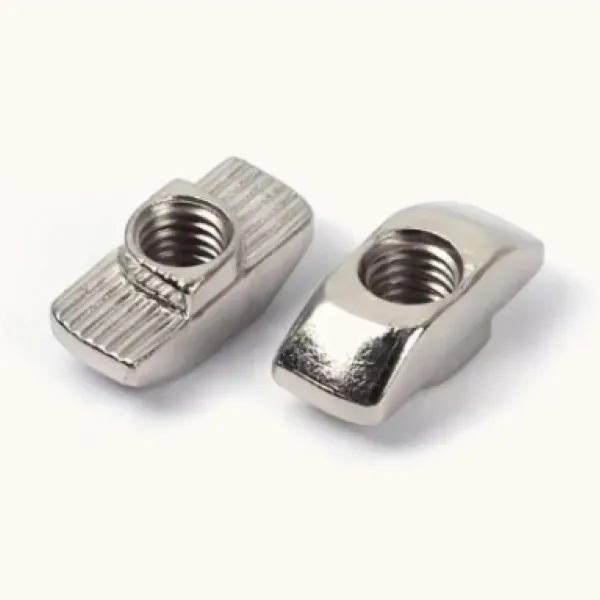
Start with the controlled assembly drawing, not with a generic “T-slot nut” label. A hammer nut is inserted into the open slot, rotated into a capture position, and then tightened against the profile or a bracket. That means three separate inputs must align:
| Input | Why it matters |
|---|---|
| Profile series and slot width | Determines whether the nut body can enter and rotate in the slot |
| Thread size and engagement length | Determines whether the mating bolt or screw can clamp the joint |
| Material and finish | Supports the intended environment and corrosion exposure |
The hammer nut product page lists carbon steel and stainless steel options with zinc or nickel plating and references M3 to M8 thread sizes. Use those statements as the starting catalogue boundary, then confirm the exact model against the project drawing.
Part 2. How do slot width and profile series relate?
Profile series names such as 2020, 3030, and 4040 are useful shorthand in modular frame design, but the purchase decision still depends on the actual slot width and nut geometry shown on the drawing. Two assemblies can use the same nominal series name yet differ in bracket thickness, slot cover, or access orientation.
| Review step | Question for engineering |
|---|---|
| Slot opening | Can the nut be inserted from the intended access side? |
| Rotation clearance | Is there enough room to turn the nut into its locked position? |
| Mating stack | Does bracket or connector thickness change the required thread length? |
| Repeatability | Will the same nut be installed at multiple positions on the frame? |
If the project mixes profile sizes in one frame, create a short compatibility table in the BOM rather than assuming one hammer nut covers every location.
Part 3. Which thread size belongs on the drawing?
Thread size is not interchangeable across the same slot family. Buyers often request M4, M5, M6, or M8 hardware in profile assemblies, but the correct callout must come from the clamp load, mating part thickness, and the threaded feature on the bracket or connector.
| Drawing item | What to show |
|---|---|
| Thread designation | M3, M4, M5, M6, or M8 as required by the joint |
| Engagement length | Usable thread in the nut and the mating component |
| Bolt or screw type | Hex socket, button head, or other head form with clearance notes |
| Quantity and location | Prevents a size-only RFQ with no install context |
When a model code is already approved internally, include it on the RFQ. The site lists examples such as Hammer Nut HN-19-08-08 and Hammer Nut HN-19-10-03 as reference pages for buyer comparison.
Part 4. How is installation checked on the bench?
Before production release, verify the installation sequence on scrap profile or a qualification fixture:
- Insert the nut into the slot at the intended angle.
- Rotate it into the captured position without binding on slot lips or covers.
- Install the mating fastener and confirm that the joint closes evenly.
- Check whether the nut stays positioned during repeated assembly and disassembly.
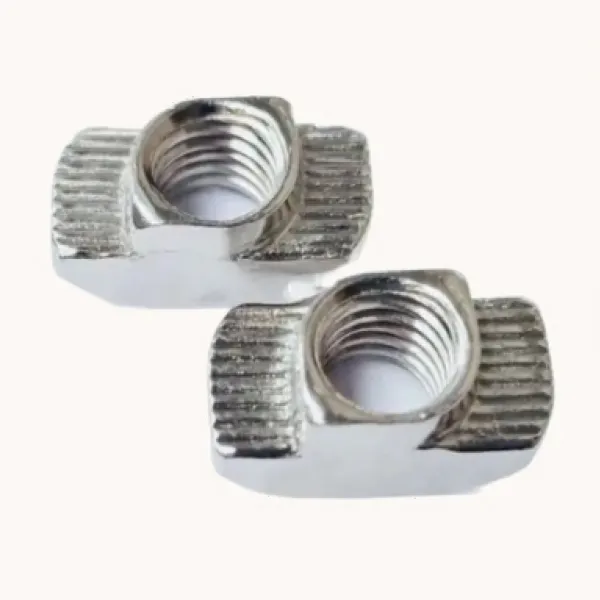
Document any interference with slot covers, cable channels, or adjacent brackets. Those details are often missing from a size-only quotation request but they determine whether the selected nut is usable in the real frame.
Part 5. What belongs on the RFQ?
| RFQ field | Example of useful detail |
|---|---|
| Profile drawing or slot width | Controlled dimension, not only a series nickname |
| Thread and quantity | M6 x location count, etc. |
| Material / finish | Carbon steel zinc plated, stainless steel, nickel plated |
| Model code if known | HN-19-08-08 or equivalent internal part number |
| Application | Machine guard, workstation, enclosure, solar frame, etc. |
Explain whether the nut must be installed after the frame is partially assembled. That access condition can eliminate an otherwise correct size.
Part 6. Fit Boundary
Do not choose a hammer nut when the assembly needs a slide-in nut for post-assembly installation, a spring-loaded T-nut for repeated repositioning, or a connector system that defines the joint without slot hardware. Likewise, do not assume every profile series in a catalogue shares one nut geometry.
Material and finish selection supports environmental suitability, but it does not by itself prove load capacity, vibration performance, or compliance with a project standard. Those items belong to the approved design and test process.
Part 7. Product recommendation and next step
Review the hammer nut product page against the drawing, then browse the wider product center if the frame also needs T-bolts, connectors, or brackets. For a quotation, send the profile series, slot width, and thread callout with quantity breaks and the required finish.
FAQs
What is a hammer nut in a T-slot profile?
It is a nut that enters the profile slot, rotates into a captured position, and accepts a mating bolt or screw to clamp a component to the frame.
Can one hammer nut fit every aluminum profile?
No. Slot width, profile series, and thread size must all be confirmed against the drawing.
Do 2020, 3030, and 4040 frames use the same slot hardware?
Not automatically. Use the controlled slot dimension and approved model code for each assembly.
What thread sizes are commonly requested?
The hammer nut product page references M3 to M8 thread sizes; the drawing should define the exact callout required.
Should I specify zinc or nickel plating?
Specify the finish required for the environment. The product page lists zinc and nickel plated options for carbon steel parts.
What if I need stainless steel?
State that requirement on the RFQ if corrosion exposure or material compatibility is part of the design basis.