When a procurement manager in Detroit encountered repeated spindle vibration on a new machining line, he reviewed the assembly guide, accepted a low-cost quotation, and approved the replacement parts with confidence. Within three weeks, two housings ran hot, inspection found fretting marks, and the maintenance team had to rebuild 48 units. The springs were not defective. The specification was: the purchase order named a spring by size, but never defined the required preload force, working height, tolerance stack, or thermal movement. That failure raises the practical question this guide answers: how should a buyer select a bearing spring or a bearing preload spring for a real industrial assembly?
Summary: A reliable preload system begins with force at installed height—not free height alone. Buyers should calculate the axial movement window, confirm bearing limits under ISO 281 and ISO 492, then specify spring load, deflection, material, fatigue life, and inspection evidence. Disc springs suit high force in short spaces; wave springs suit moderate force where axial height matters. A controlled prototype test is usually cheaper than correcting heat, noise, wear, and downtime after production release.
Why Has Bearing Preload Spring Selection Become a Procurement Priority?
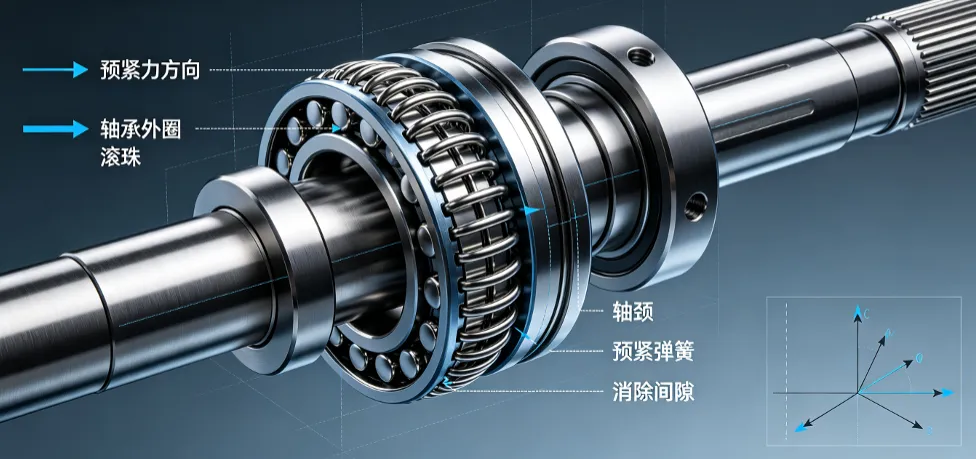
A bearing spring applies an axial force that removes unwanted internal clearance or maintains contact as parts expand, wear, or shift. A bearing preload spring performs the same functional duty but is normally selected around a defined preload target rather than treated as a general cushioning component. In practice, both terms may describe disc springs, wave springs, coil springs, or purpose-made spring washers installed beside a rolling bearing.
The commercial context matters. Research and Markets reports that the industrial fasteners market is projected to rise from USD 91.04 billion in 2025 to USD 115.67 billion by 2032, representing a 3.48% compound annual growth rate.
That scale does not make every component interchangeable; it increases the number of suppliers, materials, tolerance systems, and certificates a procurement team must compare. The China National Hardware Electric and Chemical Commercial Association also serves a broad hardware production and distribution community, reinforcing the importance of traceable specifications in cross-border sourcing.
For an engineer, preload is a force problem. For a procurement manager, it is also a documentation, repeatability, and total-cost problem. A drawing that states only outside diameter, inside diameter, and thickness leaves the manufacturer to guess the most important output: the load-deflection curve.
Recommended original image: a real inspection-bench photograph showing a disc spring, wave spring, rolling bearing, height gauge, and force tester.
Alt text: “Force-at-height inspection of disc and wave springs for an industrial bearing assembly.”
How Does a Bearing Spring Create and Maintain the Required Preload?
A preload component has to maintain an acceptable axial force as manufacturing tolerances, temperature, wear, and operating loads change. Selecting it therefore requires more than matching its outside diameter to the available housing space.
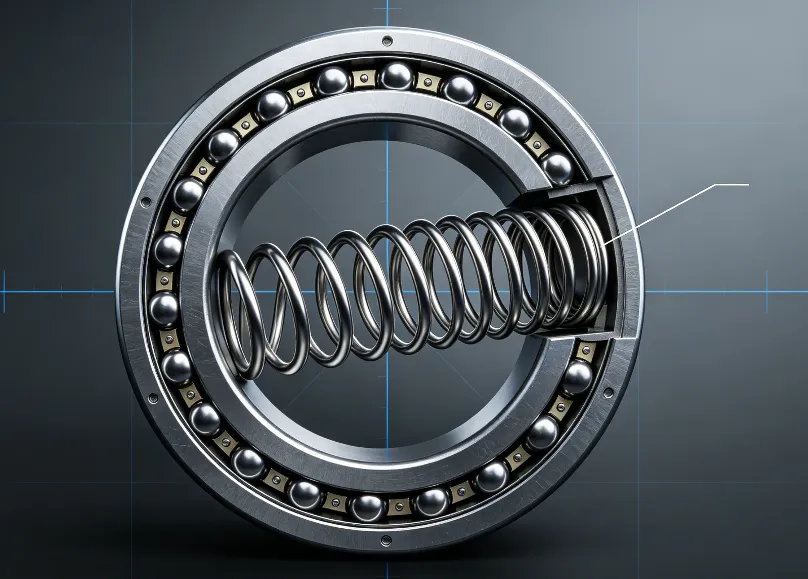
The buyer and engineer must establish four basic parameters:
- Required axial force
- Installed working height
- Minimum and maximum operating deflection
- Acceptable force variation across that deflection range
These parameters determine whether a disc, wave, coil, or custom spring geometry is appropriate.
Why Should a Bearing Preload Spring Be Specified by Force at Installed Height?
Within a linear working range, the basic relationship is:
F = k × x
Here, F is axial force in newtons, k is spring rate in N/mm, and x is deflection in millimetres.
A disc spring is often nonlinear, so one nominal spring-rate value cannot describe its entire stroke. The purchase specification should therefore state at least two verification points—for example, load at installed height and load at maximum operating deflection—rather than relying on free height.
The bearing supplier must define the acceptable preload window. ISO 281:2007 provides methods for calculating rolling-bearing dynamic load ratings and rating life, while ISO 492:2023 defines geometrical product specifications and tolerance values for radial bearings.
Neither standard supplies a universal preload percentage. The honest answer is that a 100 N target may be conservative in one small spindle and destructive in another; speed, lubrication, bearing arrangement, heat flow, and external load all change the result.
A functional specification could state:
- Load at 10.50 mm installed height: 300 N ±10%
- Load at 10.20 mm compressed height: 410 N maximum
- Minimum working height: 10.10 mm
- Maximum working height: 10.80 mm
- Required fatigue life: 1 million cycles
- Test temperature: 23°C unless otherwise specified
This information gives the manufacturer measurable acceptance criteria and gives the buyer a reliable basis for comparing quotations.
How Should Engineers Calculate the Working Travel of a Bearing Spring?
The working deflection is not simply the nominal gap shown on an assembly drawing. It is the sum of assembly and operating movements:
- Housing and shaft tolerances
- Bearing-width variation under the applicable tolerance class
- Thermal growth between hot and cold states
- Cover, shim, and shoulder variation
- Wear, settling, and coating thickness
- Installation error and service adjustment
If the nominal spring deflection is 0.40 mm but the worst-case movement is ±0.25 mm, the actual operating window extends from 0.15 to 0.65 mm. The supplier must demonstrate acceptable force at both limits.
This calculation prevents a common failure: a preload component that looks correct during room-temperature assembly but becomes nearly solid after the housing reaches operating temperature.
Thermal movement deserves particular attention. A steel shaft and an aluminium housing do not expand at the same rate. Over a long assembly, even a modest temperature increase can change axial position enough to move the spring into a much steeper region of its load-deflection curve.
The calculation should therefore consider:
- Minimum assembly temperature
- Maximum operating temperature
- Coefficients of thermal expansion
- Effective expansion length
- Direction of shaft and housing movement
- Resulting change in spring height
An engineering team that ignores these variables may approve a part that performs correctly on an inspection bench but overheats the bearing in service.
Which Bearing Spring Geometry Best Matches the Required Force and Travel?
A disc-style component generates high axial force in a short envelope. A wave spring usually offers more travel and a flatter load change for the same axial space. A coil spring can accommodate substantial movement, although its solid height and need for guidance may be impractical in compact housings.
Disc springs can also be stacked. In an idealized stack, parallel orientation multiplies load, while series orientation multiplies travel. If nₚ springs act in parallel and nₛ stages act in series, the approximate equivalent rate is:
k_stack ≈ (nₚ / nₛ) × k_single
For example:
- Two discs in parallel provide approximately twice the load of one disc at the same deflection.
- Two discs in series provide approximately twice the travel at roughly the same load.
- A combined series-parallel stack can increase both load capacity and usable movement.
Friction at the contact faces makes the real loading and unloading curves differ, so prototype testing is still required. Lubrication, surface finish, edge condition, and guiding method all influence stack behavior.
DIN EN 16983 classifies disc springs by dimensions and quality requirements, while DIN EN 16984 addresses calculation. A drawing should identify the governing edition rather than casually calling out legacy DIN 2093.
How Should the Material of a Bearing Preload Spring Match the Operating Environment?
Material selection should follow temperature, corrosion, relaxation, and cycle requirements—not appearance.
Standard spring steels are economical for controlled industrial environments. Stainless grades improve corrosion resistance but do not automatically match the force or fatigue performance of carbon spring steel. Nickel-based alloys such as Inconel 718 may be considered for demanding heat and corrosion conditions, with application-specific validation at temperatures that can approach 650°C.
For every material, the specification should define:
- Material grade and approved equivalent grades
- Heat treatment and hardness range
- Surface finish and coating
- Hydrogen-embrittlement controls where relevant
- Force at specified test heights
- Fatigue target in cycles and test amplitude
- Corrosion or salt-spray requirement
- Lot traceability
- Inspection-report format
A small change in thickness can create a much larger change in force, particularly with disc geometry. That is why nonstandard parts should be qualified by measured load-deflection data, not by dimensional inspection alone.
Coating selection also requires caution. Electroplating may improve corrosion resistance, but the plating process can introduce hydrogen-embrittlement risks in hardened spring steel. The drawing or quality agreement should therefore state whether baking, process control, or an alternative coating is required.
How Does a Bearing Spring Compare With Other Preload Methods?
The correct choice is not the component with the lowest unit price; it is the method that maintains the intended force across the full tolerance and temperature window.
| Preload method | Force and travel behavior | Space efficiency | Assembly control | Typical hidden cost | Best-fit use |
|---|---|---|---|---|---|
| Disc spring | High force, short travel, nonlinear curve | Excellent axially | Good when height is controlled | Stack friction and overload near the flat condition | Compact gearboxes, motors, clutches, and spindle supports |
| Wave spring | Moderate force, useful travel, relatively smooth response | Very good | Good; fewer stacked parts | End overlap, wave count, and installed-height variation | Electric motors, pumps, and precision housings |
| Coil spring | Broad travel, usually near-linear | Lower | Requires a pocket or guidance | Buckling, solid height, and extra housing length | Large-movement or adjustable mechanisms |
| Shim or solid spacer | Fixed displacement with no compliance | Excellent | Highly tolerance-sensitive | Selective assembly and loss of preload after thermal change | Stable, tightly controlled precision assemblies |
| Threaded or nut adjustment | Adjustable during assembly | Moderate | Operator- and torque-dependent | Labour, locking method, and field variation | Serviceable equipment and low-volume builds |
A disc solution is usually preferred when axial space is limited and force demand is high. A wave solution may be more suitable when the assembly needs additional movement without a dramatic increase in load.
A solid shim costs less per part, but it cannot compensate for thermal expansion or wear. A threaded adjustment allows field calibration, but it introduces operator variation and requires a dependable locking method.
The total-cost comparison should therefore include more than purchase price:
TCO per assembly = part cost + inspection cost + assembly labour + expected rework + downtime exposure + emergency freight
Suppose a cheaper spring saves USD 0.12 per unit across 20,000 assemblies; the annual saving is USD 2,400. One eight-hour line stop at USD 1,500 per hour costs USD 12,000 before rework, replacement bearings, or expedited shipping.
The ROI case for a qualified preload component is therefore not premium versus economy—it is controlled force versus uncontrolled risk.
Where Should a Bearing Preload Spring Be Used, and What Drives Its Cost?
The same product description can conceal very different engineering requirements. Procurement teams should classify the application before requesting quotations.
| Application | Primary preload objective | Risk if force is too low | Risk if force is too high | Main cost driver |
| Electric motor | Reduce noise and accommodate axial thermal movement | Rattle, skidding, and inconsistent rotor position | Heat and shortened bearing life | Force consistency at two temperatures |
| Machine-tool spindle | Increase stiffness and running accuracy | Chatter, poor surface finish, and axial movement | Rapid heat generation at speed | Tight force tolerance and fatigue validation |
| Pump or compressor | Maintain contact under vibration and load change | Fretting and intermittent contact | Seal distortion and excess friction | Corrosion resistance and traceability |
| Gearbox | Control shaft location and compensate for tolerance stack | Gear misalignment and noise | Bearing overload and power loss | Stack design and assembly poka-yoke |
| Construction or mobile equipment | Survive shock, dirt, and service variation | Loosening and impact loading | Reduced compliance under shock | Coating, material toughness, and field replaceability |
Price normally increases with:
- Tighter load tolerance
- Special alloys
- Low-volume tooling
- Fatigue testing
- Heat-treatment controls
- Special coatings
- Individual part traceability
- Third-party inspection
- Detailed export documentation
A custom component with ±5% load tolerance will generally require more process control than one accepted at ±15%. However, the tighter value has no commercial benefit unless the bearing analysis proves it is necessary.
We recommend buying the tolerance the assembly needs—no looser, and no tighter.
Annual volume also changes the sourcing strategy. A low-volume custom project may rely on laser-cut blanks and flexible tooling, while a high-volume automotive or motor program may justify progressive tooling, automated heat treatment, and in-line load inspection. The lowest prototype quotation is not always the lowest production cost.
Which Standards and Compliance Documents Apply to a Bearing Spring?
Compliance begins by separating bearing requirements from spring requirements. The following framework is suitable for an international request for quotation:
| Requirement area | Relevant reference | Procurement implication |
| Bearing rating life | ISO 281:2007 | Confirm that preload and operating load are included in the bearing-life assessment |
| Radial-bearing geometry and tolerances | ISO 492:2023 | Align fit, clearance, and tolerance assumptions with the bearing class |
| Metric radial bearings for the U.S. market | ANSI/ABMA 20-2025 | Check boundary dimensions, tolerances, and radial internal clearances where specified |
| Disc spring dimensions and quality | DIN EN 16983 | Define dimensional series, quality requirements, and inspection basis |
| Disc spring calculation | DIN EN 16984 | Document calculation assumptions for force, stress, and stacking |
A supplier statement that a product is “standard” is not enough. The purchase order should identify:
- Standard number and edition
- Material grade
- Drawing revision
- Load and height requirements
- Inspection level
- Sampling method
- Required test records
- Rules of precedence when requirements conflict
Failure to define these items can result in rejected first-article inspection, delayed customs or customer approval, unplanned sorting, and warranty disputes about who owned the missing requirement.
For export projects, the document pack may also need:
- Certificate of Conformance
- Certificate of Analysis
- Origin documentation
- Insurance documents
- Material certificates
- Dimensional inspection reports
- Load-test records
Those documents do not replace engineering validation; they prove that the delivered lot corresponds to the approved specification.
How Should Buyers Specify and Source a Bearing Preload Spring?
A qualified sourcing process should connect the engineering requirement, supplier capability, inspection plan, and final assembly test. Separating these activities creates gaps in which an apparently compliant part can still fail in service.
Why Should a Bearing Preload Spring RFQ Define Function Instead of Size Alone?
The RFQ should include:
- Bearing type and arrangement
- Shaft speed
- Radial and axial loads
- Lubrication method
- Minimum and maximum temperatures
- Available installation envelope
- Target preload
- Minimum and maximum working heights
- Fatigue-life expectation
- Annual purchasing volume
- Applicable standards
- Required inspection and export documents
If the application information is confidential, a redacted interface drawing is still more useful than a physical sample without operating data.
Buyers evaluating standard and custom fastener options should ask whether the manufacturer can translate these inputs into a controlled drawing, production route, and inspection plan.
Yueqing Qiyi Fastener Co., Ltd. provides standard and tailored components with ISO, DIN, and ANSI compliance support. It can also supply Certificates of Conformance, Certificates of Analysis, origin documentation, insurance documents, and related export records when specified in the order. The exact certification scope should always be confirmed against the drawing and purchase requirements.
Why Should Buyers Approve Bearing Spring Force Data Before Appearance?
At least 5 to 10 prototype pieces should be measured at the minimum, nominal, and maximum working heights.
The report should identify:
- Test-machine model
- Calibration status
- Fixture arrangement
- Compression rate
- Test temperature
- Loading or unloading direction
- Individual measurement results
- Average, minimum, and maximum values
A golden sample is useful, but the signed load-deflection report is the real acceptance baseline. Surface colour, plating brightness, and cosmetic consistency cannot demonstrate whether a spring will provide the required axial force.
If fatigue is important, static samples alone are insufficient. The prototype plan should specify the cycling frequency, minimum and maximum deflection, number of cycles, test temperature, and acceptable force loss after testing.
How Should the Complete Tolerance Chain Be Reviewed Before Bearing Spring Approval?
Spring tolerance cannot repair an uncontrolled housing. Engineering should combine the bearing, shaft, housing, cover, spacer, coating, and spring limits in one worst-case or statistical tolerance stack.
The review should answer four questions:
- What is the maximum installed compression?
- What is the minimum installed compression?
- How does temperature change those values?
- Does the resulting force remain within the bearing supplier’s limits?
For drawing-based interfaces beyond catalogue hardware, the manufacturer’s custom component capability should be reviewed together with tooling ownership, change control, gauge strategy, and prototype lead time.
A supplier may hold the spring dimensions within tolerance while the assembly still fails because the housing depth, bearing width, or cover position varies too widely. Responsibility for the complete stack must remain with the assembly owner.
Which Lot Records and Change Controls Protect Bearing Preload Spring Quality?
The order should state which documents accompany every shipment and which production changes require written approval.
Controlled changes should include:
- Material substitutions
- Steel-mill changes
- Heat-treatment source changes
- Coating-process changes
- Tooling replacement
- Tooling relocation
- Inspection-equipment changes
- Subcontractor changes
- Packaging changes that could cause deformation
These changes can alter performance even when outside and inside diameters remain within tolerance.
The supplier’s company and quality background should support—not replace—lot-specific evidence. A general company certificate cannot prove that a particular shipment meets the agreed force-at-height requirement.
Why Must a Bearing Preload Spring Be Validated in the Final Assembly?
The final test belongs in the real housing. The validation plan should record:
- Startup torque
- Axial displacement
- Temperature rise
- Vibration
- Noise
- Stabilization time
- Power consumption
- Contact marks after disassembly
Testing should cover minimum and maximum operating conditions. When possible, the engineering team should compare the prototype with a control assembly using the existing approved component.
A preload component is qualified only when the assembly behaves correctly. A laboratory force reading is necessary, but it is not the finish line.
Which Sources Support Bearing Spring and Bearing Preload Spring Selection?
- Research and Markets — Industrial Fasteners Market by Material, Type, Product, Application, Sales Channel, and Region, Global Forecast to 2032
- ISO 281:2007 — Rolling bearings: Dynamic load ratings and rating life
- ISO 492:2023 — Rolling bearings: Radial bearings, GPS and tolerance values
- ANSI/ABMA 20-2025 — Radial Bearings of Ball, Cylindrical Roller and Spherical Roller Types, Metric Design
- China National Hardware Electric and Chemical Commercial Association
Yueqing Qiyi Fastener Co., Ltd. builds standard and drawing-based fastening components for that decision point, including bolts, nuts, screws, washers, and custom hardware for industrial assemblies. To discuss a preload spring or related custom component with QIYI FASTENER, visit https://qiyifastener.com and share the application drawing, load window, applicable standard, and required export documents.