When a maintenance engineer in Sheffield encountered repeated bolt-load loss on a hot pump flange, she increased the washer count, recorded a short-lived recovery, and then watched the joint relax again after the next thermal cycle. The visible failure looked like a weak washer; the reversal came when a force-deflection review showed that the selected stack had been treated as linear and had reached its usable travel too early. The root cause was stack sizing and verification, not simply a bad product.
Summary: A belleville disc spring calculator is most useful when it predicts the working portion of a nonlinear curve, not just one nominal load. For an initial design, compare force at three or more deflection points and keep a defined reserve before flattening; then validate the selected stack with representative parts. DIN 2092 calculation practice and the DIN 2093 dimensional framework are commonly requested references, while a hardness result under ISO 6508-1 is a test result, not blanket proof of spring performance. The practical action is to model one disc first, translate the requirement into series and parallel groups, and test the assembled stack at its real temperature and travel.
A belleville disc spring calculator turns a curve into a design decision
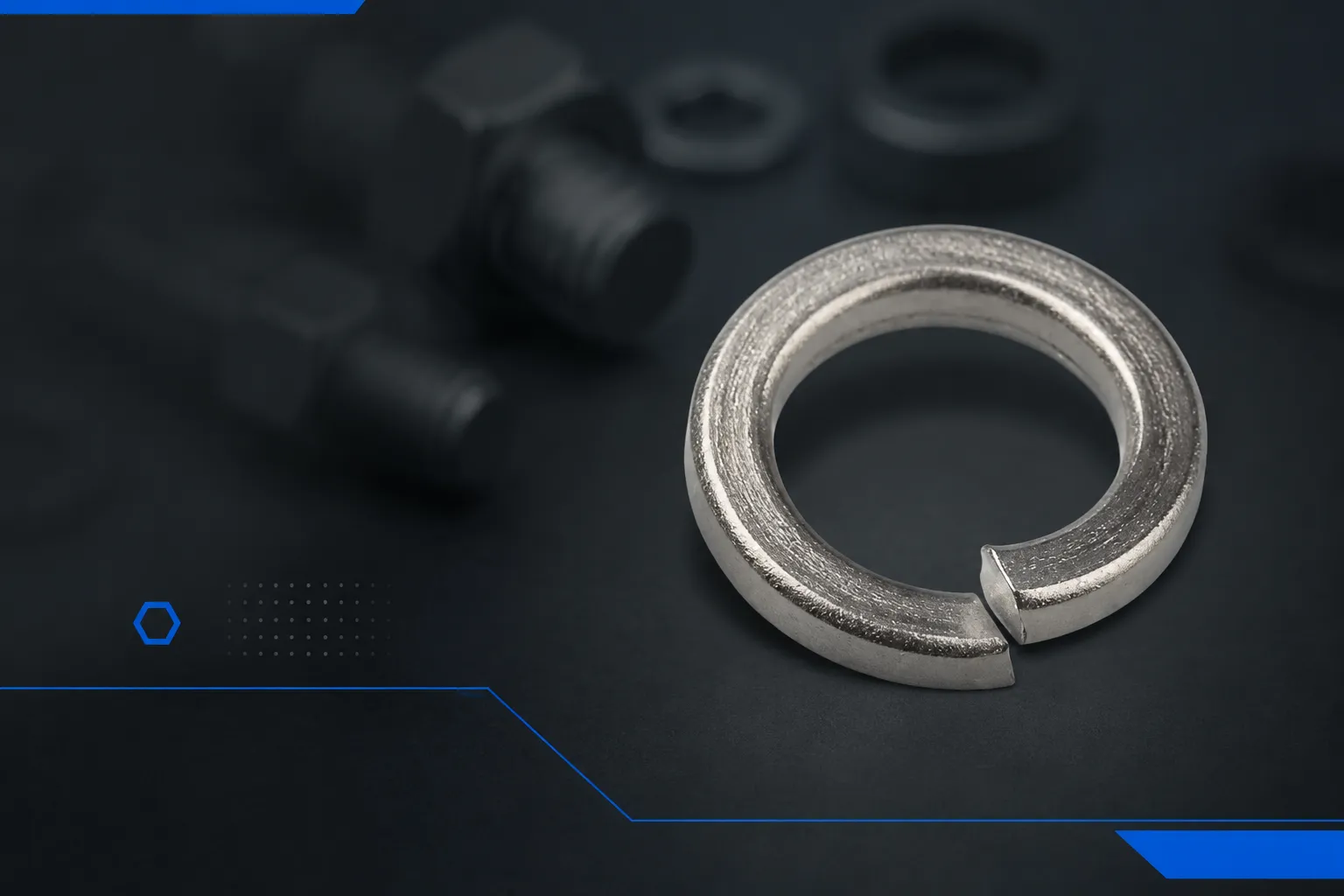
Disc springs, often called Belleville washers, provide high force in limited axial space. That makes them valuable for bolted joints, valves, clutches, tooling, and equipment that sees settlement or temperature change. A disk spring calculator should therefore be a traceable engineering aid, paired with material, dimensional, and load-test evidence.
A belleville disc spring calculator starts with outside diameter, inside diameter, thickness, free cone height, material assumptions, and the intended deflection. Those inputs describe a conical spring, not a simple coil spring. As the disc is pressed, the lever geometry changes, so the force-deflection response may rise sharply, flatten over part of its travel, or become sensitive to small dimensional changes. The useful output is a curve with stated assumptions, not an isolated force value.
For a practical first pass, record force at 25%, 50%, and 75% of the chosen working deflection, along with the deflection at which the disc approaches flat. Three points expose a misleading average spring rate that a single-point calculation can hide. Where DIN 2092 is contractually or technically relevant, use the applicable edition and its stated calculation conventions; it is more defensible than silently mixing catalog equations from different sources.
What spring rate means on a nonlinear curve
Spring rate is the slope of force against deflection. On a disc spring it is usually a local value: the tangent rate near one operating point can differ materially from the secant rate calculated across a wider travel. That distinction matters when a bolt joint needs a predictable clamp-load change after settlement. A belleville washer spring rate should therefore be reported with its deflection interval, temperature, and stack arrangement rather than as an unqualified number.
Illustrative calculation: if a single disc rises from 2.0 kN at 0.20 mm to 3.2 kN at 0.40 mm, its secant rate across that interval is 6 kN/mm. That does not prove its rate at 0.50 mm or its behavior after cycling. Measure load and displacement on a calibrated compression test setup; compare the resulting curve with the drawing assumptions and investigate a meaningful mismatch before scaling to a larger stack.

Use a disk spring calculator to model the nonlinear force-deflection curve
A disk spring calculator should show whether its curve is based on an ideal single disc, a catalog tolerance band, or a measured sample. Geometry is especially influential: the ratio of free height to thickness affects curve shape, while diameter ratio and material modulus influence load. Friction, nesting contact, surface condition, and guide clearances can change the assembled response. Treat a precise-looking decimal as an estimate unless those conditions have been defined.
For dynamic or safety-critical service, ask for a calculation range and a validation plan rather than a nominal point. A useful test sequence has a zero reference, defined loading rate, load-displacement recording, and enough cycles to reveal seating or permanent set appropriate to the duty. Schnorr’s technical discussion of disc springs is a helpful industry reference for the form and typical behavior; a supplier’s data must still be assessed against the actual application.
Inputs that calculators often simplify
- Actual thickness and free height within the agreed tolerance.
- Elastic modulus at operating temperature, not only room temperature.
- Friction between contacting discs and the effect of lubricant or coating.
- Edge loading, guide clearance, and whether the stack can stay concentric.
- Relaxation, corrosion, and cyclic fatigue risks over the intended duty.
These are not reasons to abandon a calculator; they are the boundary conditions that make its result commercially useful.
The belleville washer spring rate changes with geometry, material, and travel
The phrase belleville washer spring rate is often used as if one value applies from free height to flat. A better specification gives a load window, a deflection window, and a permitted tolerance. A disc can have an acceptable force at one checkpoint yet provide too much or too little incremental stiffness where the assembly actually operates. The requested property is consequently a system property when several discs work together.
Material and heat treatment affect strength, modulus, and resistance to set. Hardness testing can support material-control discussions, but ISO 6508-1 describes the Rockwell test method; it does not certify a finished spring design, load curve, coating, or application life. If a buyer needs traceability, specify what evidence is required: dimensions, material declaration, heat-treatment records where applicable, hardness method, load-deflection test points, and lot identification.
| Check | What the calculation can indicate | What still needs confirmation | TCO consequence |
|---|---|---|---|
| Nominal load | Likely force at stated deflection | Measured tolerance range and test method | Avoids buying a stack that misses clamp-load target |
| Working rate | Local or secant slope across a range | Settlement, temperature, and friction effects | Reduces retorque and service intervention risk |
| Stack height | Free and compressed package estimate | Guidance, clearance, and assembly tolerance | Prevents late enclosure or bolt-length changes |
| Durability | Whether travel is near a high-stress region | Duty-cycle testing and environmental exposure | Limits unplanned replacement and investigation work |
A belleville disc spring calculator clarifies series, parallel, and mixed stacks
A belleville disc spring calculator must distinguish orientation. In a parallel group, discs face the same direction and share deflection; the group carries higher force at approximately the same travel as one disc, subject to friction and tolerance effects. In a series stack, adjacent discs oppose each other; travel increases while the idealized rate decreases. Mixed stacks place parallel groups in series so designers can tune force and travel together.
For identical discs in an illustrative linearized operating range, n discs in parallel have roughly n times the single-disc rate, while m identical discs or groups in series have roughly one divided by m of the group rate. Use this only as a local check; it is not a substitute for calculating each disc on its nonlinear curve. A disk spring calculator that simply multiplies one catalog number can overstate confidence at the ends of travel.
| Arrangement | Primary design effect | Typical use | Validation focus |
|---|---|---|---|
| Single disc | Baseline force and short travel | Compact preload adjustment | Curve checkpoints and guide fit |
| Parallel group | Higher force at similar travel | High-load bolt or clamping duty | Nested contact, friction, and force spread |
| Series stack | More travel and lower local rate | Settlement or thermal movement compensation | Orientation, height, and buckling control |
| Mixed groups | Balanced force and available travel | Constrained assemblies with defined load window | Group matching, assembly sequence, full-stack test |
Before approving a stack, sketch every orientation and show the load path on the drawing. Then compare calculated free height, installed height, and worst-case compressed height with the hardware envelope. The related guide to washer stacking engineering principles is useful when the arrangement needs a clearer visual design review.
Compare a disk spring calculator with test data before release
A disk spring calculator is reliable enough for screening when the inputs match the product and the result remains inside a stated working range. It becomes less reliable when it is asked to predict coating friction, a nonstandard geometry, near-flat operation, elevated-temperature relaxation, or a stack with inconsistent orientation. The honest answer is that the calculation should set the test plan, not replace it.
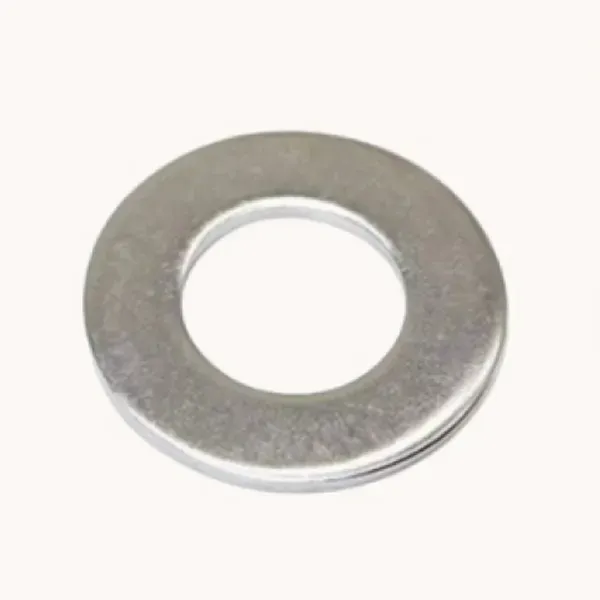
Start validation with a defined sample quantity agreed for the risk level, a calibrated load cell, and displacement measurement referenced to a repeatable datum. Compare the measured curve at the same three or more checkpoints used in calculation. If the buyer is considering a flat part instead of a conical spring, the flat-washer product photo below is a useful visual reminder: a flat washer distributes load, but it does not provide the planned conical-spring travel.

For application context beyond the calculation screen, see these disc spring uses and applications. The application determines whether static load checking is sufficient or whether cycling, corrosion, temperature, and traceability evidence should be added.
Standards keep a belleville washer spring rate claim defensible
Standards should be named for their actual role. DIN 2092 is widely associated with disc-spring calculation conventions; DIN 2093 is widely used for dimensions and quality requirements for standardized disc springs. Contract documents should identify the required edition, dimensions, tolerances, material condition, test points, and acceptance criteria. Do not imply that a calculation alone creates compliance.
The ISO Online Browsing Platform entry for ISO 19690-2 should be checked directly before it is cited in a specification, because scope and edition control applicability. ISO 6508-1 is specifically a Rockwell hardness test method. A hardness reading can be relevant evidence, but it cannot by itself substantiate a belleville washer spring rate, fatigue life, or conformity claim. Destination market, end use, and any marketing language determine which declarations or test reports are commercially necessary.
Specify a belleville disc spring calculator input set before requesting parts
- Define required minimum and maximum force at named installed heights, not only a target force.
- State allowable axial travel, envelope, guide arrangement, temperature, and expected cycles.
- Choose series, parallel, or mixed orientation from the required force-travel window, then document the sequence.
- Request agreed dimensions, material and surface condition, inspection records, and load-deflection checkpoints.
- Run a representative assembly test before releasing a critical or high-volume configuration.
QIYI Fastener can support a sourcing conversation when the buyer brings this input set, especially where configurable washer dimensions, stack documentation, or sample-based checks are needed. For a practical input workflow, review the Belleville washer calculation guide before asking for a quotation.
These are questions buyers ask about a disk spring calculator
Is a disk spring calculator accurate enough to select a part?
It is appropriate for preliminary selection and for comparing configurations when dimensions, material assumptions, and deflection range are known. Confirm final critical designs with measurement on representative parts, particularly when the stack operates near full compression or under changing temperature.
How do I calculate a belleville washer spring rate for a stack?
First establish the nonlinear curve of one disc at the intended travel. Then model parallel groups as higher-force groups and series groups as greater-travel groups, and validate the complete arrangement because contact friction and tolerance accumulation affect the result.
Can I use a belleville disc spring calculator for a bolt joint?
Yes, provided the model includes the joint’s installed height, expected settlement, temperature, and allowable clamp-load range. The calculation must be considered alongside bolt stiffness and the rest of the joint, not as an isolated washer exercise.
Why does my measured stack force differ from the calculator?
Common causes include actual thickness or free-height variation, a different material modulus, friction between discs, measurement reference errors, or an orientation mistake. Compare the same deflection points under a documented test setup before deciding whether the calculation or the sample is outside expectation.
Is a higher belleville washer spring rate always better?
No. A high local rate can resist movement, but it may also consume the usable load window quickly when settlement or thermal growth occurs. Select the rate that supports the joint’s required force range throughout its expected movement.
These references validate belleville washer spring rate data
- ISO Online Browsing Platform: ISO 19690-2
- ISO 6508-1: Rockwell hardness test method
- Schnorr: standard disc springs
- Schnorr: disc spring expertise and technology
Use a belleville disc spring calculator, then prove the stack in service.The memorable rule is simple: calculate the curve, specify the window, and verify the stack. When the purchase decision is ready, use QIYI Fastener’s belleville disc spring calculator product category as the starting point, then contact the team with the required load points, travel, environment, and evidence needed for your application.