A thumb screw is a threaded fastener with a head shaped to be tightened and loosened by hand. A knurled rim, a flat upright head or wings give the fingers a place to grip. Thumb screws are useful when a panel, adjustment or light clamp needs repeated access without routinely reaching for a tool.
Choosing one requires more than matching the thread. The operator needs room to grip and turn the head, and the screw needs enough travel to release the part. If losing the fastener would interrupt maintenance, specify a captive arrangement separately. Head shape, retention and tightening control are different decisions.
What is a thumb screw designed to do?
The defining feature is manual operation. A thumb screw may still have a slot or another drive feature, but that feature does not change the need to check the intended installation method. Some designs are turned entirely by hand; others provide a tool option for a particular assembly requirement.
A common use is light clamping or holding a removable panel. The description “hand tightened” identifies how the operator turns the fastener. It does not define an allowable load, a repeatable clamping force or resistance to loosening. Those requirements belong to the selected fastener and joint specification.
Choose the grip before choosing the head size
Compare the head with the operator’s actual approach to the assembly. A head that looks easy to hold on a catalogue page can be awkward beside a raised lip. Use its drawing to review both the gripping surface and the space occupied during turning.
| Head or feature | What the operator uses | What to check on the assembly |
|---|---|---|
| Round knurled head | Textured rim for a finger grip | Accessible rim and room around adjacent walls |
| Flat upright or wing head | Projecting surfaces for manual turning | Clearance through the complete turning path |
| Head with an additional drive | Hand grip plus the specified tool interface | Whether tool use is intended and whether that tool can reach |
Record head diameter or width, height and drive details as separate drawing fields. Do not assume two heads with the same thread offer the same access. If operators wear gloves, include that working condition in the fit review rather than judging grip from the bare fastener alone.
Check hand access in the installed and released positions
Review the screw where it will actually be used. Start with the closed assembly: can the operator reach the gripping surface without removing another component? Check the approach from the expected service position, including neighboring cables, walls and brackets shown in the assembly drawing.
Next, follow the head through a full turn. A wing can clear a nearby wall in one orientation and meet it in another. For a round head, consider the space needed by the fingers as well as the head itself. The useful clearance is the operating space, not simply the visible gap between metal parts.
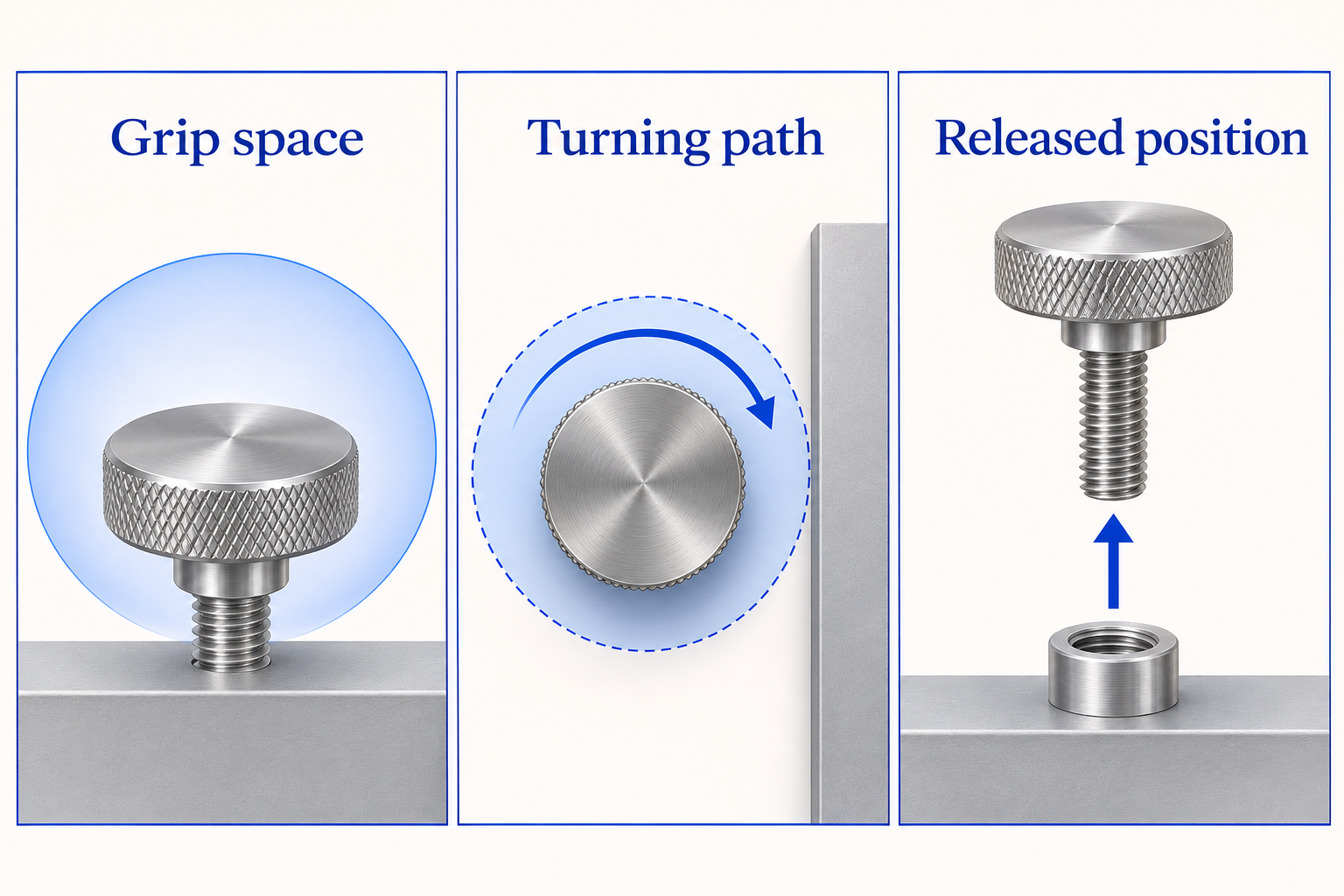
Finally, inspect the released position. Show where the head and screw tip sit when the mating thread is disengaged. Confirm that the panel can open or lift away in that condition. A drawing of the closed joint alone can leave this service movement unresolved.
A captive thumb screw needs a retention system
A captive screw stays attached to its associated part when released from the mating thread. A large or knurled head does not create that function. Retention comes from the selected assembly, which may require a matched bushing, retaining element or other product-specific interface.
Specify the retention arrangement together with the screw. The drawing should identify the retained part, its mounting preparation and the permitted released travel. A supplier’s captive assembly can have several interacting components; replacing only the screw without checking those interfaces leaves the retention requirement unanswered.
Captivity answers “will the screw remain with the part?” It does not establish the tightening torque or prove that the joint cannot loosen. If both retention and controlled tightening are required, write them as separate acceptance requirements. This also prevents a purchase description such as “captive knurled screw” from hiding an important assembly decision.
Match the thread, bearing seat and release travel
Use the complete mating-thread specification, including its thread system and pitch. A nominal diameter by itself is an incomplete purchase description. Confirm the selected screw against the mating tapped part or nut on the drawing, rather than assuming that similar-looking fasteners share a thread.
Separate overall appearance from functional length. Identify the supplier’s length reference, the thickness being held and the available mating-thread depth. Where the screw has a shoulder or unthreaded section, show those features explicitly. Their relationship to the panel and mating thread needs to be checked in the assembled position.
Review where the head bears when tightened. A shoulder, raised boss or recess can change which surfaces meet first. The drawing review should establish that the intended clamping surfaces can come together, rather than accepting a screw simply because it starts into the hole.
Also show the released position on the same assembly. For a captive design, confirm that its retained travel allows disengagement and panel movement. For a removable design, confirm that there is room to withdraw and handle the screw. These checks connect fastener length to the service task.
Decide how tightening will be controlled
If the assembly requires a stated torque or a repeatable force, specify how that requirement will be achieved and checked. Ordinary finger tightening does not supply a universal value. A purpose-designed torque-control knob is a separate feature whose setting and application must be reviewed for the actual assembly.
A tool-driven fastener may suit a different access or installation requirement. For that route, Qiyi’s socket head cap screw listing is a relevant catalogue starting point. Review its head seating, drive access, mating thread and required specification independently; it is not an automatic replacement for a thumb screw.
The important choice is the fastening method the joint needs. Avoid adding a hand grip merely because maintenance is frequent if the specified tightening method still requires a tool. Equally, do not overlook manual access where the approved assembly genuinely calls for it.
Apply the checks to a removable panel
Consider a hypothetical service panel opened regularly after the equipment is made safe. The initial request is “a hand screw that will not get lost.” Convert that request into two requirements: an accessible manual grip and a retained fastener when the panel is released.
Review the panel edge and neighboring components before selecting the head. If a proposed wing cannot complete its turning path, compare another head form or revise the interface. Then review the selected captive arrangement with the panel preparation. Confirm the released tip clears the mating part and that the retained screw does not obstruct panel removal.
The completed specification should name the thread and length, head form, retention assembly and tightening requirement. It should also show the service position. That is a clearer basis for supplier review than choosing a head from a photograph and trying to solve the retention afterward.
What to include in a thumb-screw enquiry
Send an assembled view and a released-position view, together with the required quantity and drawing revision. Identify the mating thread, length reference, head envelope and any shoulder or drive feature. State whether the screw must remain captive and name the mating retention components if they are already selected.
Include the intended operating conditions, material and finish requirements, and the method used to accept tightening and fit. Mark any unresolved interface for review before ordering. The result should let both buyer and supplier distinguish a hand-operated screw from a complete captive or torque-controlled assembly.
References
Carr Lane: knurled-head construction and light-clamping application
Essentra: thumb screws and knobs, fastener guide, page 5
Carr Lane: a captive locating and torque-control assembly