A stainless steel grades chart organizes material names and alloy families; it does not, by itself, rate a finished fastener. Names such as 304 and 316 describe materials. A designation such as A2-70 carries steel-grade and property-class information in a fastener naming system.
Those labels belong in the same technical discussion, but they do different jobs. Reading them as exact substitutes can hide a missing material requirement, processing condition or finished-product property.
The chart below is a compact orientation to six commonly discussed grades. It gives family and comparison context, followed by the distinctions needed when the material becomes part of a bolt, screw or other component description.
Stainless steel grades chart: six representative materials
The rows show selected material names and broad tendencies, not a universal ranking of corrosion resistance or strength. They are not a catalogue of grades supplied by QIYI.
| Common material name | Family | Useful orientation | Question the name leaves open |
|---|---|---|---|
| 303 | Austenitic | Free-machining bar grade | Does the part also require forming, welding or particular corrosion resistance? |
| 304 | Austenitic | Widely used general-purpose grade | What product form, condition and finished-part properties are required? |
| 316 | Austenitic | Improved chloride-pitting resistance compared with 304 | What exposure exists at the actual component location? |
| 430 | Ferritic | A different family from 304 despite the similar-looking number format | Which material and fabrication requirements apply? |
| 410 | Martensitic | Grade associated with hardened applications | Which condition is specified for the supplied part? |
| 17-4PH, also called 630 | Precipitation hardening | Material name whose processing condition needs attention | What condition and properties does the product record describe? |
A chart is most useful when its columns identify what is being compared. Family, fabrication tendency and a finished component’s measured result are different types of information. A single “best grade” column would obscure those differences.
The selection is deliberately bounded. Stainless steel includes additional grades and a duplex family as well. Leaving a grade outside this table does not mean it is unsuitable or unavailable; it means the table is an orientation rather than an exhaustive material database.
Family names group materials; grade names distinguish them
Austenitic, ferritic, martensitic, duplex and precipitation-hardening are family descriptions. A common grade name narrows the material discussion within that broader classification.
The austenitic stainless steel grades in the chart illustrate why family membership is not a complete selection rule. 303, 304 and 316 share that broad family, yet their material descriptions emphasize different characteristics. The shared heading does not make their fabrication behavior or corrosion performance identical.
A similar number format can also be misleading. 410 and 430 appear close in a numerical list but belong to different families in the adopted material directories. Reading the family column is more informative than assuming that nearby numbers describe interchangeable materials.
The chart does not use its numbering as a quality scale. A larger number is not a universal promise of greater strength, better forming or longer life. Each comparison needs the relevant property and conditions beside it.
For a focused explanation of the 304/316 material relationship, our 304 versus 316 stainless steel fastener guide discusses the environmental question. That narrower comparison should not be expanded into a ranking of every stainless family.
A material name and a fastener designation answer different questions
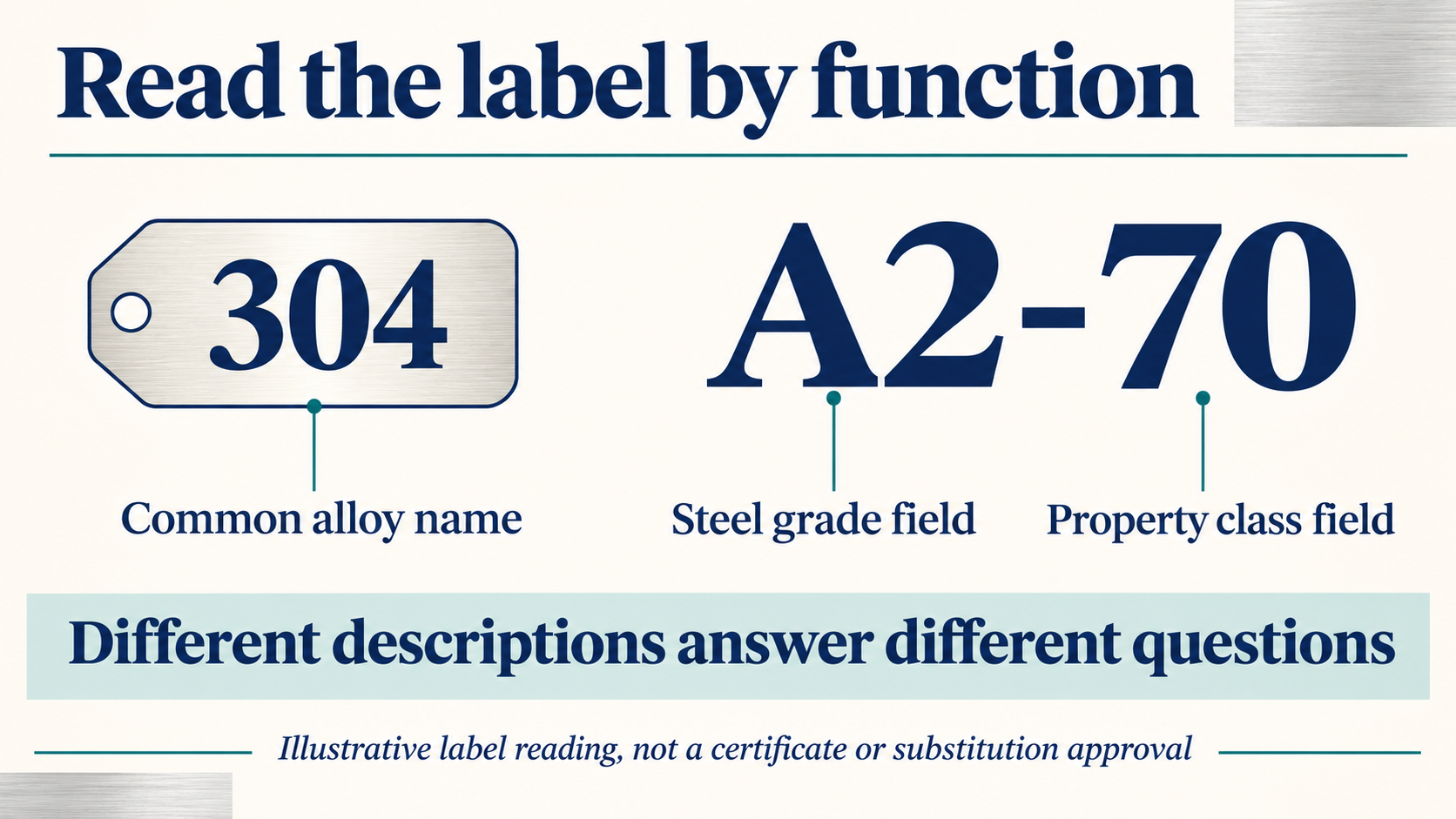
“304” identifies a common alloy name. “A2-70” is a fastener designation with a steel-grade field and a property-class field. The second description contains a performance-related field that the bare alloy name does not provide.
The distinction is easier to see when the fields are separated. In the illustrative A2-70 label, A2 is the steel-grade field and 70 is the property-class field. Neither field should be dropped merely because the reader recognizes the other.
Descriptions that associate a fastener grade with a familiar alloy type provide orientation. They should not erase the applicable chemical limits, product requirements or evidence. A convenient association is different from a declaration that every material record carrying one name satisfies every requirement attached to the other.
The BSSA leaflet cited here is a historical naming explanation. Its role is limited to illustrating the distinction between the material-grade and property-class fields. Its older dimensional ranges and property tables are not reproduced as current acceptance requirements.
For the broader relationship between fastener grade markings and mechanical property classes, our bolt grade chart treats that separate topic. A stainless material chart should not silently become a duplicate strength table with its conditions removed.
| Description type | What it contributes | What still needs its own record |
|---|---|---|
| Family, such as austenitic | Broad material classification | The actual grade and product requirements |
| Common alloy name, such as 304 | Material identification context | Applicable specification, form and condition |
| Fastener steel-grade field | Material information within that naming system | Property class and the complete product description |
| Fastener property-class field | Mechanical-property classification context | Evidence for the actual identified product |
Read a grade chart as a source record
A useful chart preserves the scope of its source. Before transferring a row into a part description, establish whether the row concerns a material family, a supplied material form or a finished product.
A material directory may describe a grade available as bar, sheet or another form. Its short description helps the reader find the relevant material information. It does not become a test report for a fastener simply because the fastener is made from stainless steel.
Condition is another field to retain. The chart’s 410 and 17-4PH entries deliberately leave that question visible. A material name without the relevant condition may be inadequate for the property comparison the reader wants to make.
Source date and purpose matter too. A historical technical explanation can remain helpful for understanding a label while being unsuitable as the sole basis for present acceptance criteria. The reader should distinguish educational use from a requirement in an actual order.
International comparison tables need the same care. A name-to-number association can help locate a specification, but a similar name is not a complete comparison of all requirements. Exact replacement questions need the actual specified limits and product context.
This is also why the present chart avoids a long column of supposedly universal equivalents. It would be easy to make the table look comprehensive while hiding differences in product form, condition and specification. A smaller table with clear questions gives the reader a more reliable starting point.
Two reading exercises reveal different missing fields
The following examples are fictional document comparisons. They show how to use the chart without implying that a particular fastener or material has been approved.
A drawing says 304, while an offer says austenitic stainless
The drawing identifies a common material grade, while the offer gives a broader family description. The family word may be consistent with several materials, but it does not repeat the drawing’s level of specificity.
The useful clarification is the proposed material identity against the drawing requirement. Asking whether the material is “good stainless” would replace a specific unresolved field with a vague judgment. Asking only for a photograph would not settle the documentary mismatch either.
Suppose the supplier then supplies a clearer material description. That can resolve the identity question while leaving any separate finished-fastener requirement untouched. The record should show which question the new evidence actually answers.
An offer says A2, while the requested description includes a property class
Here the missing information concerns a different field. The offer may identify a steel grade but omit the requested property-class description. Adding a general 304 material brochure would not complete that missing field.
The reader should preserve the full requested designation and identify the omission precisely. This makes it possible to compare the supplier’s reply with the actual request, rather than infer a performance class from a familiar material name.
The same principle applies if a complete label is present but the supporting document refers to a different part or lot. A correct-looking designation is one piece of information; its connection to the identified product is another. The chart helps interpret the label, while the product record establishes the relevant connection.
These examples concern different gaps: one description is too broad about material identity, while another is incomplete about the fastener’s property classification. They should not receive the same generic answer.
Use the chart to locate the next useful information
A stainless steel grade chart is a starting map. It helps the reader recognize a material family, distinguish common grade names and identify the kind of information a fastener label carries.
The next useful record follows the unresolved question. A family question leads to a material classification. A grade question leads to the applicable material description. A finished-product property question leads to the relevant fastener requirement and evidence.
Keeping those purposes separate makes the table useful in drawings, technical discussions and offer comparisons. The grade name remains visible, the processing condition remains attached to its properties, and a fastener property class retains its own meaning.
References
- Atlas Steels: original stainless steel grade directory, for the selected grade families and short material descriptions.
- ASSDA: stainless steel families and grade context.
- BSSA: historical stainless fastener naming leaflet, used only for the steel-grade and property-class distinction.