For fasteners, alloy steel vs stainless steel is a comparison between specified grades, conditions and service environments. Neither family name establishes a complete strength or corrosion requirement. Compare the finished fastener’s mechanical specification separately from its suitability for the exposure.
Stainless steel is itself an alloy. In this guide, “alloy steel” means the nonstainless alloy steels commonly contrasted with stainless in purchasing descriptions. That commercial shorthand is useful only if the enquiry goes on to identify the actual material and fastener requirement.
Alloy steel vs stainless steel starts with the condition
One nonstainless example is AISI 4140. The steel producer voestalpine describes it as a chromium-molybdenum steel and relates its application properties to the quenched-and-tempered condition. This is a raw-material example, not a statement that every 4140 fastener has the same strength.
Stainless grades also need a condition. Outokumpu’s material overview explains that cold work can strongly affect stainless mechanical properties. A material name without its relevant condition can therefore conceal a difference that matters to the comparison.
A useful supplier proposal identifies three layers: the alloy or permitted material group, the required treatment or condition, and the finished fastener’s specified properties. These layers answer related questions, but they are not substitutes for each other. A bar-stock data sheet alone does not establish acceptance of a finished screw.
Consequently, “replace alloy steel with stainless” is an incomplete instruction. It should identify the existing requirement and the proposed replacement requirement. The reviewer can then compare two defined products rather than two broad labels.
Separate mechanical qualification from exposure suitability
For metric bolts, screws and studs within their scope, ISO 898-1 addresses carbon/alloy-steel fasteners, while ISO 3506-1 addresses corrosion-resistant stainless grades and property classes. Their public abstracts describe mechanical-property evaluation at an ambient test range of 10–35°C. They also warn that the specified properties may not be retained at other temperatures.
The applicable grade, property class, product geometry and test requirements should therefore be stated together. Do not transfer a property requirement between these systems merely because the fasteners share a head shape. The cited abstracts also leave functional matters such as torque/clamp-force performance and fatigue outside their requirements.
Exposure creates a separate question. Outokumpu explains that stainless corrosion resistance depends on a chromium-rich passive film, which can be disrupted in aggressive conditions. Its corrosion-testing guidance distinguishes controlled laboratory conditions from actual service and warns that uniform-corrosion data may not predict localized attack.
For a review request, describe the actual liquid or atmosphere, temperature, contaminants and wetting conditions as far as they are known. “Outdoor” or “washdown” may be a starting description, but it leaves substantial questions for the person selecting the material.
Apply both questions to a change in service
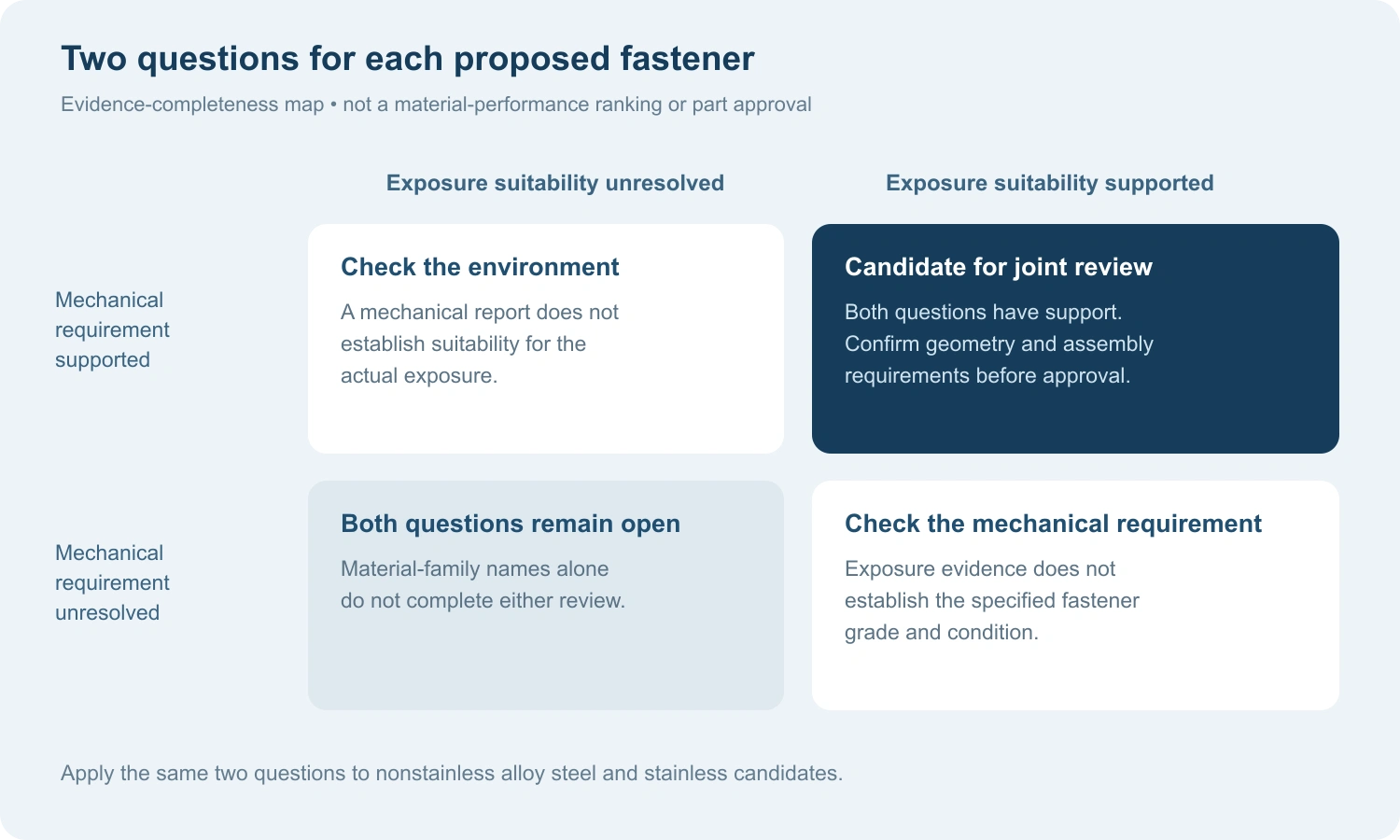
Consider a hypothetical machine bracket originally used indoors. A new location introduces repeated wet cleaning. The supplier proposes a stainless screw with the same nominal dimensions as the existing nonstainless alloy-steel screw, but the proposal identifies no property class or mechanical acceptance evidence.
The exposure concern is real, yet the proposed material name does not close the mechanical comparison. On the map, even convincing exposure evidence would leave the candidate in the lower-right cell until its mechanical requirement is supported. A buyer should keep that missing item visible in the proposal.
The opposite gap is possible too. A replacement may have documented mechanical properties matching the purchase requirement, while its suitability for the cleaning environment remains unresolved. That candidate belongs in the upper-left cell. A mechanical report does not answer the exposure question simply because it contains test results.
The useful next step is to request the missing evidence and have the complete proposal reviewed for the joint. It may involve the selected grade, condition, surface treatment, mating materials or assembly requirements. This example chooses no universal winning family and supplies no torque or allowable load.
Even the upper-right cell says “candidate for joint review.” Both material questions can have support while the wrong head, thread or assembly arrangement still prevents approval. The map helps organize a decision; it does not perform the design review.
Make the supplier’s confirmation specific
QIYI’s Socket Head Cap Screw page lists steel and stainless-steel material descriptions alongside dimensional and finish options. Those broad descriptions are a starting point for an enquiry. They do not establish a particular alloy, property class or treatment for every variant.
Attach the drawing and identify the required fastener standard, grade or property class, condition, finish and quantity. Add the service description and documents needed for review. If the supplier proposes a change, ask which requirement changes and what evidence supports it. This keeps the final comparison tied to the purchased part and its intended use.