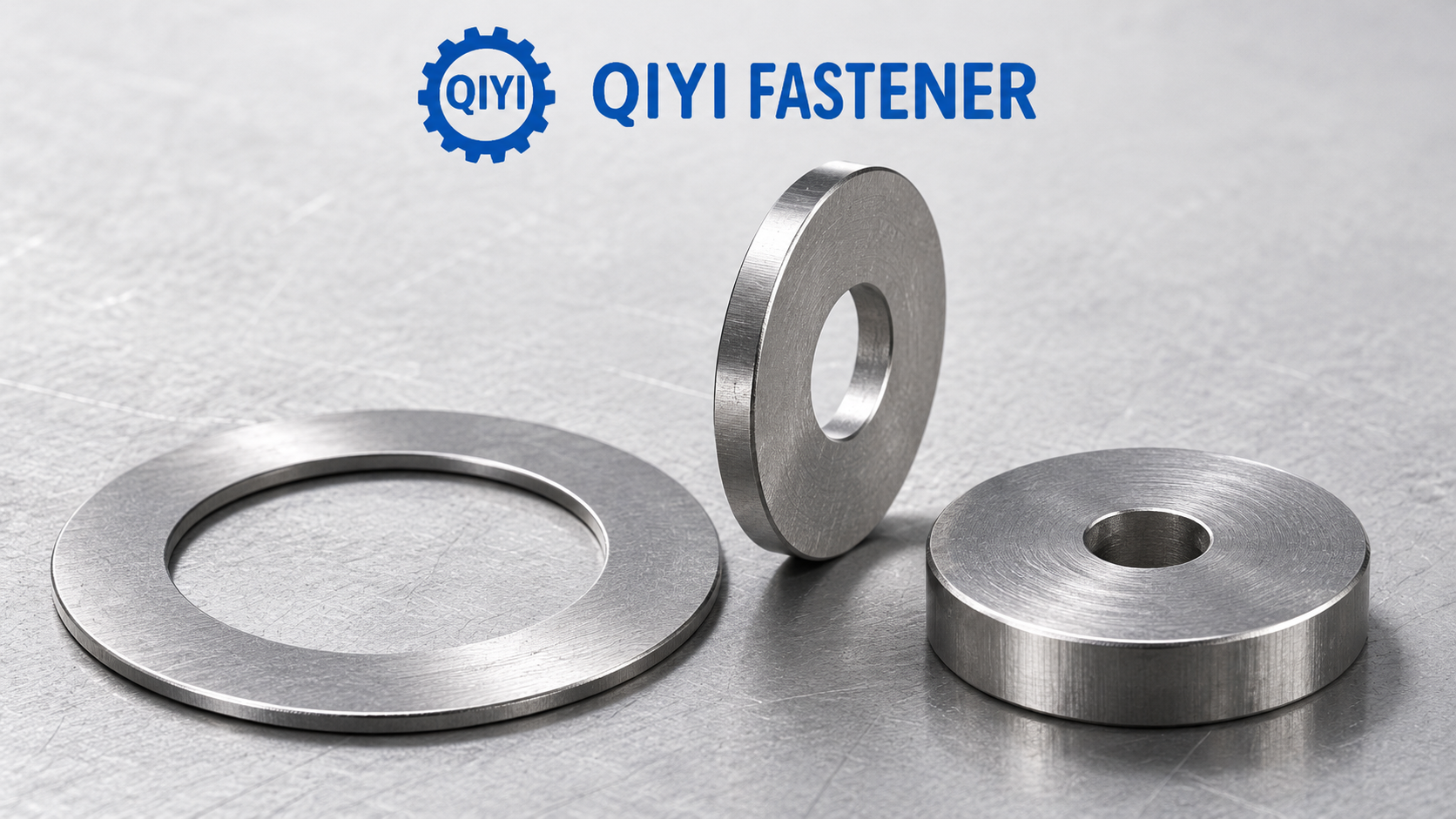
The main types of washers differ by the job they perform: spreading contact, fitting a shaped head, separating components or supplying spring action. A washer that fits over a bolt can still be wrong for the bearing surface. Start with the joint requirement, then specify the washer’s inside diameter, outside diameter, thickness, material and finish.
For buyers comparing types of washers for bolts, the useful question is which interface needs attention. Is the head bearing on a narrow cover? Does a sleeve need to separate the screw from another component? Does the drawing call for a spring element? Those questions lead to different parts.
Types of washers by their function
This is a selection of common families, rather than an interchangeable-parts list. The short descriptions follow Boker’s washer-selection guide; the drawing for the selected part remains the dimensional reference.
| Family | Identifying feature | Selection question |
|---|---|---|
| Plain flat | Flat ring; wide-OD variants enlarge its footprint | Does its bearing area fit the surface? |
| Shoulder | Ring with an integral sleeve | Where must the sleeve locate or separate components? |
| Finishing / countersunk | Shaped seat for a countersunk head | Does the head match the seat? |
| Tab | Projecting tab or tabs | What mating feature does the drawing require? |
| Split or toothed lock | Split ring or teeth | What evidence supports its proposed retention role? |
| Spring | Curved, wave or conical disc form | What deflection and load behavior is required? |
Check the footprint before ordering the ring
Inside diameter, outside diameter and thickness answer separate fit questions. The bore must accommodate the selected fastener. The outside footprint must fit the available space. Thickness affects the assembly stack. Material and finish need their own specification.
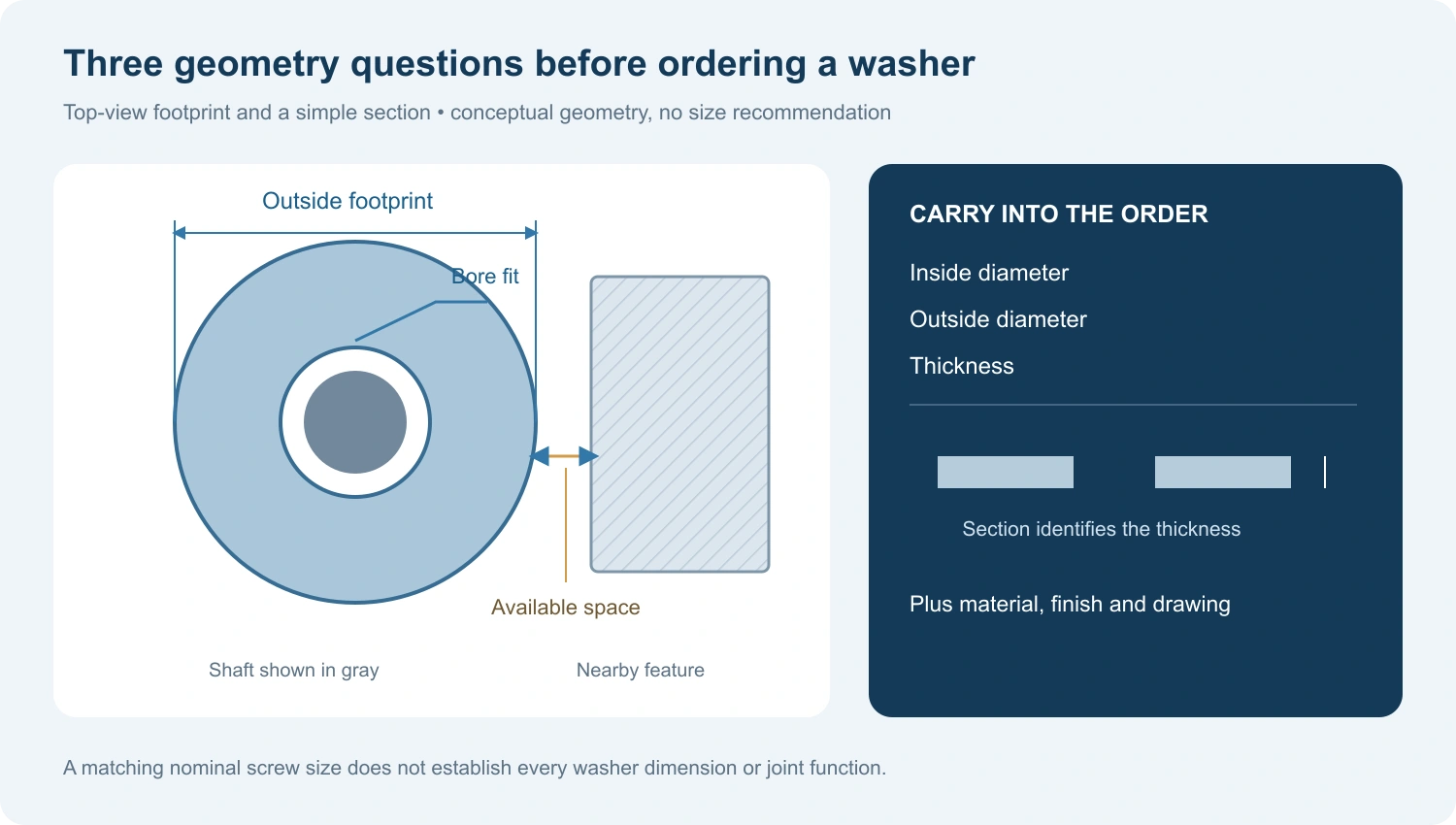
The illustration separates three drawing reviews. The central opening concerns the fastener passing through the washer. The outer circle concerns the surface under the washer. The neighboring feature concerns whether the part can physically occupy that location. A nominal screw designation answers none of these questions completely.
A useful purchase record therefore has three entries: the washer drawing and revision, its material and finish, and the mating-joint reference. “Washer for this screw” leaves too much interpretation to the supplier. A repeat order should point to the same controlled part, rather than rely on a familiar appearance.
The drawing review should also identify which surface is intended to contact the head or nut. A photograph helps explain the arrangement, but it cannot establish the contact geometry or an acceptable edge condition. Where the fit is unclear, a section through the assembly gives the supplier a more useful question to answer.
A larger washer can solve one fit problem and create another
Consider a hypothetical removable cover. Its approved assembly uses a plain washer, and a buyer proposes a wider replacement to increase the contact footprint. The proposal appears reasonable when the washer is viewed alone. On the cover drawing, however, a raised flange sits beside the hole.
The first comparison is between the existing and proposed outside diameters and that flange. The second is between their bores and the screw. The third compares their thicknesses within the existing stack. If the proposed washer touches the flange before it seats as intended, its larger outline has not established a suitable replacement.
This example demonstrates a fit review, not a strength calculation. No load capacity, torque or allowable cover stress can be inferred from the sketch. The engineer responsible for the joint would need the actual materials, dimensions and service conditions to approve a substitution. Purchasing can make that review faster by supplying both part drawings and identifying exactly what changed.
A concise substitution request might read: “Proposed washer W-B replaces W-A; outside diameter changes; bore and thickness require confirmation; attached cover section shows the nearby flange.” These labels describe an illustrative document trail, not a QIYI part number or a tested assembly.
Spring action needs a defined purpose
A spring shape should not be treated as proof that a joint resists loosening. NASA’s 1990 Fastener Design Manual describes Belleville washers as conical spring elements and distinguishes their tension-maintaining role from locking. It also warns that a typical helical split washer flattens under full tightening and should not be assumed to provide locking. The manual notes that toothed washers can damage mating surfaces as their teeth bite.
That guidance is a reason to ask for the joint requirement and supporting evidence. It does not qualify every spring washer or settle a particular vibration application. Where retention matters, the purchase description should identify the approved assembly arrangement and acceptance basis, rather than use “spring washer” as the performance requirement.
Carry the selected dimensions into the enquiry
QIYI’s Flat Washer page lists stainless-steel variants with a natural finish and a dimensional table. Its Spring Washer page provides a separate product route and dimensions. Compare the selected variant against the mating drawing; the shared nominal size does not make these two forms interchangeable.
For an enquiry, include the required quantity, drawing revision, dimensions, material and finish. If a tab, sleeve, shaped seat or spring response is essential, state that requirement explicitly. Availability of a plain or spring washer listing does not establish supply of every family shown above, or any particular locking performance.