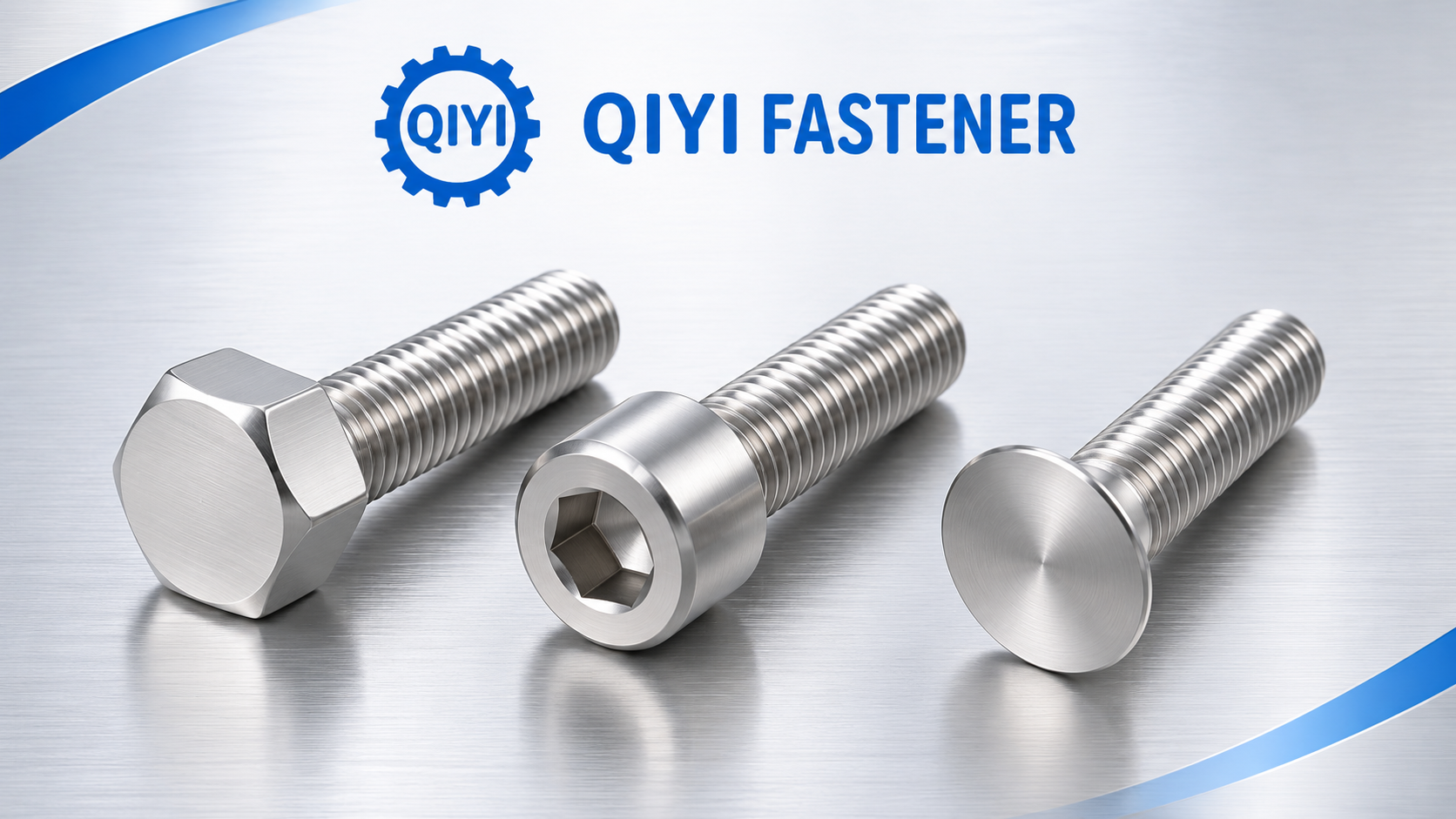
Common bolt types include hex, carriage, flange, shoulder, T-slot, U, eye and elevator bolts. Their names describe different things: a head shape, a locating feature, an overall form or a particular task. The useful choice starts with the connection the bolt must make, followed by its drawing, material and strength specification.
A list of types of bolts therefore cannot rank them from weakest to strongest. A flange changes the bearing face; a shoulder changes the shank geometry; an eye provides an attachment point. None of those labels alone specifies the capacity of the finished joint. For a replacement, the critical question is which feature the original assembly depends on.
Common bolt types and the feature to verify
The family descriptions below follow established supplier terminology, including Bolt Depot’s identification chart. The final column turns visual identification into a practical drawing check. Some catalog names overlap, so use the actual part specification when placing an order.
| Type | Identifying feature | Selection check |
|---|---|---|
| Hex bolt | External hexagonal head | Tool clearance and specified bearing face |
| Carriage bolt | Domed head with square neck | Neck fit and restraint against rotation |
| Flange bolt | Integrated flange below the head | Bearing diameter and surface suitability |
| Shoulder bolt | Smooth enlarged shoulder above the thread | Shoulder diameter, length and mating fit |
| T-slot bolt | Head shaped for a particular slot | Head envelope and actual profile geometry |
| U-bolt | U-shaped body with threaded ends | Inside dimensions and supported component shape |
| Eye bolt | Ring-shaped attachment feature | Intended use and product-specific loading instructions |
| Elevator bolt | Broad, comparatively flat head | Seating geometry and intended conveyor attachment |
These checks do not establish interchangeability. A round carriage head may look unobtrusive, but the square neck still needs a suitable receiving feature. A shoulder bolt used as a pivot depends on dimensions that a threaded bolt of the same nominal diameter may not provide.
A T-slot bolt needs more than the right thread
For an aluminum-profile bracket, the threaded shank connects to the nut while the head engages the extrusion. Those are separate interfaces. Matching an M8 nut confirms only part of the selection; the head must also fit the intended slot and seat on the intended surfaces.
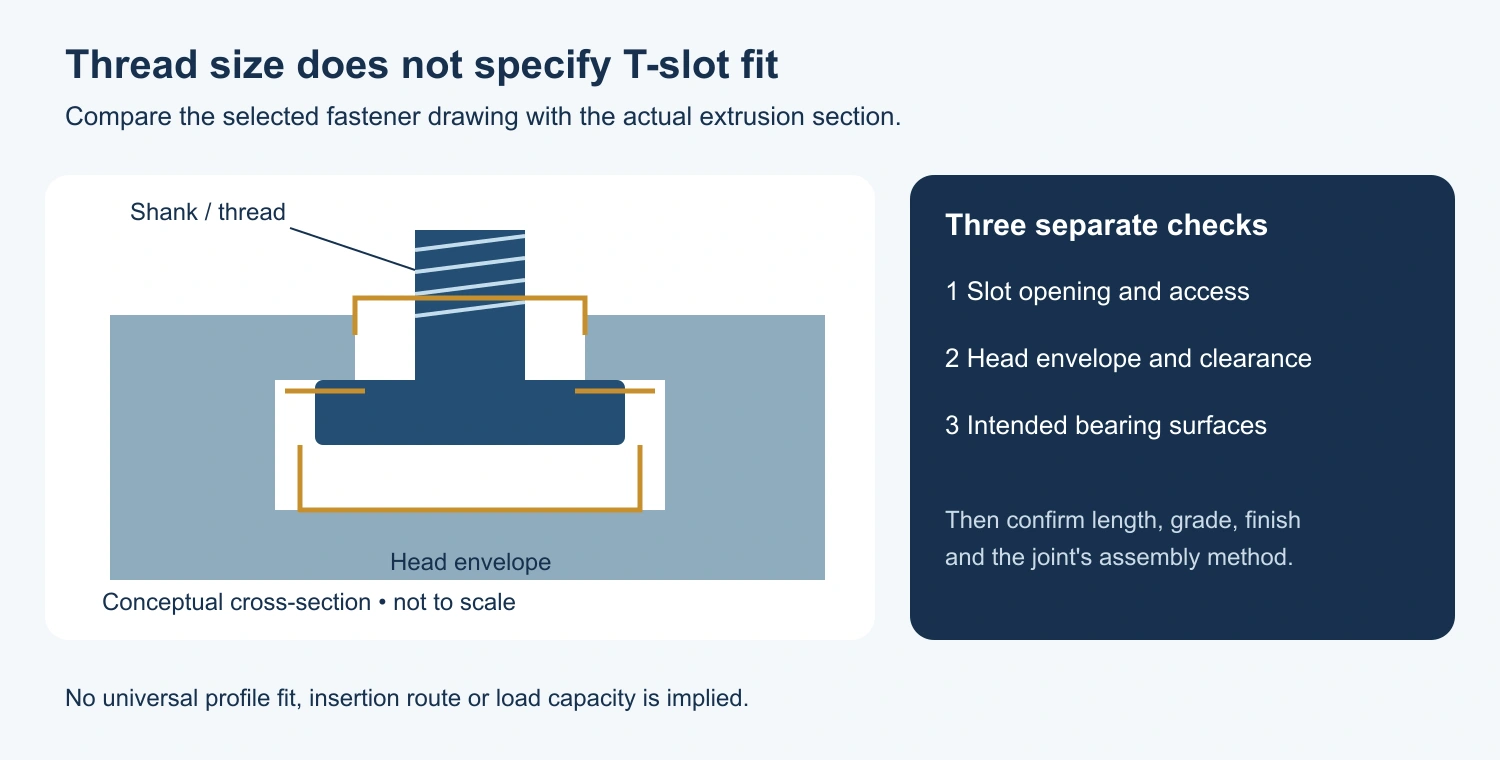
The comparison should cover the slot opening, internal head clearance and bearing ledges. Installation access matters too: the assembly drawing must show how the selected head enters and reaches its working position. A generic “T-bolt” label does not prove that every version can be inserted or rotated in the same way.
QIYI’s T-bolt product page lists several M8 groups with different descriptions and part-number families. That is a reason to select a specific variant before checking fit. Catalog suffixes alone should not be treated as proof that a part fits a named extrusion series from another supplier.
A useful request includes the actual extrusion section and the bracket stack, together with the proposed T-bolt part number. The supplier can then confirm the relevant drawing. The purchaser still needs the specified material, finish and joint requirements; a head that physically fits is not automatically approved for the service load.
Keep geometry separate from grade and installation
Head geometry helps answer questions about access, seating and restraint. Material and property class answer different questions about the fastener’s mechanical requirements. Surface treatment adds another specification, particularly when the joint will face moisture or an aggressive environment.
NASA’s Fastener Design Manual treats material, corrosion, preload and fatigue as distinct design concerns. A shape-based substitution leaves those concerns unresolved. A wider bearing face, for example, does not establish a stronger fastener or eliminate every washer requirement on an existing drawing.
Eye bolts require an additional boundary. Some eye-shaped hardware is intended only for attachment, while lifting hardware has its own rated conditions. Crosby’s application guidance shows that direction of loading and installation affect the selection of its eye bolts. A generic identification table cannot approve a lifting point or transfer one manufacturer’s rating to another product.
Example: replacing a bracket fastener
Consider a hypothetical bracket removed from an aluminum frame. Its nut accepts the replacement bolt’s thread, but the proposed head differs from the original. Approving the part at that stage would leave the most important profile interface unchecked.
The next comparison is between the original and proposed head drawings. A head may interfere with the slot opening, lack internal clearance or contact an unintended surface. If the candidate fits geometrically, the reviewer then checks length, material, finish and the original assembly requirements. These are successive questions, not evidence that the first candidate is suitable.
The same method works outside T-slots. Replacing a carriage bolt requires checking its neck and receiving feature. Replacing a shoulder bolt requires preserving the relevant shoulder fit. A different family may be usable after a deliberate joint redesign, but matching only the thread does not make it an equivalent replacement.
Record the feature that controls the order
An orderable description should connect the family name to the feature the assembly needs. For a shoulder fastener, include the shoulder dimensions. For a profile fastener, identify the selected head drawing and extrusion interface. Then add the full thread, length reference, material or property class, finish and applicable part specification.
Keep unresolved fields visible when requesting a quotation. “Confirm head-to-slot fit against the attached section” is more precise than “supply an M8 bolt that fits.” The completed drawing comparison becomes the basis for approval, while the family name remains a useful starting point for finding the right part.
References
- Bolt Depot: Fastener Type Chart — selected family terminology and identifying features.
- NASA: Fastener Design Manual — material, geometry and joint-design considerations, 1990.
- Crosby: Lifting Points Application Guidance — product-specific eye-bolt selection boundaries.