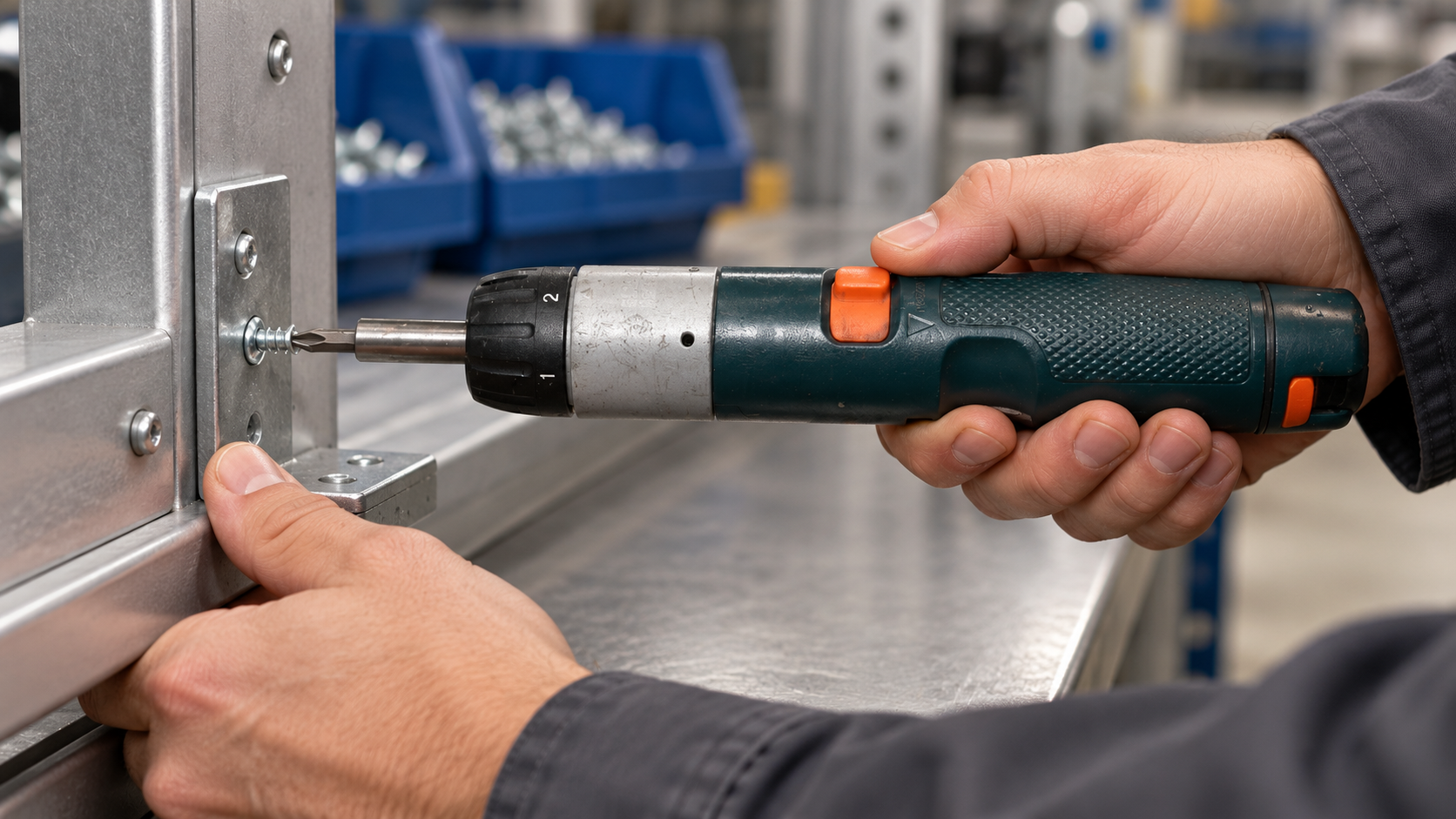
When Maya, an electronics assembly engineer in Brno, encountered intermittent resets on a controller panel, she replaced the board fasteners and tightened the enclosure screws to the same torque. The visible failure appeared within one shift: a corner of the PCB touched the panel and two solder joints showed witness marks. The reversal came when she measured the stack-up; the root cause was a standoff selection and height specification that left too little clearance, not a defective circuit board.
A standoff nut sets the assembly datum
A standoff nut is a threaded spacer that establishes a repeatable distance between two parts. In a PCB assembly, one end may accept a machine screw while the body bears against the board or a bracket; in a panel assembly, the same part can create a serviceable mounting point. The useful datum is the shoulder or bearing face, not the nominal thread length. Measure from that face to the board support surface and keep washers, coatings, and compressed gaskets in the stack-up.
Start with the mating hardware. Confirm whether the screw is metric or inch, identify its pitch, and calculate usable engagement after the screw passes through the board and any washer. A practical starting point is to avoid relying on only one or two engaged threads; use the supplier drawing and a hand-fit check to confirm full, smooth engagement without bottoming. A thread plug or matching screw can verify pitch, while a digital caliper records height and outside diameter.
Clearance is a system measurement. Include component keep-outs, connector latches, cable bends, heat spreaders, and the panel’s local flatness. If a board is 1.6 mm thick and a connector needs 8 mm of air below its shell, a nominal 10 mm spacer may provide less usable space after a washer and tolerance stack are included. Record the worst-case minimum clearance rather than the catalogue nominal alone.
A pcb standoff manages clearance and support
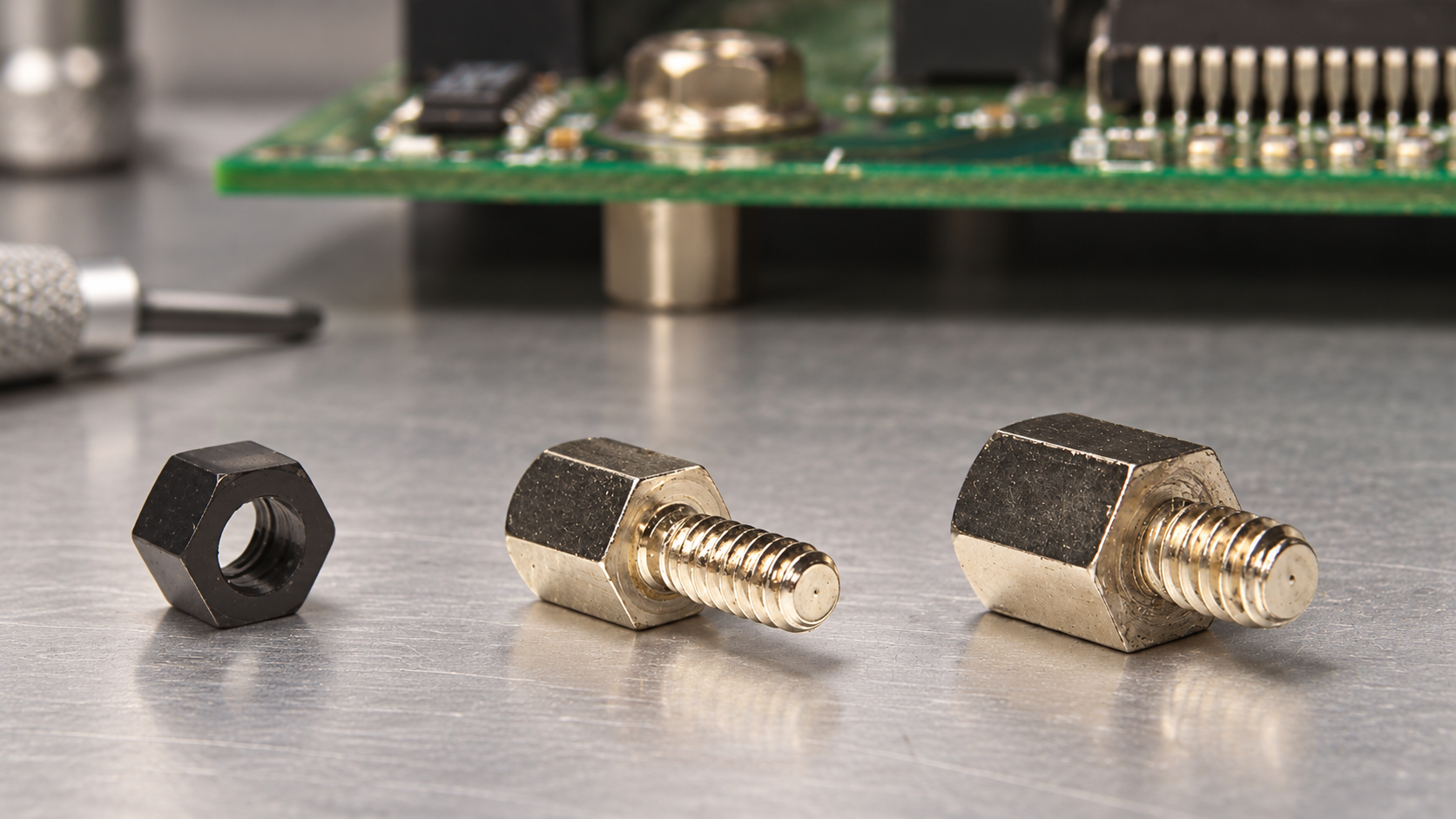
The phrase pcb standoff covers several geometries, so the selection should follow the board and enclosure rather than the label. Female-female parts accept screws from both ends, while male-female variants can join a board to a panel with fewer loose components; snap-in styles use a retention feature instead of a screw at one interface. Shoulder diameters and head forms also matter when a mounting hole is close to a trace or a plated edge.
Check the board hole diameter and land pattern against the fastener’s shoulder. A metal shoulder that is too large can touch a copper keep-out, while a narrow shoulder can concentrate load around a thin laminate. Nylon or another insulating material can reduce accidental conduction, but it brings different strength, temperature, creep, and torque behaviour. Treat the material choice as an environmental decision, not simply an electrical shortcut.
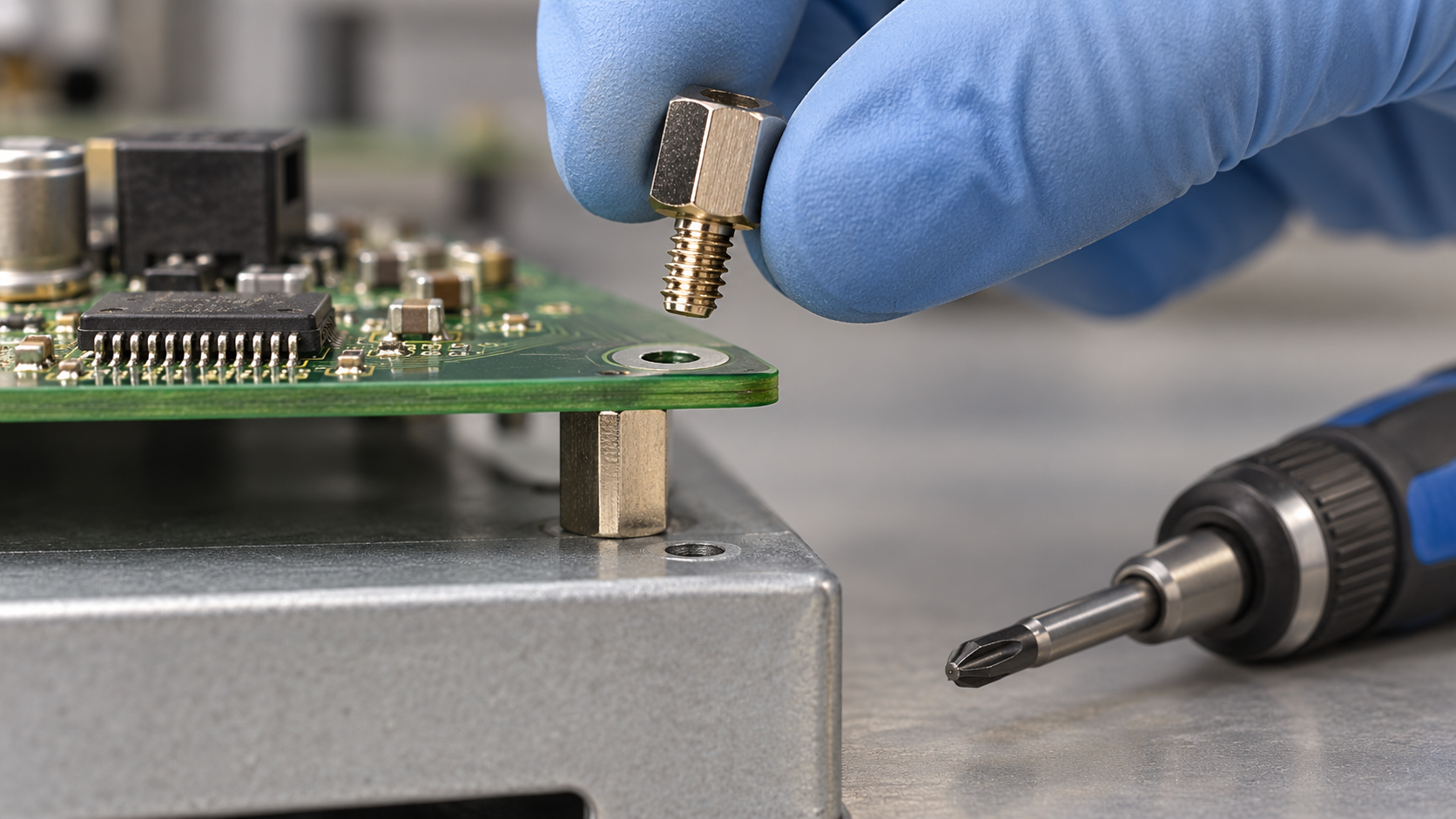
Use a controlled installation sequence: seat the spacer against the panel, place the board without forcing it over a misaligned hole, start screws by hand, and then apply the approved torque in a cross pattern. A torque-controlled driver and a visual inspection for board bow are useful process controls. IPC standards can inform assembly workmanship and acceptance criteria, but the exact torque limit and clearance remain properties of the selected hardware and board design.
A threaded standoff changes load and serviceability
A threaded standoff is often chosen because it allows a board or cover to be removed without disturbing the opposite side of the assembly. That service benefit can hide a load issue: every added interface introduces thread friction, bearing stress, and a tolerance stack. Define whether the joint carries only the board’s static mass or also cable pull, fan vibration, a connector insertion force, or a transport shock. Use the expected load and the number of supports to estimate the reaction at each location, then verify the design with a prototype.
Compare thread engagement, body diameter, and material hardness together. Steel can tolerate higher tightening and impact loads than many plastics, but it may need an insulating washer or coating where galvanic or electrical contact is unacceptable. Brass is common where machinability and conductivity are useful; stainless steel can support corrosion resistance but still requires compatible mating hardware and an appropriate anti-galling process. Do not infer corrosion performance from a colour or finish description alone.
Vibration changes the decision. A prevailing-torque nut, thread-locking feature, washer, or controlled adhesive may be appropriate, but each can alter installation torque and service access. Validate the actual combination using the intended screw, surface finish, and assembly tool. A short vibration screening or transport simulation is more informative than selecting a locking feature by habit.
The standoff nut options differ in production
The table below compares common approaches without treating one material or geometry as universally superior. Unit-cost tendency is directional; the hidden cost often sits in rework, line time, and field service rather than in the fastener invoice. For a frame or panel that also uses captive nuts, compare the related T-nut types and common uses before specifying both interfaces.
| Option | Performance profile | Efficiency and service | Compatibility risk | Typical total-cost implication |
|---|---|---|---|---|
| Metal female-female spacer | Good compressive support and broad temperature capability when correctly specified | Simple two-sided screw access; moderate assembly time | Requires careful hole, thread, and insulation checks | Often efficient for repeatable panel builds; rework is costly if height is wrong |
| Metal male-female spacer | Rigid connection with a locating shoulder or stud | Fast board-to-panel installation and easy removal from one side | Stud length can clash with traces, brackets, or a rear cover | Can reduce loose parts, but custom lengths may increase unit cost |
| Insulating polymer spacer | Electrical isolation and low mass; strength and creep depend on polymer and temperature | Lightweight and easy to handle; torque window is narrower | Thermal, chemical, and long-term compression limits need confirmation | Useful when isolation avoids secondary parts; replacement risk rises if creep is ignored |
| Integrated captive or locking feature | Improved retention or vibration resistance when tested as a system | May shorten line steps and prevent dropped hardware | Feature changes insertion clearance, torque, and service method | Higher part complexity can pay back where downtime or lost hardware is expensive |
A standoff nut should be selected and documented systematically
- Map the interface: record board hole size, panel thickness, keep-outs, connector envelope, screw head, washer, and required gap. Photograph or retain a measured sample when the original drawing is incomplete.
- Choose the thread: state metric or inch, nominal diameter, pitch, tolerance, and usable engagement. Check the mating screw rather than assuming a familiar label is interchangeable.
- Choose the material and feature: balance strength, temperature, corrosion, electrical isolation, locking, and service access. Confirm that the chosen finish is compatible with the panel and screw.
- Approve a first article: assemble the production board, enclosure, and tools; verify clearance, seating, torque, and board flatness. Record the measured result against the drawing revision.
- Control replenishment: keep the approved sample, inspection points, packaging requirements, and change-notification rule with the part number. For configurable sourcing, clarify which dimensions may change and which are fixed.
Qiyi Fastener can be considered when a procurement team needs configurable fastener options and documentation support, subject to confirmation of the requested specification and destination requirements. Review the broader pcb standoff product range only after the interface record is complete; the brand should support a controlled decision rather than replace one.
Which standoff nut questions do buyers ask?
What is a threaded standoff?
A threaded standoff is a spacer with an internal thread, an external thread, or both, used to hold a PCB, panel, or bracket at a defined distance. It can provide repeatable alignment and service access when the thread, shoulder, and height match the assembly. Confirm the mating screw and the actual load path before choosing a size.
What are the different types of PCB standoffs?
Common types include female-female, male-female, male-male, snap-in, and insulating polymer forms. Their insertion method, shoulder diameter, and service access differ, so compare the board hole, panel interface, and required clearance. A sample fit check is useful when replacing a legacy part with a different body style.
What are the different types of standoffs available?
Standoffs may be made from steel, stainless steel, brass, aluminum, or engineering polymers, and may include captive, locking, knurled, or reduced-head features. Select by environment, electrical behaviour, load, and installation method rather than by material name alone. Request the drawing and applicable test evidence for the exact configuration.
What are standoff screws?
Standoff screws are screws designed to create or work with a fixed spacing feature, often with an extended shoulder or a male-female form. They can reduce loose hardware in a panel assembly, but the shoulder length and thread engagement still need to match the board stack. Verify that the screw head and shoulder do not enter a component keep-out.
References
- The Aluminum Association
- ASME Codes and Standards
- McMaster-Carr threaded standoffs
- NASA Fastener Design Manual
When the part specification is ready, contact Qiyi Fastener with the drawing, measured sample, quantity, and destination requirements.