When Li Wei, a maintenance engineer in Suzhou, tightened a vibrating pump flange, the joint loosened again before the next shift; after replacing the flat washer with the correct conical disc and controlling torque, the leak stopped. The visible failure looked like a bad fastener, but the root cause was selection and sizing of the washer for the joint’s movement.
Summary: A washer adds a controlled elastic reaction to a bolted joint, but it is not a universal cure for loosening. Helical types suit limited movement and light preload retention, while a conical disc washer can deliver a defined load in a short axial space; stack geometry changes both load and deflection. Specify material, dimensions, working load, temperature and the applicable ISO or ASTM requirement, then validate the assembly with torque and vibration testing before release.
A Belleville spring washer works by storing elastic energy in the joint
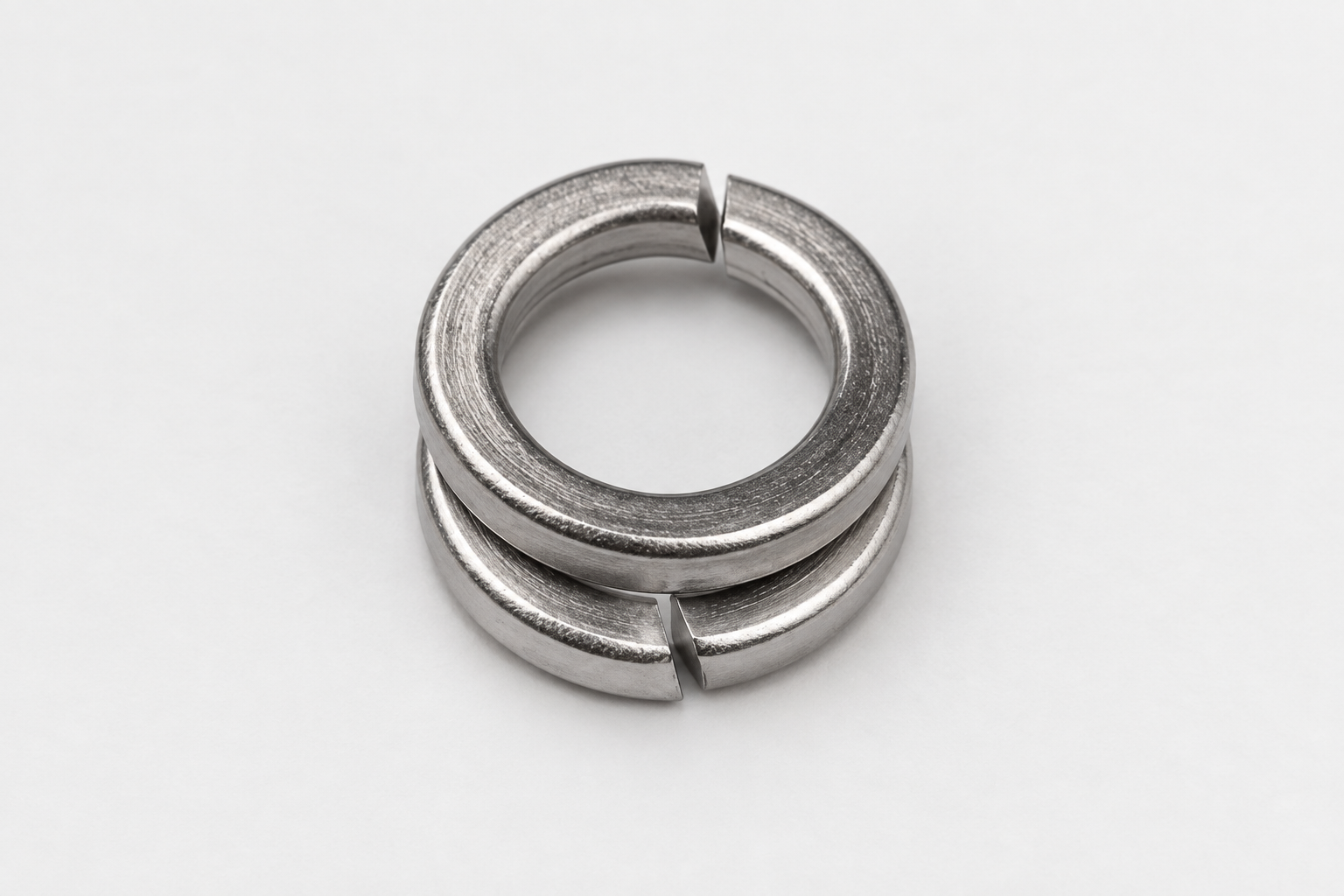
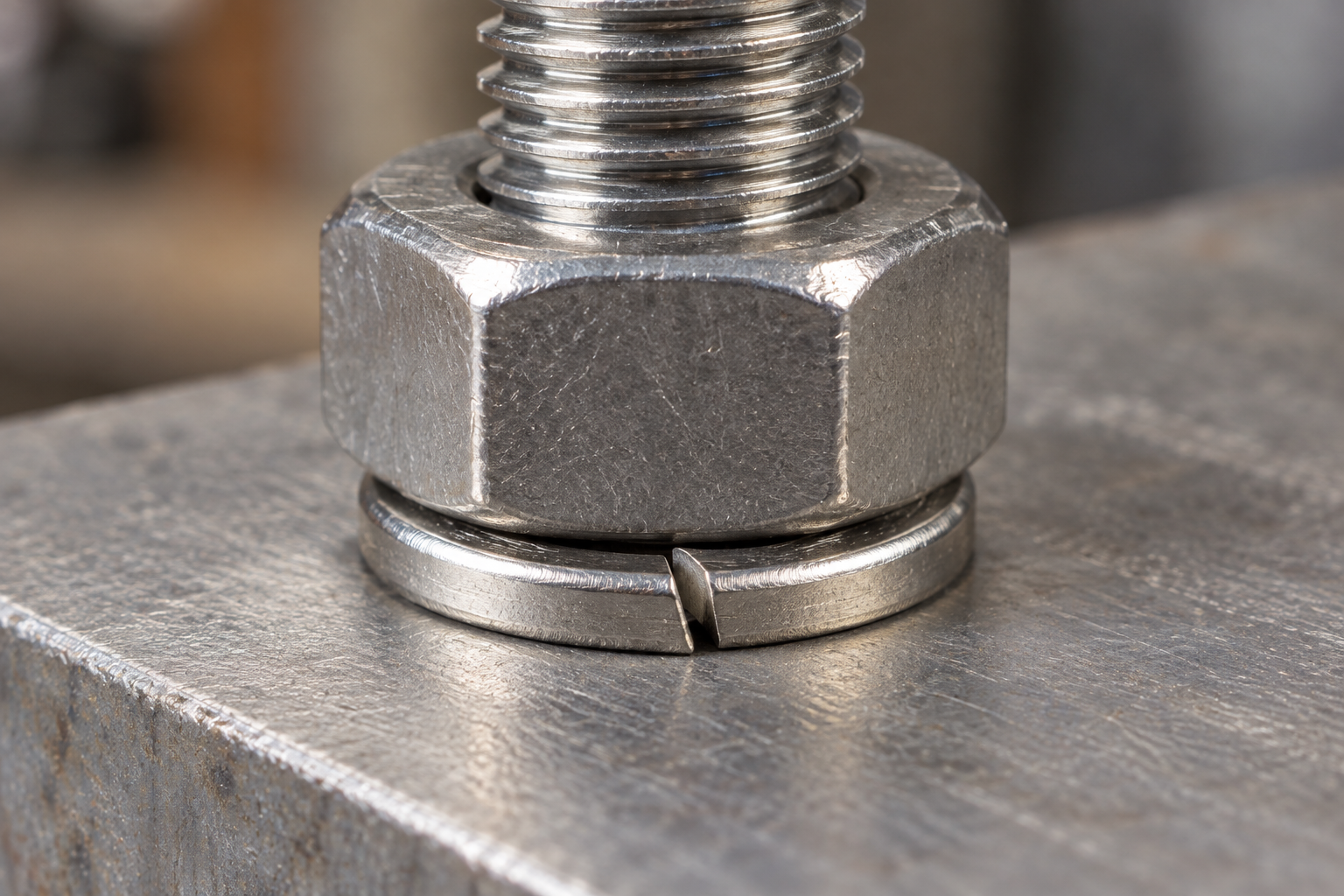
The term covers several geometries. A split helical washer twists as the bolt is tightened, creating a modest spring force and a locking edge. Wave, curved and toothed forms use bending or teeth for different installation constraints. A conical disc washer is often called a Belleville washer; its cone flattens under load and produces a predictable force-deflection curve.
Elastic reaction is useful only while the spring washer remains in its working range. Joint embedment, thermal expansion, transverse slip and insufficient clamp load can consume that range. In practice, the bolt, clamped parts and washer act as one spring system, so a washer cannot compensate for a poorly designed joint. Measure installed height and clamp load, and document the torque method (for example, calibrated torque-angle or tension measurement).
For critical equipment, run a recognized vibration or loosening test defined by the customer or design authority. The test is evidence for the selected design, not a blanket certification for every size.
A Belleville spring washer delivers high load in a compact axial height
A conical disc behaves differently from a split washer. As cone height (h) and thickness (t) change, the ratio h/t shapes the curve: a low ratio gives a steep, short-stroke response, while a higher ratio allows more deflection before flattening. Designers should use the supplier’s load-deflection data and verify it at the expected temperature and surface condition rather than infer load from outside diameter alone.
Stacking provides useful tuning. Discs in the same orientation (parallel) add load at roughly the same deflection; opposing orientations (series) add deflection at roughly the same load. Mixed stacks can achieve an intermediate curve, but friction between discs and tolerance accumulation must be included in the calculation. A Belleville spring washer stack should be guided on a mandrel or in a recess when lateral stability matters.
As an illustrative calculation, four identical discs in parallel can provide approximately four times the single-disc load at one-disc deflection, subject to friction and tolerances. Treat that as a starting estimate; confirm it with a compression test under the purchaser’s specified method.
A Belleville spring washer choice depends on load, motion, material and environment
Start with the joint’s minimum required clamp load and allowable relaxation. Then identify whether the joint sees axial cycling, transverse vibration, thermal cycling or only assembly compensation. A wave washer may fit a low-load bearing preload; a toothed washer may suit a panel ground path but can mark coatings; a conical disc is usually the more controllable choice when load retention and limited travel are measurable requirements.
Material changes performance. Carbon spring steel offers high strength at ordinary temperatures; stainless grades improve corrosion resistance but have different modulus, fatigue and galling behavior. For outdoor or chemical service, specify coating, hydrogen-embrittlement controls where relevant, and a corrosion test agreed with the customer. Do not claim a temperature limit without a grade-specific data sheet and validation.
Surface finish and seating are equally important. A washer must bear on a sound, appropriately sized land; excessive clearance can cause tilt, while a sharp edge can create local stress. Check bolt head, nut and hole dimensions against the spring washer‘s inside and outside diameters, and include the washer in the stack-up tolerance.
These washer choices trade performance against total cost
| Dimension | Helical or wave type | Belleville spring washer |
|---|---|---|
| Primary action | Twist or bend for light elastic reaction | Conical compression with defined load curve |
| Typical stroke | Small; varies with geometry | Specified deflection, often short and repeatable |
| Load control | Usually qualitative unless tested | Can be calculated and tested from manufacturer data |
| Vibration suitability | May help in limited cases; verify | Useful for preload maintenance when stack is guided and validated |
| Compatibility | Simple holes and common bolt heads | Needs correct cone direction, support and clearances |
| Unit-cost tendency | Often economical for standard sizes | Higher tooling or inspection cost can be offset by fewer adjustments |
| Maintenance/TCO | Inspect for flattening, damage and retorque history | Inspect stack height and load retention; document replacement criteria |
The lowest purchase price is not necessarily the lowest total cost. A washer that reduces unplanned retorque, leakage or bearing preload drift can pay back through uptime, but the claim should be based on the buyer’s measured failure cost. Keep an incoming inspection plan for dimensions, hardness and coating, and retain lot traceability.
Washer dimensions should be selected from the joint envelope
| Selection dimension | What to record | Why it matters |
|---|---|---|
| Inside diameter (d1) | Bolt diameter plus permitted clearance | Prevents interference while limiting tilt |
| Outside diameter (d2) | Available seating land and head/nut bearing | Controls bearing stress and edge distance |
| Thickness (t) | Nominal and tolerance | Sets stiffness, stress and installed height |
| Free cone height (h0) | Unloaded height for a conical disc | Determines travel and stack space |
| Working deflection | Minimum/maximum assembly movement | Keeps the washer away from over-flattening |
| Material/coating | Grade, hardness range and finish | Links corrosion, fatigue and hydrogen-risk controls |
Use a drawing with datum surfaces, not a catalog name alone. For a Belleville disc washer, state cone orientation, number of discs, guide diameter and target installed height. For a helical washer, state the standard series, free gap and acceptable flattening. Sampling plans should follow the customer’s quality agreement; do not substitute a test certificate for dimensional inspection.
Washer compliance requires a named standard and a testable claim
Use standards only within their stated scope. NASA-STD-5020 sets threaded-fastening practices for NASA programs, while the NASA Fastener Design Manual provides joint-design background. The exact washer product requirement may instead be a purchaser drawing or a regional standard; identify the revision and acceptance criteria on the purchase order.
ISO, ASTM and NASA documents define methods or engineering requirements; they do not automatically certify a washer or authorize a marketing logo. Confirm destination-market regulations, restricted substances, plating requirements and customer approvals. Unsupported “aircraft grade,” “self-locking” or life-cycle claims can trigger rejection, field returns and contract exposure. Link each claim to a report, lot and test method.
A Belleville spring washer sourcing guide turns calculations into a repeatable purchase
- Write the joint envelope: bolt size, seating land, clamp-load window, movement, temperature and corrosion exposure.
- Choose geometry from the load-deflection need; request a curve and installed-height limits for every conical-disc stack.
- Specify grade, heat treatment, coating, hardness, dimensional tolerances, lot traceability and inspection records.
- Validate the assembly with torque/tension checks and the relevant vibration or cycling method before approving production.
- Define replacement and retorque rules so maintenance teams can recognize a flattened or damaged washer.
Share the drawing and operating envelope with the Qiyi Fastener technical team so proposed substitutions can be checked before tooling or production release.
Qiyi Fastener can help buyers configure belleville spring washer dimensions, materials and documentation against a drawing. Request a sample lot and a load-deflection report; treat any unverified certificate or performance statement as pending review.
Frequently Asked Questions
What is a Belleville washer?
A Belleville washer is a conical disc washer that acts as a compression spring. Its load depends on diameter, thickness, cone height, material and deflection; use a tested curve for design values.
How do you stack Belleville washers?
Place discs in the same direction for parallel stacking and higher load, or face them alternately for series stacking and greater deflection. Mark orientation on the assembly drawing and guide the stack when lateral movement could cause instability.
Can Belleville washers be reused?
Reuse is acceptable only when the engineering specification permits it and inspection confirms no permanent set, cracks, corrosion or coating damage. Critical joints should use new, traceable parts unless a validated refurbishment process says otherwise.
What is a Belleville spring washer used for?
It maintains axial preload where space is limited, such as bearing settings, thermal-compensation joints and clamped electrical or hydraulic components. Select it by required load and travel, then verify installed height and fatigue life.
What is the difference between a spring washer and a Belleville washer?
The broader washer category includes helical, wave and curved forms; a Belleville washer is one specific conical-disc geometry. Their load curves, seating needs and locking behavior differ, so one should not be substituted for the other by outside diameter alone.
How does stacking affect load and deflection?
Parallel discs primarily multiply load at similar deflection, while series discs primarily multiply deflection at similar load. Friction, tolerances and support conditions shift the ideal result, so test the complete stack at its operating height.
References
- NASA-STD-5020, threaded fastening practices.
- NASA Fastener Design Manual, preload and joint-design background.
- NASA Technical Reports Server record, source record for the Fastener Design Manual.
The practical lesson is simple: match elastic travel to the joint, then prove the assembled load. When the decision affects uptime or safety, Qiyi Fastener is ready to review your drawing, propose a configurable fastener solution, and supply samples with the documentation your quality team needs.