When a maintenance supervisor in Sheffield found a conveyor-guard nut loose after a rapid repair, the team replaced it; the next inspection showed fresh witness marks. The root cause was not a bad product but an unspecified washer-integrated locking method.
K Nuts use a captive washer to add locking action
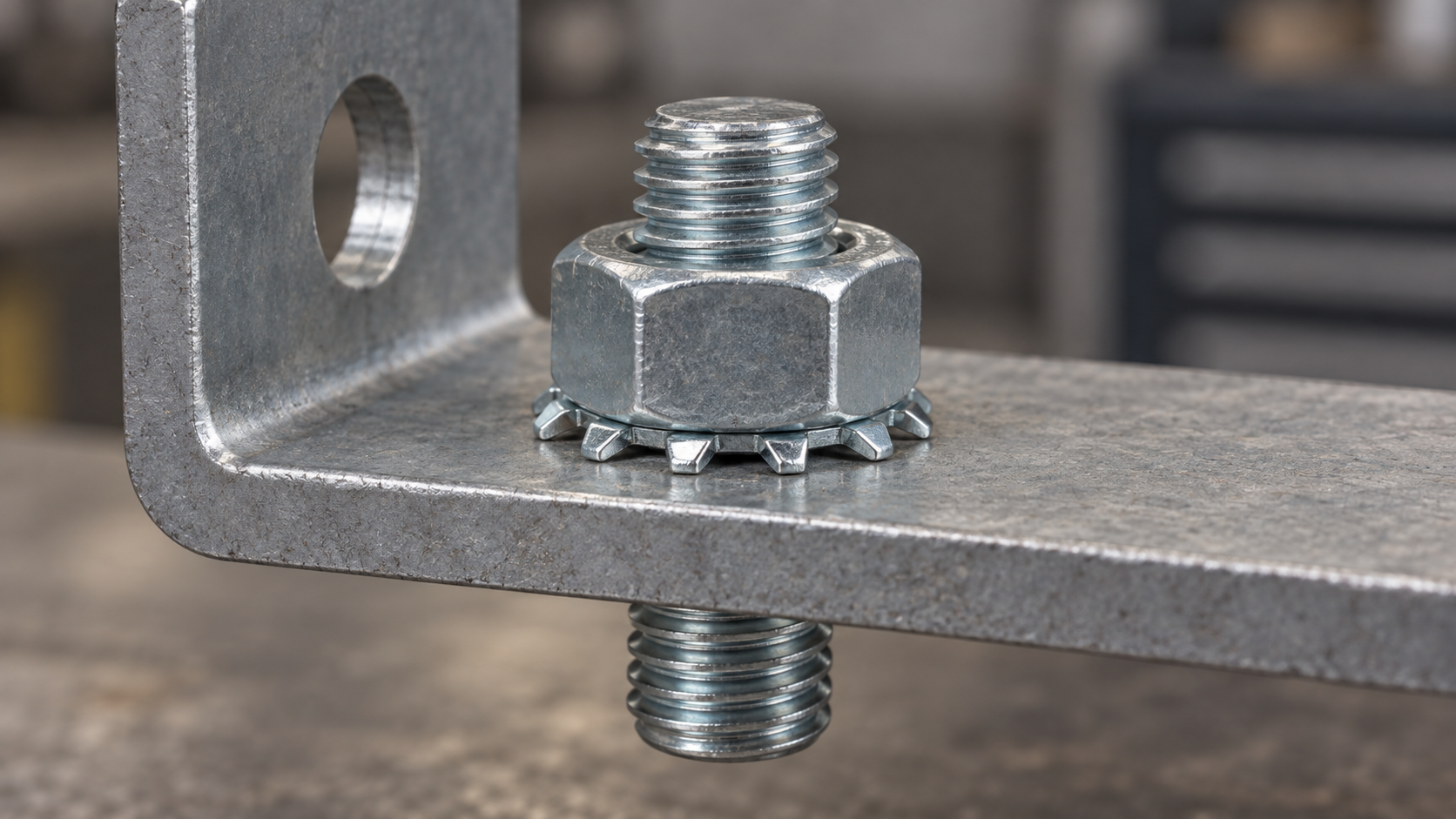
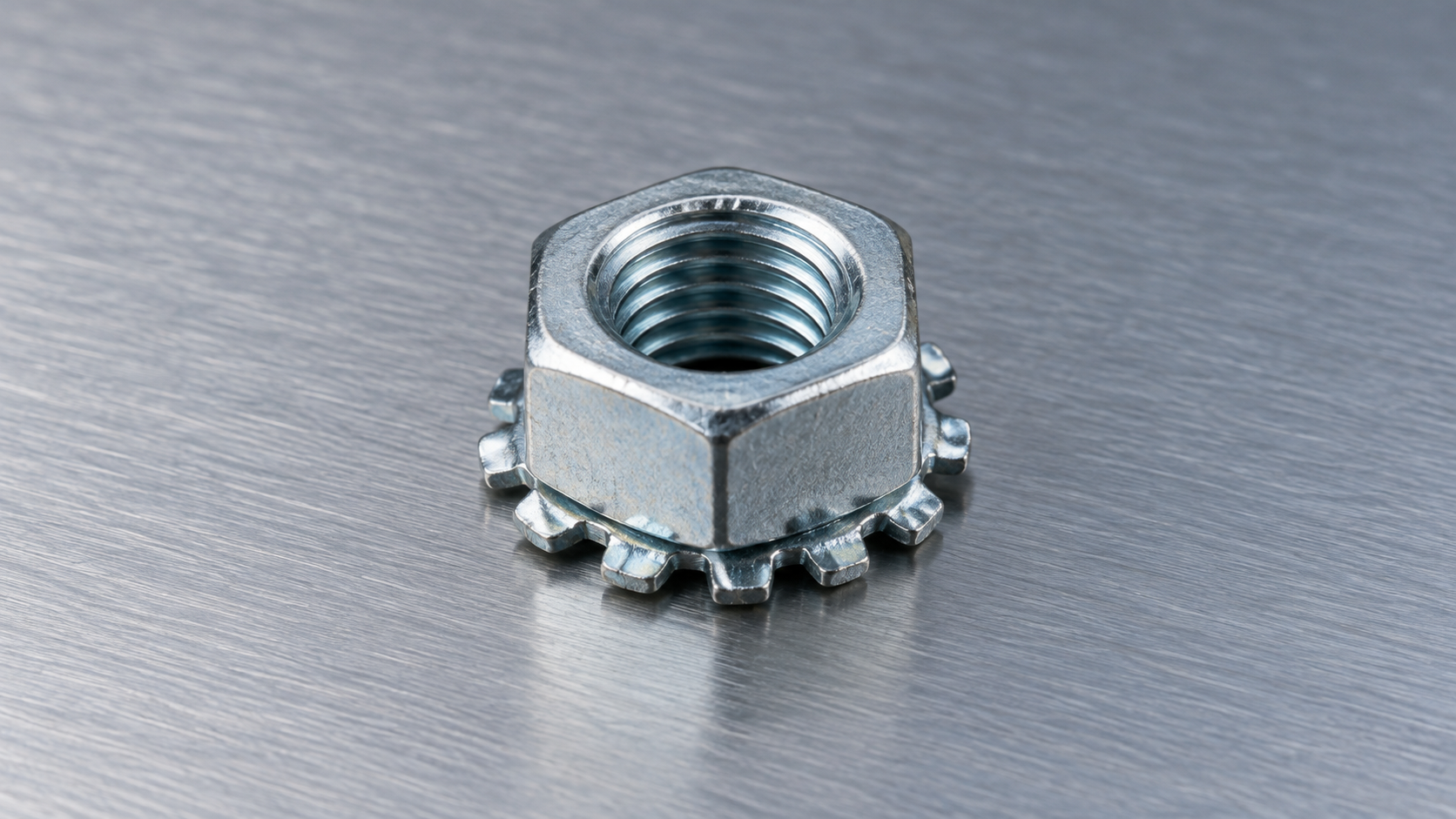
A conventional K-lock assembly has two captive functional elements: a six-flat hex nut and an external-tooth lock washer. The captive washer simplifies handling because it is retained on the nut; it does not make every installation washer-free in every sense. A drawing, assembly instruction, or customer specification may still call for another interface component, coating control, or a specific bearing arrangement.
Often called K-lock or keps nuts, these assemblies are useful where assembly flow benefits from keeping the washer and nut together. The external teeth are intended to create a locking interface at the bearing surface. That description identifies geometry and function; it does not by itself establish a vibration rating, installation torque, reuse limit, temperature capability, or conformance to any standard. Those decisions remain dependent on the joint design, material pairing, finish, intended use, and the supplier’s product specification.
For buyers comparing related hardware, Qiyi’s guide to industrial fastener manufacturers is a useful reminder to obtain traceable dimensional, material, and test documentation before treating similar-looking parts as interchangeable.
Unlike an insert-style locknut, K Nuts do not depend on a polymer collar. The tooth washer acts at the joint interface, while a nylon-insert nut develops resistance through its insert. This distinction matters when a purchase order simply says “lock nut”: the buyer needs the locking mechanism, material, thread designation, finish, and applicable test or inspection requirements written into the requirement.
Where tightening behavior must be studied, ISO 16047 provides a recognized method for examining the relationship between tightening torque and clamp force in fasteners. It can inform a test plan, but it is not a blanket certification for a fastener or joint. In particular, a captive tooth-washer K-lock nut should not be described as a prevailing-torque nut by default.
Comparison of common locking approaches
| Approach | Locking interface | Assembly implication | Specification question | Total-cost consideration |
|---|---|---|---|---|
| K-lock / keps nut | Captive external-tooth washer at the bearing surface | Nut and washer are handled as one assembly | Is the surface and washer geometry suitable for the joint? | May reduce loose-part handling; confirm the full assembly requirement |
| Nylon-insert locknut | Polymer insert acting on the thread | Separate washer may still be specified for bearing or surface reasons | Is an insert-type prevailing-torque requirement applicable? | Evaluate installation, environmental, and documentation needs together |
| Flange nut | Integral flange provides a bearing surface; locking feature varies by design | One-piece nut geometry | Does the selected flange-nut design include the required locking method? | Compare surface coverage and sourcing requirements, not just piece count |
| Plain nut with separate washer | Depends on the specified washer or joint design | Two loose components to stage and install | Which washer type, orientation, and installation process are controlled? | Consider picking, omission, and inspection exposure |
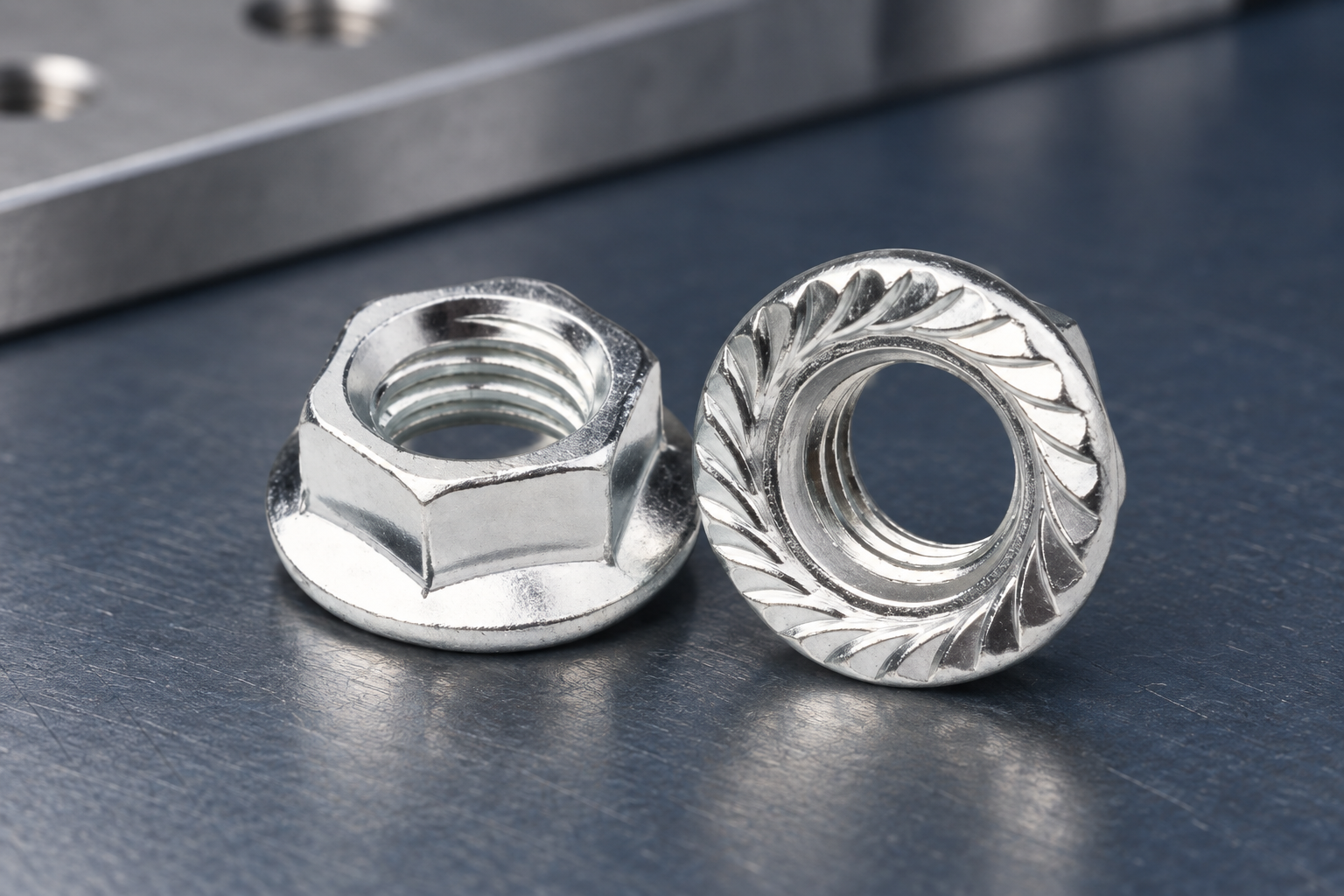
For a related bearing-surface configuration, review flange nuts; a flange alone should not be assumed to provide the same locking action as an external-tooth washer or a nylon insert.
Decision table for selecting the locking method
| Decision input | What to confirm | Why it changes the selection |
|---|---|---|
| Mating surface | Material, hardness, coating, finish, and permissible marking | Tooth contact and bearing-surface requirements may affect suitability |
| Assembly process | Manual or automated installation, access, and loose-part controls | A captive washer can simplify component presentation, subject to the work instruction |
| Joint duty | Loads, movement, inspection interval, and consequence of loosening | The locking method must be evaluated as part of the complete joint |
| Evidence required | Drawing, material certificate, lot traceability, and requested test method | Prevents a generic “lock nut” description from becoming an unsupported claim |
Standards for a k lock nut define tests, not automatic approvals
ISO 2320 addresses prevailing-torque type steel nuts and the associated mechanical and performance requirements. It is the standard to examine when the specified solution is an applicable prevailing-torque, including non-metallic-insert, nut; it should not be used to automatically classify a captive tooth-washer assembly as a prevailing-torque product. Ask the supplier which product standard and test requirements apply to the exact part number.
ISO 16047 is a torque/clamp-force test method. A report using that method can be useful evidence for an agreed test plan, but “tested to ISO 16047” does not by itself mean that a product is certified for every load case or application. The relevant torque, lubrication, mating components, and acceptance criteria must be stated by the purchaser or governing specification.
For controlled industries, the governing rules may be more restrictive than general industrial purchasing practice. FAA Advisory Circular 43.13-1B concerns acceptable methods, techniques, and practices for aircraft inspection and repair in its stated context, while NASA-STD-5020 covers threaded fastening systems for NASA program use. Neither document is a shortcut to claim that an ordinary commercial K-lock nut is approved for aviation or space hardware. Destination market, intended use, and the exact marketing claim determine what compliance evidence is needed.
Select K Nuts by joint evidence before part number
- Convert “lock nut” into a complete requirement: thread, material, finish, captive-washer geometry, mating surface, and any drawing-controlled dimensions.
- State the joint duty and assembly process, including access, automation, and whether surface marking from external teeth is acceptable.
- Identify whether the requirement is for a washer-integrated assembly, an insert-type prevailing-torque nut, or another locking approach; do not substitute based on a shared generic name.
- Request the applicable product documentation and, where relevant, an agreed ISO 16047 test plan with defined hardware and acceptance criteria.
Use the term k lock nut on a purchase order only when the requested captive-washer construction is clear; otherwise, describe the locking mechanism and required evidence in full.
Qiyi Fastener can support an inquiry for K Nuts and related industrial hardware by helping procurement teams compare drawings, materials, finishes, quantities, and documentation needs before a sourcing decision. Availability and suitability should be confirmed against the requested specification.
Frequently Asked Questions
How do K-lock nuts work?
A K-lock nut commonly combines a hex nut with a captive external-tooth lock washer. As the assembly is tightened, the washer provides a locking interface at the bearing surface. The result depends on the mating surface, joint design, installation process, and the exact part specification.
Can you use a lock nut without a washer?
It depends on the lock-nut design and the joint requirement. A K-lock assembly typically eliminates the need to separately handle a loose lock washer, but a drawing or work instruction may still require a washer or another bearing component. Confirm the specified stack-up rather than removing parts by assumption.
What is the main difference between a keps nut and a nylock nut?
A keps nut is commonly a hex nut with a captive external-tooth washer, whereas a nylock nut uses a nylon insert. The locking mechanisms and their interactions with the joint are different. Select against the application conditions and the supplier’s documented specification rather than treating the names as interchangeable.
What is the difference between nut and lock nut?
A plain nut provides threaded clamping when assembled with its mating fastener. A lock nut adds a defined feature intended to resist loosening, such as a captive tooth washer, nylon insert, or an all-metal prevailing-torque feature. The feature does not replace the need to engineer and specify the complete joint.
When should a buyer ask for a k lock nut sample?
Ask for a representative sample when the mating surface, coating, access, controlled documentation, or installation process could affect the decision. Use the sample to confirm fit and the agreed inspection or test plan. Do not infer service performance from appearance alone.
References
- NASA-STD-5020 official standard page — system-level requirements for threaded fastening systems in spaceflight hardware.
- ISO 16047: Fasteners — Torque/clamp force testing.
- FAA Advisory Circular 43.13-1B, Acceptable Methods, Techniques, and Practices — Aircraft Inspection and Repair.
A reliable locking choice is made at the joint definition stage, not after a loosening problem appears on the line.
When your team needs to compare a washer-integrated option with adjacent designs, Qiyi Fastener can help organize the technical request; contact the team with the drawing, application context, quantity, and documentation requirements.