Screw head types describe the shape that seats against the assembly: a flat head fits a countersink, a button head has a low dome, and a socket cap head has a cylindrical profile. Choose the seating shape and available head space first. Specify the drive recess separately, because a hex socket can appear in several head styles.
For machine-screw selection, three checks are especially useful: how the underside seats, how far the installed head projects, and whether the installation tool can reach it. Those checks give a more useful starting point than choosing a head from appearance alone.
Screw head types compared by seating shape
The main distinction is between a countersunk head, which seats in a matching tapered recess, and a head that bears on a flat surface. The table separates these interfaces from the shape visible above the part. It is a profile reference, not a dimensional drawing.
| Head type | Recognizable profile | Seating relationship | First check |
|---|---|---|---|
| Flat / countersunk | Flat top with conical underside | Fits a matching countersink | Recess geometry and required flush position |
| Button | Low rounded dome | Rests above a flat seating surface | Head height, diameter and tool access |
| Socket cap | Cylindrical head | Rests above a flat seat unless recessed | Head envelope and axial driver access |
| Pan | Slightly rounded top with short sides | Flat bearing face | Projection above the part |
| Truss | Wide, low rounded head | Broad footprint above the surface | Available space around the head |
| Oval / raised countersunk | Rounded top with tapered underside | Countersunk seat; dome remains visible | Whether a raised top is acceptable |
| Hex | External six-sided head | Flat bearing face | Wrench or socket access around the head |
Different types of screw heads can look similar in a top-down product photograph. A side view or drawing reveals the underside and installed height. That is why a rounded top alone cannot tell a buyer whether the screw needs a countersink or a flat seating face.
Head shape and drive type are separate choices
The head shape controls the seating profile; the drive is the interface used to turn the screw. Phillips, slotted and hex socket describe drive arrangements. Flat, button and cylindrical cap describe head profiles. Both fields belong in a complete part specification.
For example, a button head socket screw and a flat head socket screw share a hexagonal recess but seat differently. Ordering an “Allen screw” identifies the tool interface loosely and leaves the head shape unresolved. Ordering a “flat head” without naming the drive leaves a different field unresolved.
With an internal socket, check that the driver can approach and engage the recess along the screw axis. With an external hex, check the space required by the selected wrench or socket. Neither the head name nor a photograph establishes the complete tool-access envelope.
Flat, button and socket cap heads in the joint
A flat head can finish flush when its conical underside matches the prepared countersink. A button head remains above a flat surface, even though its dome is relatively low. A socket cap head also projects above a flat seat unless the part has a suitable recess.
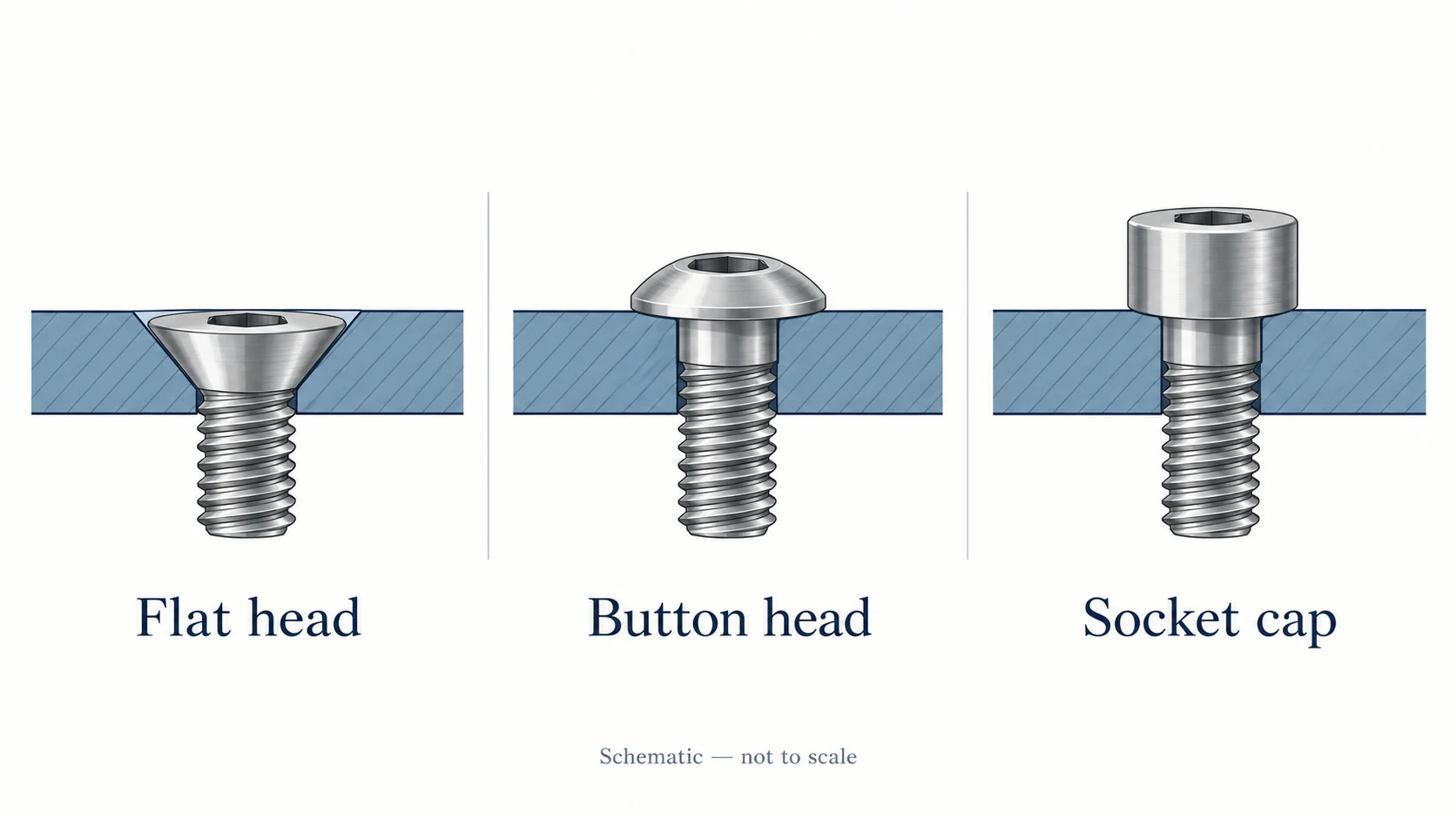
Read the illustration as a seating comparison. It does not specify a countersink angle, clearance-hole diameter or allowable load. Those values must come from the selected fastener drawing and assembly requirements. A flush appearance alone does not verify a correctly matched seat.
A practical selection sequence for assembly clearance
Start with the assembly drawing’s seating requirement. If the top must be flush, evaluate the specified countersunk arrangement and its matching head. If a raised head is acceptable, compare the available height and width around the hole before choosing among the flat-bearing profiles.
Check tool access with the surrounding parts in their installed positions. Space above a head and space around a head are different constraints. A low dome can fit the available height while the driver approach remains obstructed; an external hex may need room that the surrounding bracket does not provide.
Keep joint performance as a separate verification. Head geometry helps screen physical fit, but it does not supply a tightening torque, load rating or material grade. A substitution needs the complete thread, head, material and assembly specification, even when the new screw appears to occupy less space.
QIYI M5 example: head height changes with the profile
QIYI’s product tables provide a concrete comparison. The listed M5 socket head cap screw has head height k of 5 mm. The listed M5 button head socket screw has k of 2.5 mm. Both pages also list M6 and M8 options.
These are values from the named QIYI product tables, rather than a universal rule for every cap or button screw. They illustrate why matching M5 thread diameter does not settle head clearance. The complete drawing still needs to establish the head diameter, drive dimensions and other requirements.
QIYI also lists a flat head socket screw for a countersunk interface. Use that product route when the specified seating arrangement calls for a tapered underside; do not select it solely because a low installed profile is desirable.
Specify the head clearly before ordering
A useful purchasing description names the head profile and drive separately, then includes thread diameter, pitch, length, material and finish requirements. Attach the relevant fastener and assembly drawing when head clearance or a countersink controls the selection.
For a replacement request, identify which dimension caused the problem: excessive projection, insufficient space around the head, a mismatched seat or blocked tool access. That detail lets the supplier compare the relevant features. A request for a “smaller head” leaves several different dimensions open.
Confirm the exact drawing match before approving a different head style. The profile table and seating figure help narrow the choice; the specified part dimensions establish whether the selected screw belongs in the joint.
References
Albany County Fasteners: machine screw head styles reference chart — basic profile and seating descriptions.
Essentra Components: The Ultimate Guide to Fasteners — head and drive categories, pages 3–4.