In today’s global manufacturing ecosystem, spring pin, roll pin, and slotted spring pin have become essential fastening components across automotive, machinery, and industrial assembly systems. As OEM supply chains continue to prioritize lightweight design and modular assembly, demand for precision-engineered tension pin solutions is steadily increasing.Market demand is being driven by the expansion of automated production lines, electric vehicle platforms, and high-precision mechanical systems. These industries require fastening elements that provide reliable alignment, vibration resistance, and repeatable assembly performance under dynamic load conditions.At the same time, buyers are increasingly sensitive to material consistency, dimensional tolerance, and long-term fatigue reliability. Common concerns include inconsistent sizing between suppliers, insufficient shear strength, and unclear compliance with international standards such as DIN and ISO.As a result, engineering teams and procurement specialists are shifting toward standardized roll pin and coiled spring pin systems that ensure predictable mechanical behavior and stable supply chain integration.
Definition and Functional Behavior
Pin fasteners consist of two types: roll pins and spring pins. They are cylindrical interference type fasteners that create a radial spring force by using high-precision machined boreholes.
Spring Pin (Coiled Pin)
A spring pin is an elastic fastener with a hollow design that allows for creating a retention force via radial deformation when it is installed. This means that there will be continuous preload against the bore surfaces. Some of its typical uses include gearbox assemblies, electric motor shafts, robotic articulation joints and precision indexing systems.
Roll Pin (Slotted Pin)
When you insert a hollow, longitudinally split, roll pin into a hole, its elastic properties allow for expansion. This simplicity of design, combined with lower cost, generates more even stress distribution compared to standard pins or dowels.
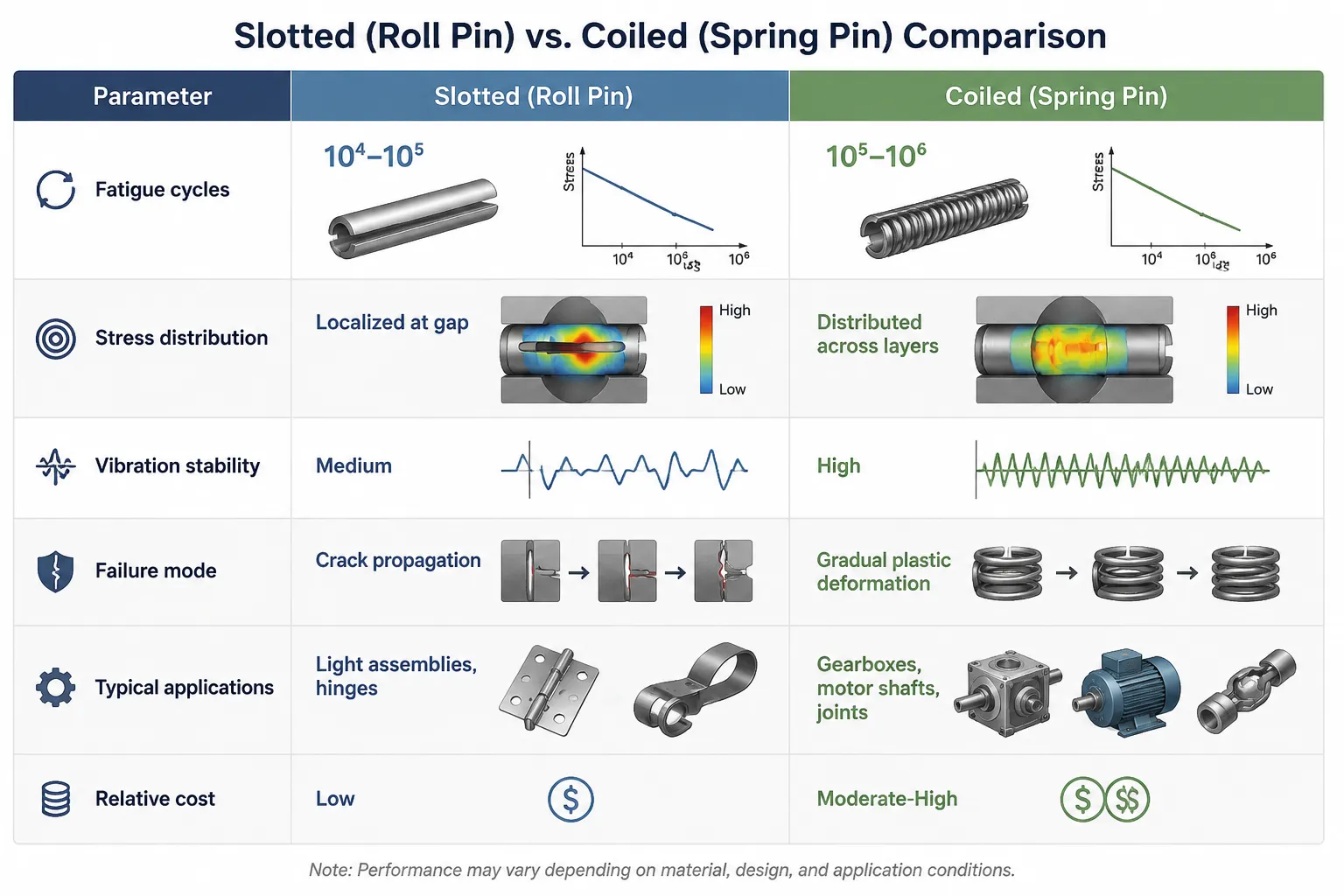
| Parameter | Slotted (Roll Pin) | Coiled (Spring Pin) |
|---|---|---|
| Fatigue cycles | 10⁴–10⁵ | 10⁵–10⁶ |
| Stress distribution | Localized at gap | Distributed across layers |
| Vibration stability | Medium | High |
| Failure mode | Crack propagation | Gradual plastic deformation |
| Typical applications | Light assemblies, hinges | Gearboxes, motor shafts, joints |
| Relative cost | Low | Moderate-High |
Typical applications:
-
Gearbox assemblies
-
Electric motor shafts
-
Robotic articulation joints
-
Precision indexing systems
-
When Slotted Pins May Be Preferred
- While coiled spring pins offer superior fatigue performance in many dynamic applications, slotted spring pins may be preferred in cost-sensitive or low-cycle static applications.
Their simpler geometry can reduce manufacturing cost and may be suitable where vibration and cyclic loading are minimal.
Structural Engineering Mechanics
Engineering Performance Model
| Parameter | Slotted Pin (Roll Pin) | Coiled Pin (Spring Pin) |
|---|---|---|
| Fatigue cycles | 10⁴–10⁵ | 10⁵–10⁶ |
| Stress distribution | Localized | Distributed |
| Vibration stability | Medium | High |
| Failure mode | Crack propagation | Gradual plastic deformation |
Engineering Insight:Cyclic loading of elastic dowel pins under test conditions varies substantially with the type of material and structural design or use, but when installed properly, they may resist fatigue for 10k to 100k cycles before failure.
Fretting Wear Mechanism
Fretting wear occurs due to micro-scale relative motion between pin and bore under vibration.
Vibration direction
    ↓
┌──────────┐
│   Pin    │ ←→ micro-slip
├──────────┤
│  Bore    │
└──────────┘
Oxide debris builds up over time and is the cause of surface fatigue initiation and loss of interface integrity. Contact stress can be distributed over multiple layers through coiled structures to reduce the impact of fretting.
Vibration–Fatigue Coupling Effect
Fatigue failure is strongly influenced by vibration frequency (50–2000 Hz in industrial systems).
Stress Amplitude
    ↑
    │         /\
    │        /  \    ← resonance peak
    │       /    \
    │      /      \
    │─────/────────\─────→ Frequency (Hz)
    │    50        2000
Resonance causes a huge increase in stress amplitude on an object, resulting in quicker crack initiation and a much lower threshold for ultimate failure.
Bore Material Interaction System
| Bore Material | Behavior |
|---|---|
| Aluminum alloy | Deformation sensitivity – requires tighter tolerance |
| Cast iron | Brittle stress concentration – risk of bore cracking |
| Steel housing | Stable – but tolerance-sensitive |
Non-Linear Fatigue Behavior Model
Three distinct stages of fatigue failure are observed including stable cyclic zones, microcracking, and rapid development of cracks.
Stress (MPa)
    ↑
  900 │ *
      │   *      ← slotted pin
  600 │      *
      │         *
  300 │            *  ← coiled pin (higher life)
      │→ Cycles (log)
         10⁴    10⁵    10⁶
Coiled pins delay transition into phase 3 due to distributed stress geometry.
Manufacturing & Metallurgy Engineering Layer
Cold-forming process produces elastic pins and are subsequently subjected to heat. The materials used to make elastic pins are: carbon steel at (40-50 HRC), stainless steel (35-45 HRC), and alloy steel (45-55 HRC).
| Parameter | Range |
|---|---|
| Shear stress range | 300–900 MPa |
| Fatigue life | 10⁴–10⁶ cycles |
| Interference fit tolerance | 0.01–0.03 mm |
Interference fit: There is a radial stress build-up after assembling when the outer diameter of a pin fits tighter than the bore diameter.
Engineering Standards Deep Layer
| Standard | Scope |
|---|---|
| ISO 8752 | Dimensional retention and tolerance system |
| DIN 1481 | Slotted geometry stress distribution limits |
| ASTM A684 | Steel strip grain structure control |
| SAE J463 | Vibration fastener application zones |
Roll pins are standardized under international specifications such as ISO 8750 (slotted spring pins) and ISO 8748 / ISO 8751 / ISO 8752 (coiled spring pins).
These standards define key parameters including dimensional tolerances, hardness requirements, and mechanical performance under shear load conditions.
According to ISO mechanical fastening guidelines, spring pins are designed to maintain consistent radial force after installation, ensuring secure retention in dynamic assemblies.
OEM Supply Chain Variation Model
| Parameter | Expected Deviation |
|---|---|
| Hardness | ±2–5 HRC |
| Coating thickness | ±3–8 μm |
| Strip thickness | ±0.01–0.03 mm |
Failure Case Engineering Analysis
Case 1: Pin cracks develop slowly due to the total amount of torque oscillation, which affects how fast they will spread.
Case 2: EV motor misalignment – improper interference fit caused micro-slip leading to bearing wear.
Case 3: Robotics joint fatigue – cyclic load caused localized fretting at bore interface.
Field applications have shown that improperly selected slotted pins may lead to localized stress concentration at the slot edges, increasing the risk of hole wear or micro-cracking under cyclic vibration.
Coiled pins, due to their multi-turn structure, tend to better absorb dynamic loads and reduce peak stress concentration.
Micro-Motion and Fretting Wear in Elastic Pins
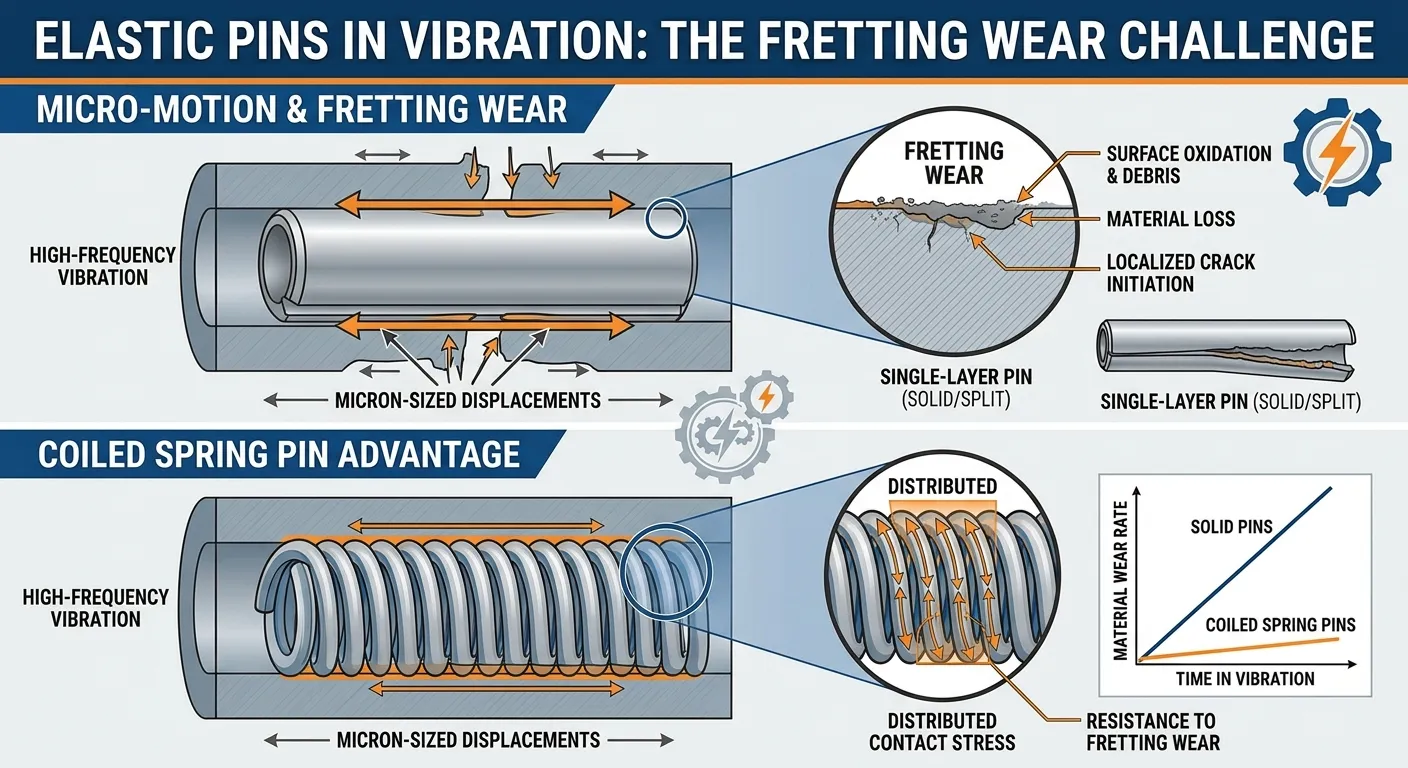
One of the most commonly ignored causes of malfunction in high-frequency vibration assemblies is the wearing down of springs and roll pins from micro-movement (fretting wear) at the connection point.
Fretting wear occurs due to small relative movements (micron-sized displacements) occurring continuously between the surfaces of the pin and the wall of the bore; over time this results in:
-
Surface oxidation debris formation
-
Progressive material loss
-
Reduction in interference fit effectiveness
-
Localized crack initiation
Because of their multi-layered design, coiled spring pins resist fretting wear by providing contact stress distribution over several areas rather than just one.
Most manufacturers do not mention this method of operation in their product literature but it plays a vital role in an automotive driveline and electric motor applications.
Our Manufacturing Capability
At Qiyi Fastener, we have 50,000 sq. ft. of manufacturing space and more than twenty years of experience producing precision fasteners. We produce approximately 12 million elastic pins each year using our advanced cold-forming equipment, automated heat-treat ovens, and digital CMM (Coordinate Measuring Machine) inspection stations to assure consistent, quality repeatability for each of our high-volume runs. We supply primarily Tier-1 automotive manufacturers and robotics OEMs throughout North America and Europe.
Case Study: EV Motor Shaft Assembly
When a leading manufacturer of electric vehicles experienced sporadic noises and premature wear of their motor components, they contacted the Qiyi Fasteners team for assistance. We recommended switching from standard slotted pins to coiled pins with tighter interference fit (+0.02 mm) and implemented that recommendation. The result was that the failure rates dropped by 70%, and the manufacturer saw approximately 40% reduction in warranty claims. This was accomplished, according to their lead design engineer, “thanks to the technical support and custom solutions provided by Qiyi Fasteners.”
Buyer’s Guide
When sourcing roll or spring pins, consider:
-
Verifiable ISO 8752 certification
-
Batch traceability with hardness and dimension reports
-
Application engineering support for fit selection
-
Lead time and minimum order flexibility
For critical fatigue applications, always choose coiled pins with documented S-N curves.
| Property | Slotted Spring Pin | Coiled Spring Pin |
|---|---|---|
| Insertion Force | Higher variation | More consistent |
| Vibration Resistance | Moderate | High |
| Hole Stress | Higher localized stress | Distributed stress |
| Cost | Lower | Slightly higher |
| Fatigue Life | Moderate | Higher |
Engineering Insight: The selection between slotted and coiled spring pins should be based on application requirements, including load type, vibration intensity, material hardness, and assembly method.
In engineering practice, no single pin type is universally superior; selection should follow functional requirements rather than general preference.
FAQs
Q: Can roll pins and spring pins be used interchangeably?
A roll pin will generate localized stress at the point of separation while a spring pin distributes that stress over all layers. A spring pin should not be replaced with a roll pin without a thorough check for possible premature failure.
Q: In gearboxes and motor shafts, why is the coiled pin preferred?
During normal operation and use of such environments, the vibration levels are much higher than with most other environments. Therefore, crimped pins provide superior performance compared to all other forms of mechanical fastening regarding both fatigue and shock.
Q: Do the two pin types differ in anti-rotation capability?
Yes. Coiled pins generate more uniform frictional torque along the bore contact area.
Q: Why does my pin loosen over time?
There may be multiple causes of vibration around a certain frequency (resonance). Some possibilities include the following: having an improper fit between components (the difference in diameter is greater than 0.01 mm), the material of the bore being soft, and wear due to fretting. A vibrational analysis can be performed to analyse the frequency at which these vibrations occur.
fretting wear: Micro-oscillatory motion (i.e., pin to bore interface) caused by vibration can create surface damage, which generates oxide debris and results in a loss of interference.
Q: What factors accelerate fatigue failure?
Corrosive atmosphere at high temp and cyclic frequency both misaligned when mounted.
Q: How to distinguish material defect from design error?
Radial compression/delamination is indicative of issues with coating substrate or thermal processing, while axial fracture/bore wear suggests problems with the design of that component. Further evidence of these types of failures can be obtained through the use of both a scanning electron microscope and hardness testing on any components that have failed.
Q: ISO 8752 vs DIN 1481 – which is stricter?
ISO 8752 specifies the testing methods for elastic and dimensional retention to ensure a tighter fit between goods that move through modern international supply chains.
Q: Are coiled pins significantly more expensive?
The more intricate nature of manufacturing has created higher unit costs for manufacturing steel rather than light-weight metals. Although it is common for steel to be more expensive per pound than light-weight metals, it is ultimately a better value because of the reduced amount of time spent repairing high-fatigue application machinery and equipment than light-weight metals.
Q: Are spring pins being replaced in EV motors?
The predominant use of coiled pin arrangements in many applications is still quite evident, while other fastening methods like using solid wood dowels are being increasingly used. An example of this would be that coiled pins are commonly used to attach motors to their roter’s, or to mount encoders onto sleeves that are the same size as the rotary gear carrier for use with a planetary gear carrier.
Q: How can pin design mitigate fretting wear in robotic joints?
Using both spring pins that have a nitrided or diamond-like carbon coating on their outside surface as well as an increase in the interference fit to .02 to .03 mm will allow for optimal contact between the two surfaces when applying an assembly lube that is adequately lubricated.
References
-
ISO Fastener Standards → https://www.iso.org
-
DIN Standards Database → https://www.din.de
-
ASTM Materials Standards → https://www.astm.org
-
SAE Engineering Library → https://www.sae.org