The engineering and manufacturing industries are changing rapidly, and mechanical stability relies heavily on small components such as conical disc spring washers. The purpose of these washers is to provide evenly distributed loads, absorb shock/vibration, and increase the overall strength of the structure. This guide will explain the purpose, type, size, and applications of conical disc spring washers in order to help you understand how they can be utilized in your designs. You will also find answers to the most commonly asked questions, along with the appropriate professional responses as per current industry studies and statistics.
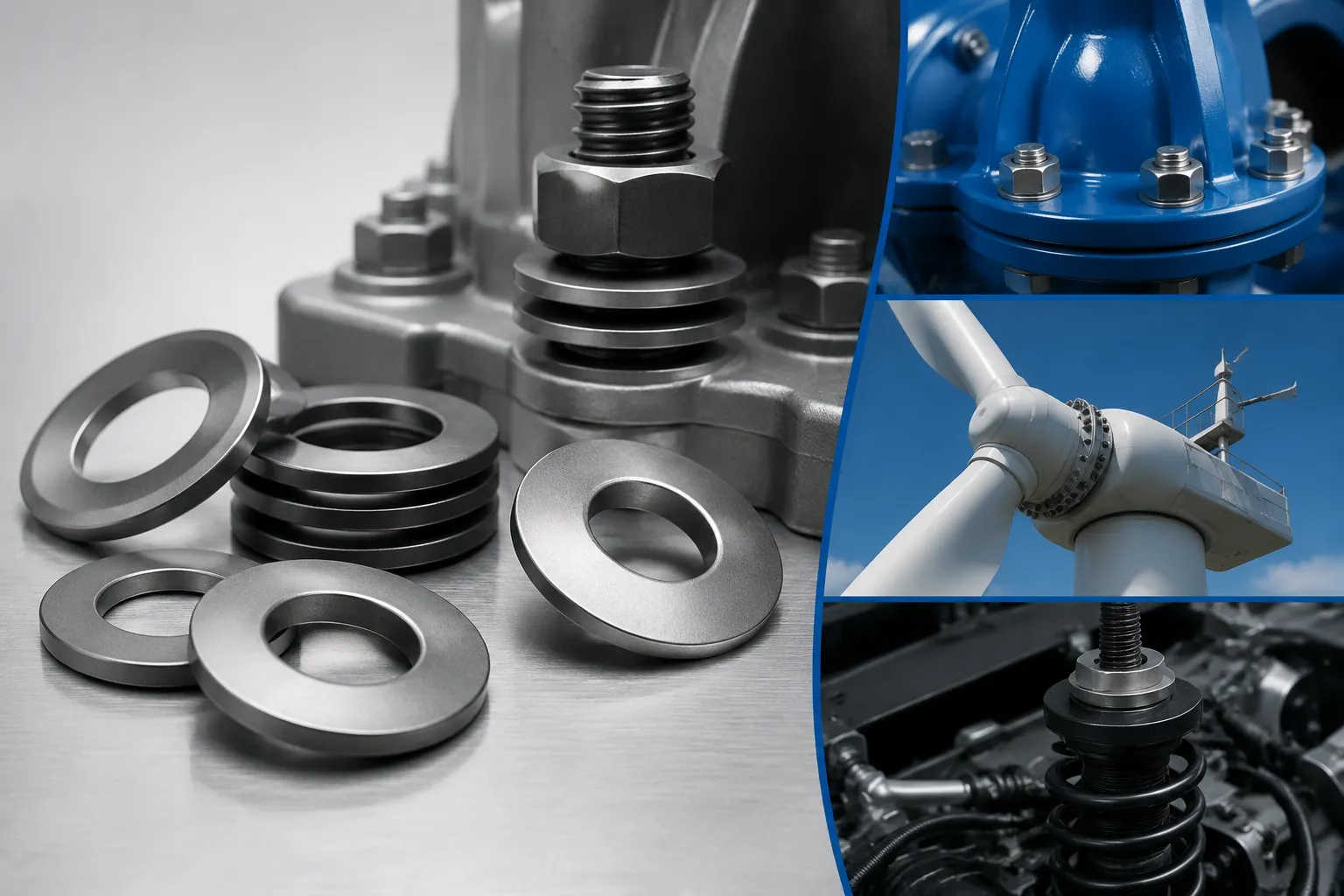
What is a Conical Disc Spring Washer?
As its name suggests, the conical disc spring washer is a conically shaped washer used in mechanical assemblies as a supporting piece to provide pressure for bolts and other fastening hardware. It’s important to note that conical disc spring washers can be used in both dynamic applications (where loads are applied and removed) or static ones (where loads remain constant).
When weight is applied directly on top of the conical disc spring washer (in other words, as force is exerted directly onto the washer), the center portion of the conical disc spring washer will deform outwardly, thereby creating uniform distribution of any force(s) being applied over the entire surface area of all supported hardware.
Additionally, conical disc spring washers, by virtue of their unique cone-shaped design, will prevent the loosening of fastener hardware pieces which can result from vibration generated by dynamic (i.e., moving) applications. The majority of conical disc spring washers are manufactured from various high-grade materials, such as carbon steel, stainless steel, and other many types of exotic materials toxic to the environment; however, they may also be manufactured using non-toxic/low-toxicity materials as well.
According to several studies regarding the disc spring washer market, the global market for disc spring washers is projected to grow by an average of 5.8% annually from 2023 to 2030 due to increased usage across multiple industries benefiting from their improved functionality. Additionally, the use of disc springs instead of traditional leaf springs provides users with an improved performance. (1)
Functions of Conical Disc Spring Washers
A conical disc spring washer has multiple functions due to its special shape/geometry:
1. Load Distribution
A washer acts to distribute the load across an increased area, thereby reducing the likelihood of developing stress concentrators that could cause a failure.
2. Vibration Dampening
Many machines create a lot of vibration as they are constantly moving, which can cause nuts and bolts to become loose over time. This type of washer has the capability to absorb vibrations created by the machine, thereby reducing the chances of failure occurring in a joint assembly.
3. Compensation for Relaxation or Creep
Due to high or low temperatures as well as other deformities over time, the washer compensates for the potential for loss of clamping force from relaxation (creep) of an affected (heat) material.
4. Increased Longevity of Components
Conical Washers are used to reduce wear-and tear, increase the total lifetime, and add to the overall durability of any mechanical or structural component with conical washers.
Exploring the Types of Conical Disc Spring Washers
There are several different kinds of conical disc spring washers, and they all have a different purpose. Being aware of them will assist you when trying to determine which one is appropriate for your situation.
| Type | Material | Key Features | Applications |
|---|---|---|---|
| Standard Conical Washers | Stainless steel, carbon steel | General-purpose, cost-effective | Construction, automotive |
| High-Temperature Washers | Inconel, titanium | Resistant to extreme heat | Aerospace, turbines |
| Corrosion-Resistant Washers | Galvanized steel, coated alloys | Protection against corrosion | Marine, chemical plants |
| Custom Washers | Custom materials | Designed for specific needs | Unique industrial requirements |
Importance of Disc Spring Washer Dimensions
The washer’s performance is determined by the dimensions of a disc spring washer and are significant in determining resistance to or flexibility to load through the outer diameter, inner diameter, thickness and height of the cone.
Here is a breakdown of the key dimensions and their importance:
| Dimension | Function |
|---|---|
| Outer Diameter | Defines the total surface area for load distribution |
| Inner Diameter | Determines compatibility with bolts or screws |
| Thickness | Impacts the stiffness and load-bearing capacity |
| Overall Height | Affects the amount of deflection or compression |
Advanced Applications of Conical Disc Spring Washers
Conical washers can be used in many different types of applications, such as:
1. Renewable Energy
Wind turbines use these unique types of washers to assist in securing and retaining all kinds of fastened items regardless of how much vibration and wind pressure is exerting on them.
2. Military and Defense
Conical or cone-shaped washer has strong characteristics as well as being dependable defence inventories and is used extensively in many service types including tanks, aircrafts and ships to provide structural strength and dependability for various defence equipment.
3. Industrial Machinery
Industrial equipment like conveyors and heavy loading machines use vibration resisting conicals to lessen the number of replacement cycles for parts, and to increase the life of industrial machinery.
4. Railways
The rail industry utilizes these washers to securely fasten rails to sleepers and resist vibration caused by high-speed traffic or heavy loads on rails.
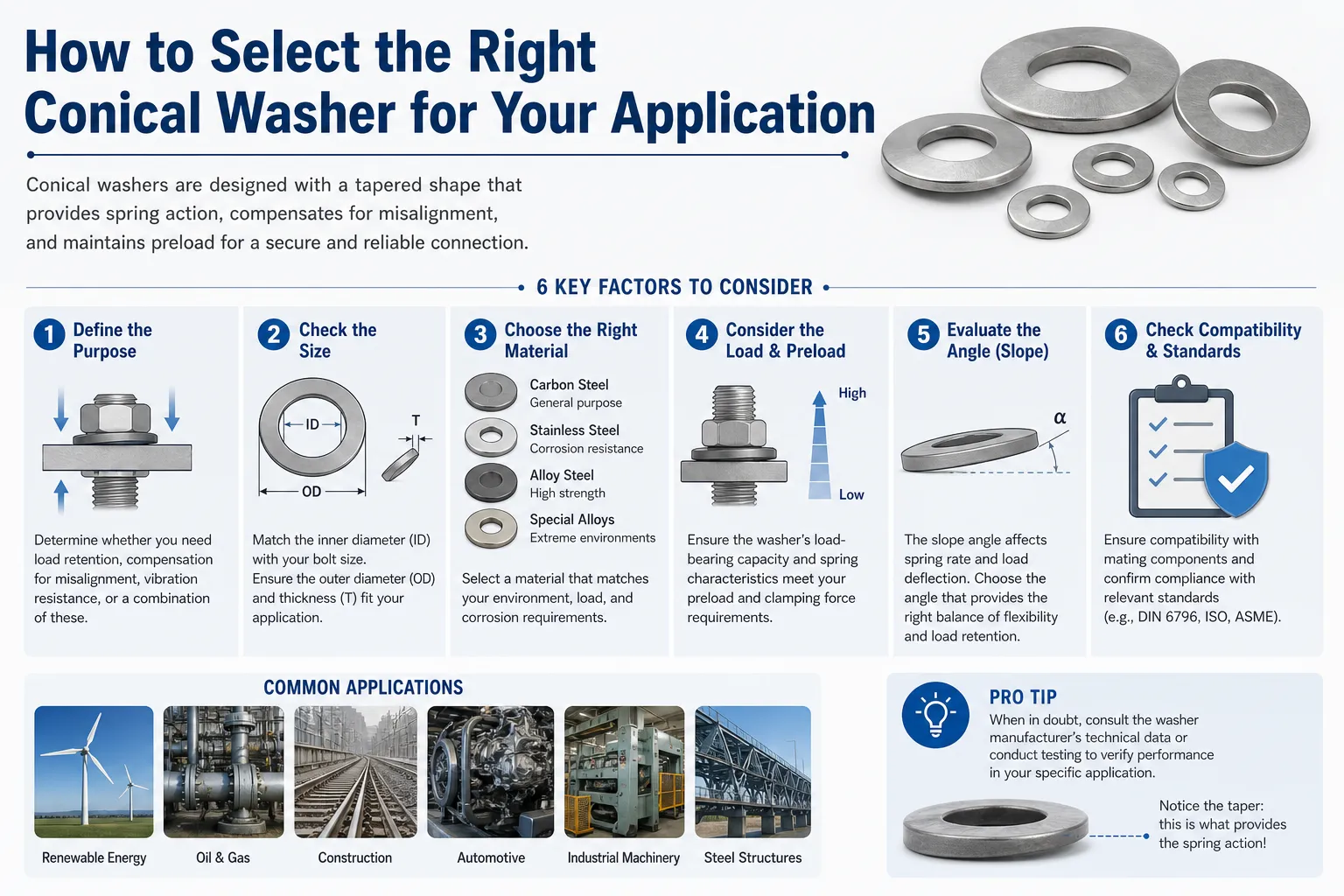
How to Select the Right Conical Washer for Your Application
When choosing a conical washer, consider the following:
1. Load Requirements: Before selecting gasket washers, it is essential to know exactly how much load your application will experience under max and minimum loads.
2. Environmental Factors: Consider the operational environment, such as temperature and exposure to corrosive substances.
3. Material Compatibility: Select a material for the washer that is compatible with bolts, nuts and the surrounding materials to ensure minimal rust and/or corrosion and/or degradation occurs on both parts.
4. Standards Compliance: If you are using disc spring washers, ensure the washer you choose is compliant with the industry safety specification for washers: DIN 2093 (ISO 2093) or similar; otherwise it might not function properly or safely.
FAQs
What exactly does a conical washer do?
Great Question! A conical washer helps distribute the load evenly across a surface, relieve vibrations and keep your fasteners tight against changing temperature (due to high heat or severe vibration). You could think of structural stability as the unsung hero of the washer – it is doing all of its work “behind the curtain.”
Are conical spring washers and Belleville washers the same thing?
Unquestionably true! A Belleville-type washer is basically like a conical-shaped spring washer (the letters “B” represent “belle”). The name of the Belleville-shaped washer is taken from Julian F. Belleville, the developer of the conical springs’ widespread use.
How do I know if I need a conical washer?
When subjecting your project to rigorous loads, bending and vibration, conical washers become a viable option because of their superior ability to handle these stresses. In addition to providing great support when assembling bolted joints, there may also be instances where conical washers are ideal for maintaining ongoing force and preventing the complete or partial loosening of fasteners after completing assembly processes.
Can I reuse a conical washer?
Multiple factors determine whether or not you should reuse a conical washer. If you have used a high-quality conical washer made from durable materials like stainless steel or aluminum and there is no evidence of excessive wear, deformation or damage (i.e., rust, corrosion), then you can potentially reuse them.; however, even though you meet the criteria for reusing conical washers, it may be best to replace them anyway because you do not have proof that they will perform properly in the future without testing first.
Is there a difference between disc springs and Belleville washers?
Although disc springs (spring-like structures) and Belleville washers (type of disc spring) technically refer to both; however there is no overlap between the definitions of the two. As a result of this each Belleville washer is a disc spring. However, the opposite is not true.
Can I use standard conical washers in high-temperature applications?
Certain cone-shaped washers can’t be used in high heat. If you want to use a washer in high heat applications, look for one made of a heat-resistant metal like Inconel. Or find another specialized alloy with properties suitable for the high temperatures that could occur.
What is the difference between a regular flat washer and a conical washer?
The purpose of a normal flat washer is to space things or distribute loads over a wide area; however, because of their shape, conical washers provide some “spring” characteristics. Therefore, you could say conical washers are better at absorbing shock (or vibration) and maintaining tension on a bolt in a bolted connection than flat washers are.
What’s the best way to measure washer size?
To assess the fit and support of a washer, you must evaluate its external diameter, internal (or hole) diameter, thickness (in uncompressed state), and height. You will use the data collected from these measurements of the washer you are evaluating to answer whether it will be able to hold the load for which you intend to use it.
Are there standard specifications for disc spring washers?
Conical washers exist as standard specifications in both DIN 2093 & ISO 2093 for the purpose of providing uniformity with respect to the dimensional size of each individual conical washer (including material quality) as well as load carrying capabilities.
How do I install a conical washer correctly?
The process for installing parts is quite easy; however, there is one key installation rule that must be followed. The curved side of a dome must always point away from the mounting surface to produce adequate pressure to hold the joint under tension. Additionally, confirm all torque values after installation, and completely tighten all assemblies to prevent removing torque after installation.
What’s the difference between conical washers and lock washers?
Lock washers and conical washers are two types of washers used to fasten parts together. However, they work using different principles. A conical washer provides tension through its elastic deformation and also absorbs shock. Unlike conical washers, which use their elasticity to create tension, lock washers are a mechanical means of preventing fastener rotation, by having split or serrated edges.
Conical Disc Spring Washers are an essential part of many commercial or industrial applications. They’re able to accommodate heavy loads, absorb vibration and endure extreme conditions; as such, their application will make your engineering or manufacturing systems work properly. By learning about the features, applications and best practices related to Conical Disc Spring Washers you will be in a position to make an informed decision.
Got Questions About Conical Or Disc Spring Washers? Contact One Of Our Experts For Assistance! We Can Offer You Personalized Support Based On Your Needs. We Want To Help You Make The Best Decision For Your Project!
References: