When Li Wei, a procurement engineer in Shenzhen, found an enclosure door swinging shut during service, he replaced the hinge; within an hour, the replacement scraped the frame and pulled the gasket out of alignment. The reversal came when the team measured door mass, center of gravity, hinge spacing, stop angle, and latch force: the failure was a selection and installation mismatch, not simply a bad hinge.
How does a locking door hinge hold an industrial door in position?
A locking door hinge generally describes a hinge with detent, friction, torque, spring, pin, or another position feature. It can resist drift, keep a panel at a service angle, or limit uncontrolled swing. The word “locking” describes hinge behavior here; it does not necessarily mean that the closed opening resists unauthorized entry.
For an initial engineering screen, calculate door moment as applied force multiplied by the perpendicular distance from the hinge axis. Record required positions, such as 0, 45, and 90 degrees, and state whether the door must hold, resist, or close from each. A repeatable torque measurement, angle check, and cycle test at the intended temperature are more useful than an unqualified catalog adjective.
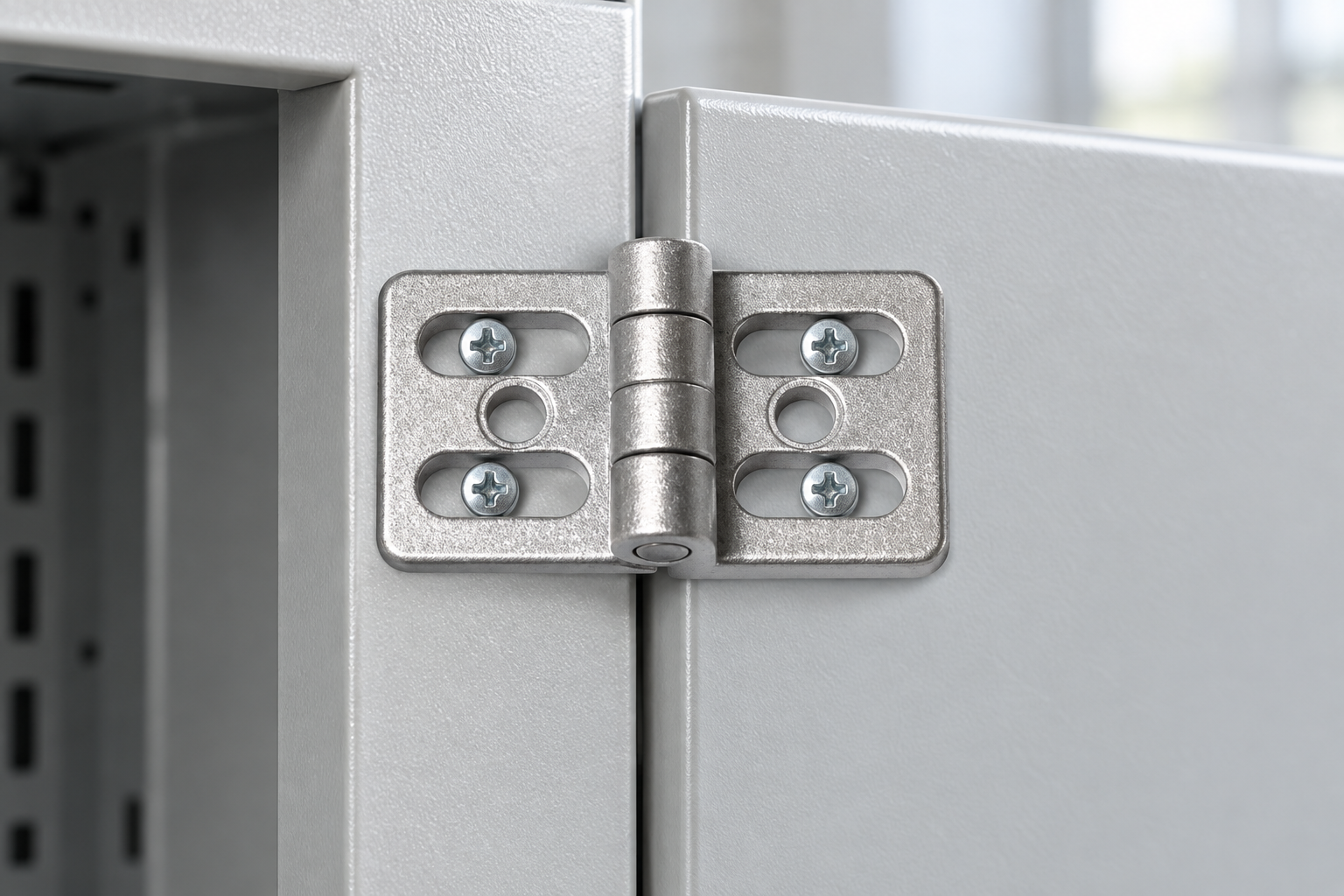
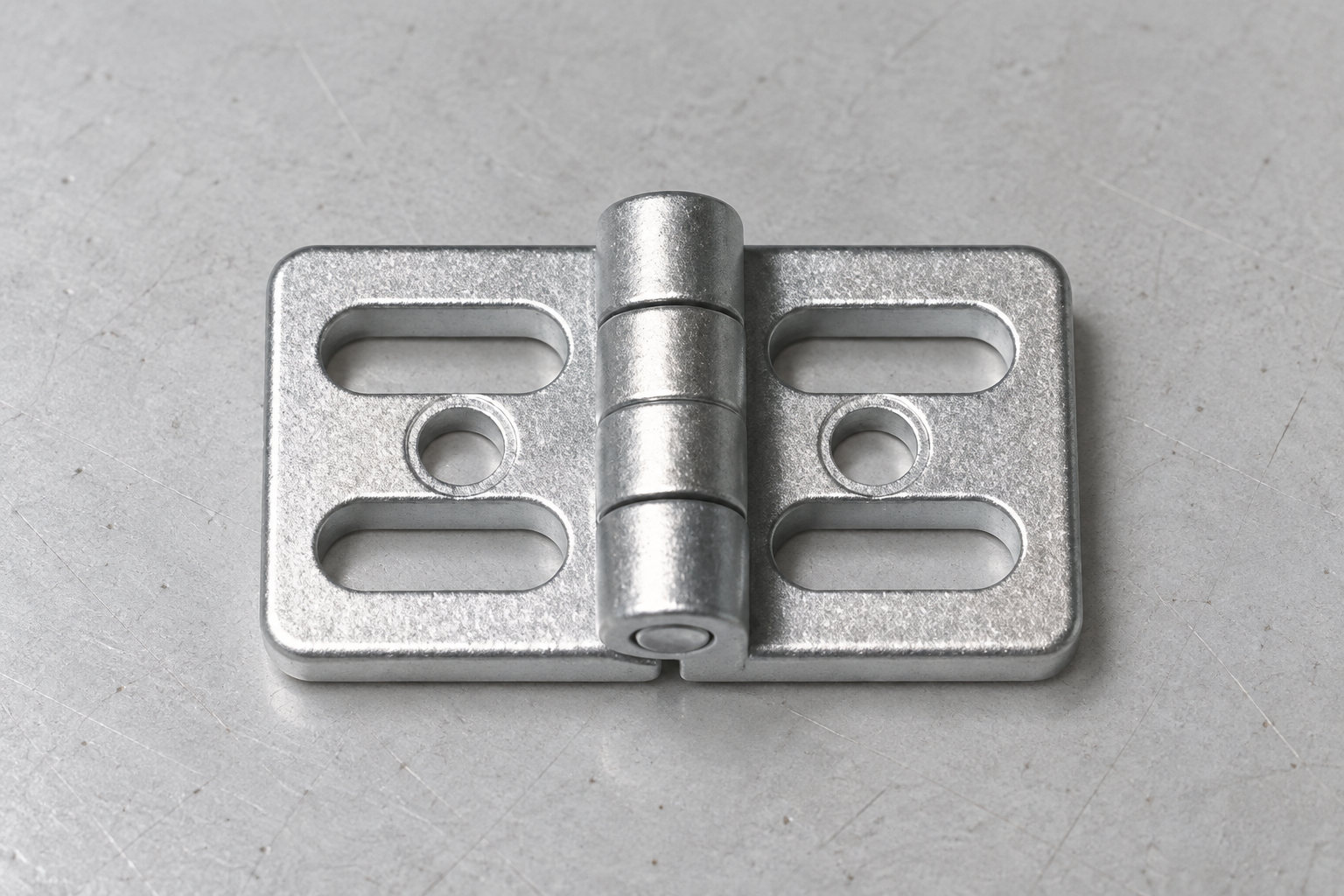
For a visual starting point, Qiyi’s locking door hinge product reference identifies a zinc alloy hinge family for outdoor cabinets and industrial equipment. The product page is a hinge reference with durability and corrosion-resistance language; it does not by itself establish a security-lock, fire-door, or safety-interlock certification, and buyers should request the drawing and performance conditions for the intended assembly.
When does a door hinge lock need a separate latch or access device?
Model the opening as closed and latched, closed and locked, released, opening, held open, and closing. A door hinge lock may support position retention, while a latch, keyed cylinder, cam, hasp, interlock, or electronic device normally controls whether the closed door can be opened. Some industrial doors need both functions; others need only a plain hinge and latch.
Procurement documents should state access separately from motion. If the door must remain at 105 degrees during service, specify the retention angle and expected torque. If it must prevent unauthorized entry, specify release method, authorized users, emergency-release needs, and defeat scenarios for the separate access device. A hold-open mechanism is not a security control.
| Hardware approach | Primary function | Useful verification | Unit-cost tendency | Total-cost consideration |
|---|---|---|---|---|
| Plain hinge plus latch | Door rotation and closed-door retention | Alignment, latch engagement, fastener retention, cycle test | Often lower for standard doors | May need a separate service prop or hold-open device |
| Position-holding hinge | Resists drift or holds a selected angle | Opening torque, angle retention, cycle and temperature checks | Often higher than a plain hinge | Can reduce handling time and damage from uncontrolled swing |
| Hinge plus keyed or cam access device | Movement support plus controlled entry | Latch engagement, release, keying, defeat and system tests | Varies with the access device | Commissioning and documentation can exceed the hardware difference |
| Guard-door interlock system | Controlled access to a machine hazard | Risk-assessment-driven functional verification | Application dependent | Safety architecture, diagnostics, and validation affect TCO |
A door hinge lock request should therefore identify what happens when power is removed, the door is pushed, the latch is released, or the operator needs emergency egress. The complete door, frame, fasteners, seal, stop, latch, and hinge must work together; a hinge label cannot establish the behavior of the whole opening.
Which hinges and locks for doors variables control performance and total cost?
Buyers often search for hinges and locks for doors as if one component can solve alignment, retention, durability, and access at once. Separate the variables that control the hinge from those that control the opening. Record door dimensions, mass, center of gravity, hinge quantity and spacing, mounting substrate, opening envelope, cycles per day, contamination, corrosion exposure, temperature, and operator force.
Use project-set targets rather than invented universal ratings. For example, a team may choose an illustrative target of 5,000 or 10,000 opening cycles, then define checks for torque, alignment, pin retention, and fastener tightness before and after testing. If the door faces vibration or outdoor moisture, include representative exposure and inspect the hinge afterward.
| Application | Primary decision | Evidence to request | Main cost driver |
|---|---|---|---|
| Electrical or controls enclosure | Hold-open angle, clearance, corrosion, seal compression | Drawing, material, torque data, mounting guidance, cycle method | Alignment rework and environmental durability |
| Service access panel | Operator handling and safe maintenance access | Door mass and center-of-gravity assumptions, installed test record | Labor time, door damage, and repeat adjustments |
| Machine guard door | Risk reduction and controlled access to hazards | Risk assessment, interlock architecture, validation records | Safety validation and commissioning |
| Outdoor equipment cabinet | Material compatibility and exposure resistance | Material information, finish details, exposure assumptions | Corrosion, replacement access, and field service |
The hidden cost is often installation variation. As an illustrative calculation, eight extra minutes of adjustment on 150 doors equals 1,200 minutes, or 20 labor hours, before travel, downtime, damaged seals, or replacements. Reviewing Qiyi’s locking-hinge assembly guide can align terminology, but the selected product still requires assembly-specific evidence. A plastic hinge reference can help compare form factors, mounting holes, and material options.
What standards apply when hinges and locks for doors are used on industrial openings?
Standards and regulations apply to the intended opening and market, not merely to the search phrase hinges and locks for doors. These sources help define buyer questions, but none should be converted into an unsupported certificate for a generic zinc hinge.
- ANSI/BHMA A156.1 is a relevant butt-hinge standard reference. Confirm edition, scope, test conditions, and project applicability; the reference does not make every hinge compliant.
- NFPA 80 concerns fire doors and other opening protectives. It applies only when the opening is in scope and the responsible authority requires the applicable listed or approved assembly; a zinc hinge description is not a fire-door certification.
- 29 CFR 1910.36 addresses exit routes in the cited U.S. workplace regulation. It is an egress requirement, not a hinge test; local code and the responsible authority determine obligations.
- 29 CFR 1910.212 covers general machine-guarding requirements. It may affect guard-door design, but it does not certify a hinge or interlock product.
- US Access Board ADA Chapter 4 provides accessibility provisions for doors and gates. Verify adopted code, clearances, operating force, hardware, and project conditions; a hinge alone does not establish compliance.
Unsupported claims such as “secure,” “rated,” “fire rated,” or “code compliant” can shift specification risk to the buyer and complicate approval, liability, and replacement decisions. Confirm applicability by destination market, door construction, intended use, and planned marketing claims. Keep test reports, drawings, and authority decisions with the project record.
How should procurement teams specify and validate a locking door hinge?
A usable purchase specification turns the phrase locking door hinge into measurable requirements. Identify door and frame materials, dimensions, mass, center of gravity, hinge spacing, opening angle, retained positions, cycle target, environment, mounting interface, finish, and any separate latch, cylinder, cam, or interlock. Ask the supplier to state the conditions behind published performance figures.
- Write the operating states: closed, latched, locked if required, released, opening, held open, and closing.
- Capture geometry and loads, including door mass, center of gravity, hinge axis, spacing, stop location, seal compression, and likely misuse.
- Request a drawing, material information, installation guidance, stated test method, cycle data, and limits of use; do not infer a rating from a photograph.
- Build one representative door and record alignment, opening force, retained angle, latch engagement, clearance, and fastener condition before and after cycling.
- For machine guards, exits, or fire openings, keep the risk assessment and responsible-authority decision linked to the hardware approval record.
Qiyi Fastener can support sourcing with dimensional and application information for industrial hardware. The decision point is whether the selected part, mounting method, and separate access device perform together under actual door conditions. Request project-specific evidence rather than relying on a generic “heavy duty” or “locking” label.
Frequently Asked Questions
What are the different types of locking hinges?
Common categories include detent hinges, friction or torque hinges, spring-assisted hinges, pin-retaining designs, and hinges with a dedicated position-stop feature. A locking door hinge in one catalog may hold an angle, resist drift, or provide a service position; those behaviors are not interchangeable. Confirm the mechanism, angle range, test load, and cycle method for the intended door.
What are the 7 types of door locks?
There is no single universal taxonomy, but procurement teams commonly discuss deadbolts, knob locks, lever-handle locks, mortise locks, rim locks, cam locks, and electronic or smart locks as seven broad categories. Industrial enclosures often use a cam or quarter-turn lock, while personnel doors may use a different architecture. A separate door hinge lock should not replace the access device selected for the threat and release scenario.
What are the best hinges for doors that automatically close?
The best choice depends on door mass, closing force, frame geometry, cycle rate, seal resistance, and any fire or egress requirement. Self-closing hinges or a separate door closer may be appropriate, but a position-holding hinge is designed to retain or resist movement and may conflict with automatic closing. Test closing and latch engagement from the required starting angles on the completed assembly.
What is the most secure type of door lock?
There is no universal most-secure lock because security depends on the threat model, credential control, door and frame construction, fasteners, installation, monitoring, and emergency release. A high-security cylinder, mortise lock, cam lock, or electronic system can fit different applications when specified and installed correctly. The hinge supports door geometry; it does not prove resistance to forced entry.
References
- https://buildershardware.com/ANSI-BHMA-Standards/BHMA-A156-1 — ANSI/BHMA A156.1 – butt-hinge standard scope and applicability should be confirmed for the project.
- https://www.nfpa.org/codes-and-standards/nfpa-80-standard-development/80 — NFPA 80 – fire doors and other opening protectives.
- https://www.govinfo.gov/content/pkg/CFR-2024-title29-vol5/pdf/CFR-2024-title29-vol5-sec1910-36.pdf — 29 CFR 1910.36 – U.S. exit-route requirements in the cited regulation.
- https://www.govinfo.gov/content/pkg/CFR-2024-title29-vol5/pdf/CFR-2024-title29-vol5-sec1910-212.pdf — 29 CFR 1910.212 – general U.S. machine-guarding requirements.
- https://www.access-board.gov/ada/chapter/ch04/ — US Access Board ADA Chapter 4 – accessibility provisions for doors and gates.
When your team is ready to turn that requirement into a documented sourcing request, review the Qiyi industrial hardware range and contact Qiyi Fastener for drawings, material options, and application evidence. The product reference is a starting point for hinge geometry; security, fire, egress, and safety decisions remain assembly- and project-specific.