“Lag screw” and “lag bolt” commonly refer to the same kind of wood fastener. Lag screw is the technical term used in Portland Bolt’s explanation; lag bolt remains a familiar name. The two labels do not, by themselves, identify different strength classes.
In a lag screw vs lag bolt comparison, the useful next step is to identify the actual part and receiving wood. A name can narrow a search, but a drawing or complete specification must settle what is being purchased.
Lag Screw vs Lag Bolt: Is There a Difference?
The naming difference is usually linguistic. It should not be turned into a table claiming that a lag bolt is stronger, longer or better suited to heavy work simply because the word “bolt” appears.
Portland Bolt describes lags as screws installed by turning their heads, normally in wood applications. Its naming explanation also identifies hex and square head forms. These details help recognize the category; they do not establish that every product sold under either name has identical dimensions.
Two suppliers can use different labels for equivalent specified parts. They can also use the same label for different variants. The procurement task is to compare those variants against the requested part, rather than treating the wording as the deciding feature.
Identify the head, shank and thread
A typical hex-head lag screw has wrench flats, an unthreaded shank portion and a coarse wood-threaded portion. The illustration shows that familiar form. Actual geometry, including the head and threaded length, belongs in the part specification.
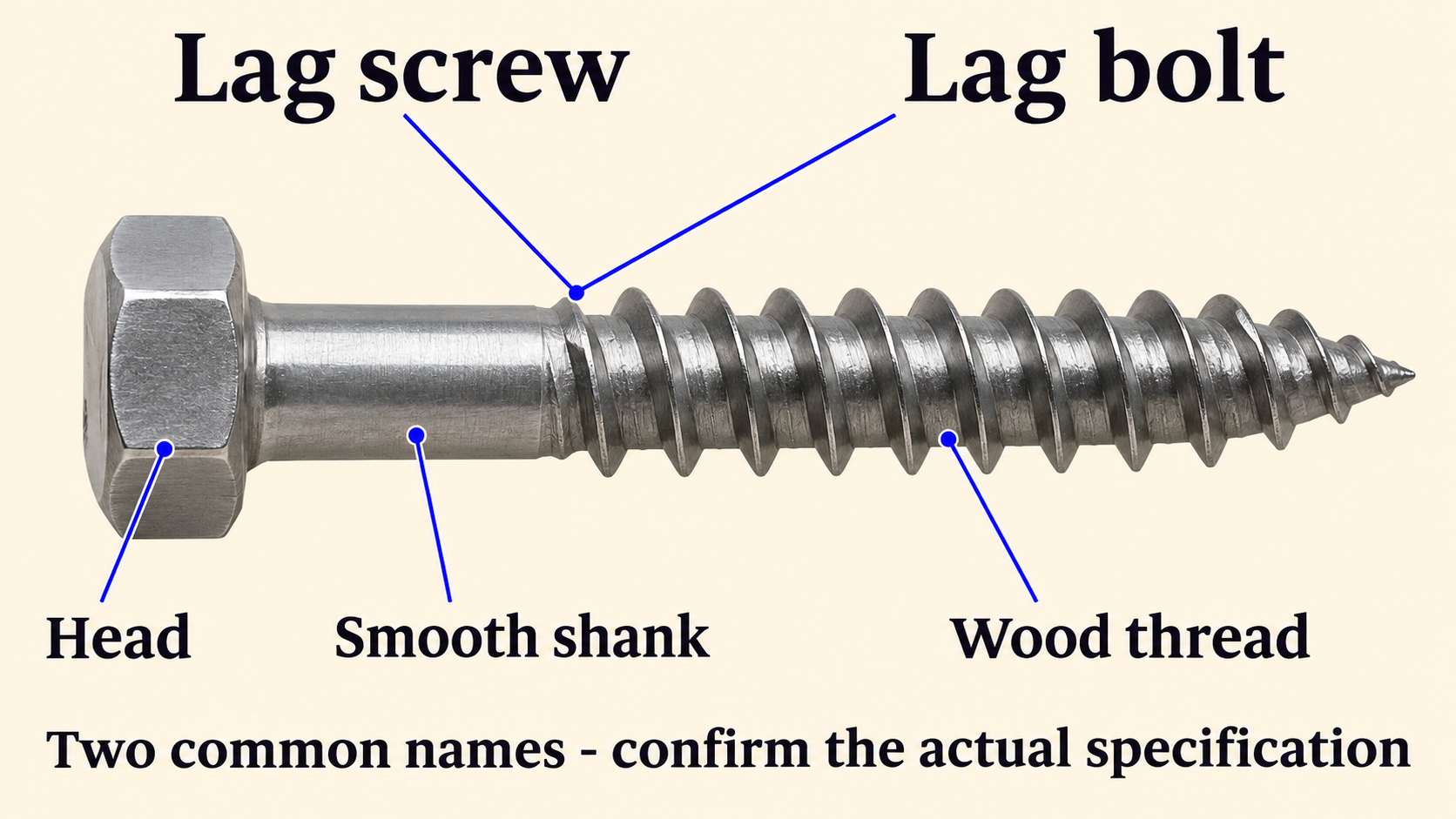
A hex head alone cannot identify a lag screw. Other fasteners also have hexagonal heads, so the thread and intended receiving part need to be considered together.
For an unidentified sample, keep the observations separate: head form, visible thread, shank and length. A photograph can communicate appearance, while the drawing supplies requirements that the photograph cannot confirm.
The screw diameter chart explains diameter descriptions. Use that distinction when reading a request: a wrench-size observation should not silently become the stated fastener diameter.
Start with the receiving member
A lag-screw selection concerns its wood connection. A machine-thread fastener used with a nut or a tapped component presents a different mating arrangement. A similar-looking head does not make those choices interchangeable.
The broader bolt versus screw guide covers nut, tapped-hole and insert arrangements. For a lag-specific enquiry, the important question is where the wood thread engages and which member receives it.
The USDA Forest Products Laboratory’s Wood Handbook treats lag screws within wood-fastening design. Its discussion connects performance with the wood and connection details. This is why the receiving material belongs in the request, rather than being left out as background information.
A useful review distinguishes the part description from the connection requirement. Purchasing may be able to confirm a proposed fastener’s identity while the responsible designer still needs to confirm whether that part is suitable for the wood assembly. These are separate decisions with different supporting documents.
Overall length does not settle threaded penetration
A length description tells only part of the selection story. The portion that engages the receiving wood must be understood in the actual assembly, alongside the fastener’s threaded and unthreaded portions.
The Wood Handbook’s lag-screw discussion uses penetration of the threaded portion when addressing withdrawal behavior. The practical lesson for an enquiry is to record the connection geometry, rather than equating a nominal overall length with effective engagement.
For example, a request may identify the desired fastener length while omitting the thickness of the member it passes through. The reader of that request cannot recover the missing assembly detail from the length alone.
Keep the drawing’s length convention and threaded-length requirements explicit. If a supplier proposes a variant with a different shank or threaded portion, review that difference against the connection. Accepting the same overall length does not automatically resolve the changed geometry.
This review does not require inventing a penetration rule. It requires locating the actual requirement and showing how the proposed part relates to it.
Hole preparation and alternatives need their own evidence
A lag-screw name does not determine the prepared-hole dimensions. The Wood Handbook discusses appropriate preboring and relates the threaded lead hole to the wood. A single pilot-hole value cannot be inferred from a generic product photograph.
Use the applicable connection requirements to resolve hole preparation. A product name or a broad “heavy duty” description leaves the receiving wood and installation conditions unanswered.
The same discipline applies when a structural wood screw is offered as a lag-screw alternative. Simpson Strong-Tie’s engineering discussion points to product-specific substitution information that includes such conditions as penetration, spacing and lumber species.
That example illustrates the evidence needed for a proposed change; it does not approve every structural screw as a replacement. Compare the exact proposed product and application with the relevant documented requirements before accepting a substitution.
Turn an ambiguous order into a usable request
An enquiry such as “Supply lag bolts for a timber bracket” communicates a category and an application. It leaves the actual part and the connection inputs unresolved.
A more useful draft request would read: “Supply the lag screw identified on the attached drawing. Confirm the specified head form, diameter, length, threaded portion, material and finish. Identify any proposed deviation. Wood-connection suitability and hole preparation remain subject to the approved connection details.”
This is an example of request wording, not an approved design. Its value is the separation between requirements a supplier can confirm and questions the connection designer must resolve.
If no approved drawing exists, mark missing information as missing. A supplier’s stock description can identify a candidate; it should not become an assumed answer to an unspecified load or installation requirement.
The successful comparison ends with an identifiable fastener and a resolved connection specification. Changing “lag bolt” to “lag screw” makes the terminology clearer, but the supporting details make the order usable.
References
Portland Bolt: lag screw and lag bolt terminology
USDA Forest Products Laboratory: Wood Handbook, Chapter 8, Fastenings (2021)
Simpson Strong-Tie: engineering questions on fasteners and lag-screw alternatives