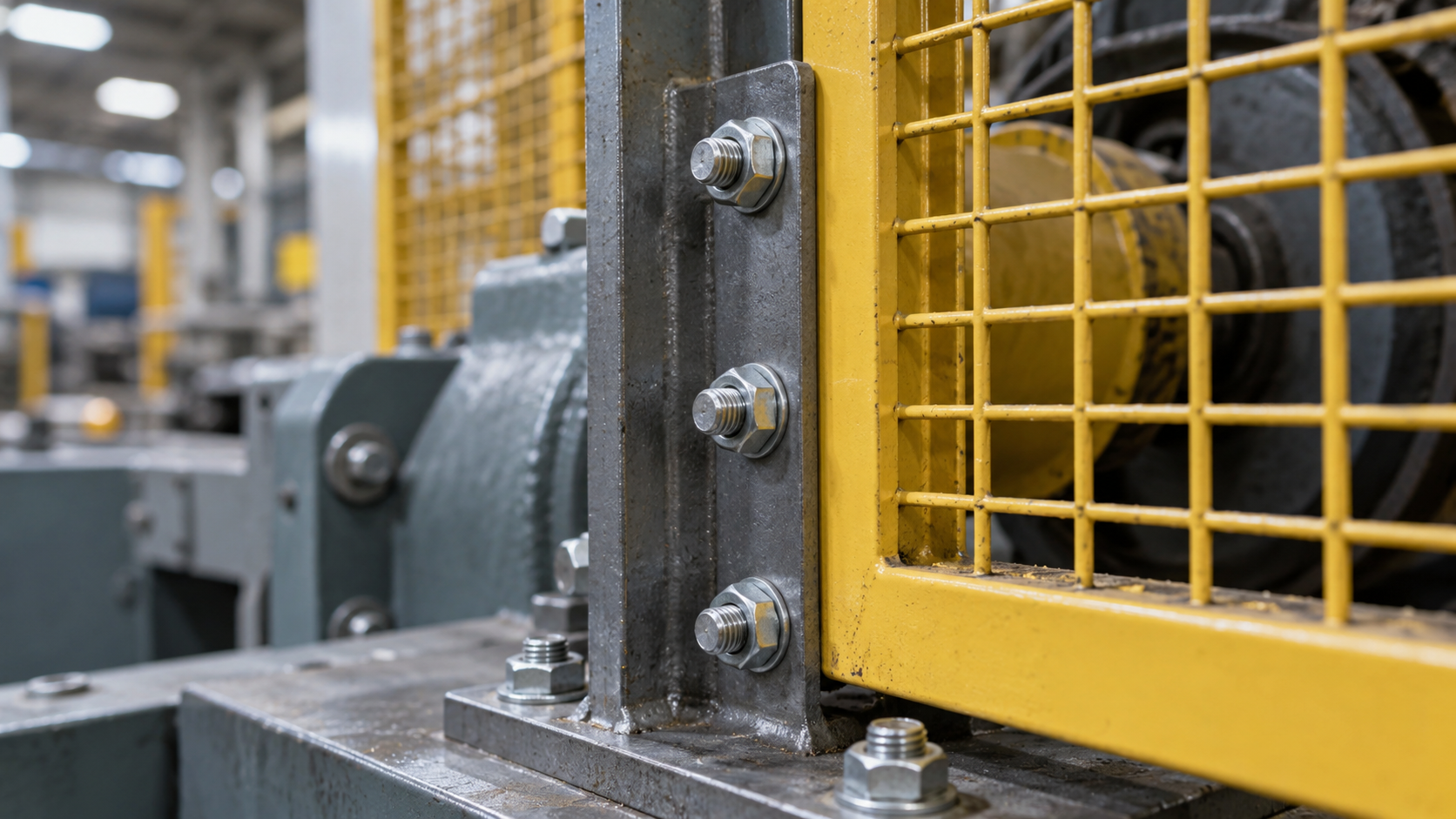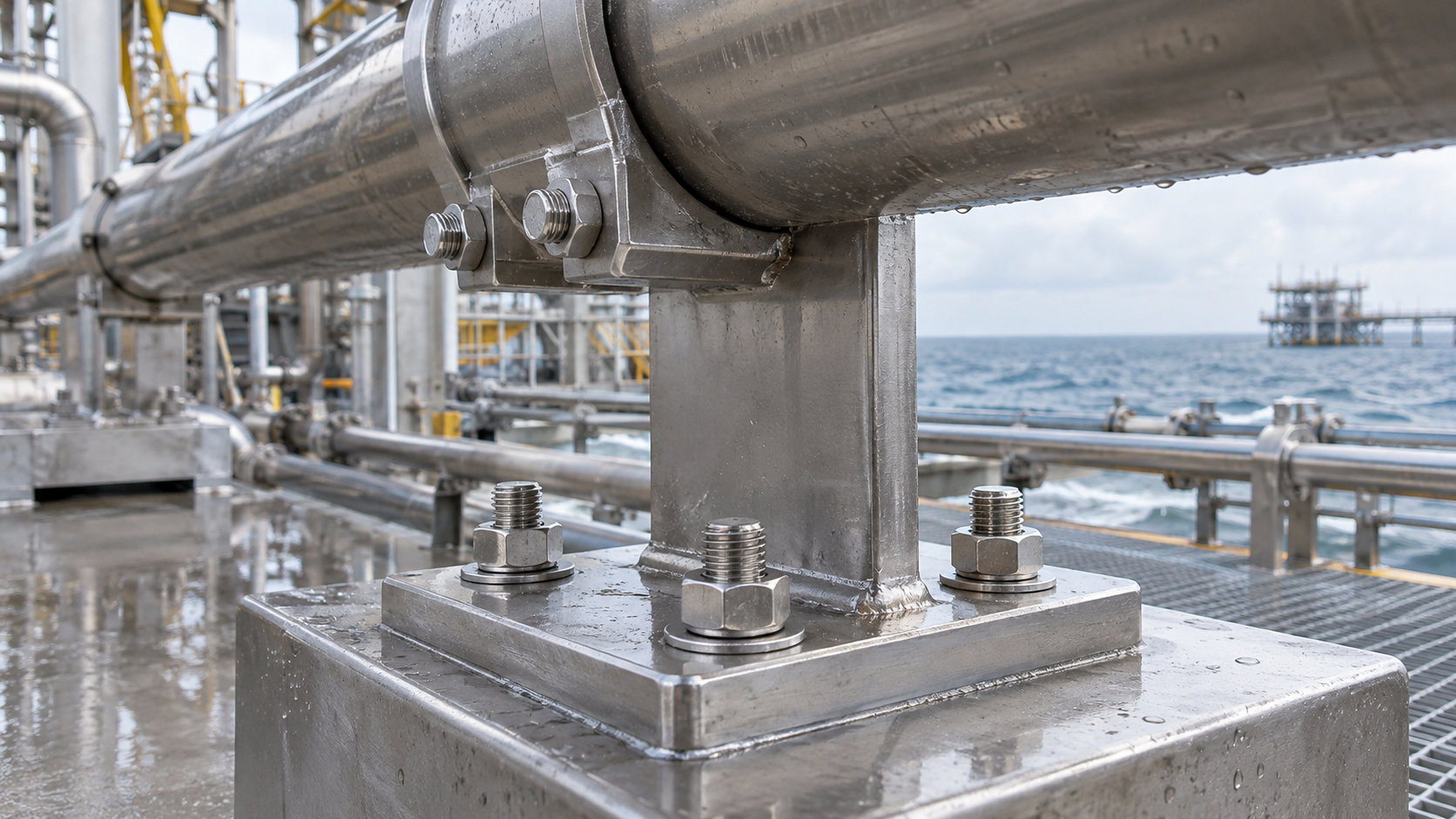
When a maintenance engineer named Alex in Suzhou encountered a marked bracket after tightening a flange nut, the first suspicion was defective hardware. In this illustrative scenario, Alex had replaced a washer-backed connection, tightened the new nut, and immediately seen the painted surface indent. Reviewing the assembly reversed the diagnosis: the bearing surface and specified washer had been overlooked, not proven defective.
When can a flange nut work without a separate washer?
The flange provides a wider integral bearing face than an ordinary nut. That can perform the load-distribution role of a plain washer when the mating surface supports the flange properly. It does not make every joint suitable for washer-free assembly, because effective contact area depends on the part underneath, not simply on the fastener’s outside diameter.
Bolt Science’s fastener FAQ identifies load distribution as a principal purpose of plain washers and explains that flanged fasteners can replace them in suitable applications. NASA’s Fastener Design Manual, RP-1228, provides the broader engineering context: preload, friction, material selection, and joint construction must be considered together. Neither source establishes blanket permission to delete a washer from an approved assembly.
The useful procurement question is therefore not whether a flange always eliminates a washer. It is whether this bearing face, mating material, hole, coating, and assembly procedure have been qualified as a system. Follow the drawing; an undocumented substitution can change both local bearing stress and installation behavior.
How does a flange nut distribute clamp load?
A flange nut spreads the reaction from clamp load across its bearing face, but a broad face only helps where the substrate supports it. A flange hanging over a slot, chamfer, edge, or oversized opening cannot use its entire apparent area. Thin sheet and unsupported brackets may deform even when the contact face looks large.
For simplified screening, average bearing pressure can be estimated as p approximately F / [pi/4(D squared – d squared)], where F is clamp force in newtons and D and d are the outside and inside diameters of a fully supported annular contact area in millimeters. The result is in N/mm squared, equivalent to MPa. An illustrative 10,000 N load with D = 20 mm and d = 9 mm gives about 40 MPa; this is not a fastener or washer product rating.
Actual supported area may be smaller, and the estimate does not resolve bending, edge contact, surface roughness, coating damage, or substrate yielding. NASA RP-1228 is relevant to the underlying load and joint-design assumptions. For a released assembly, the specified engineering calculation and validation procedure take precedence over this screening calculation.
A suitably specified flat washer can enlarge or stabilize the bearing land, but a thin or insufficiently hard washer may dish or embed. Increasing diameter without checking thickness, hardness, and local support merely moves the weak point. The hidden cost is often bracket replacement, coating repair, or rework, not the washer’s purchase price.
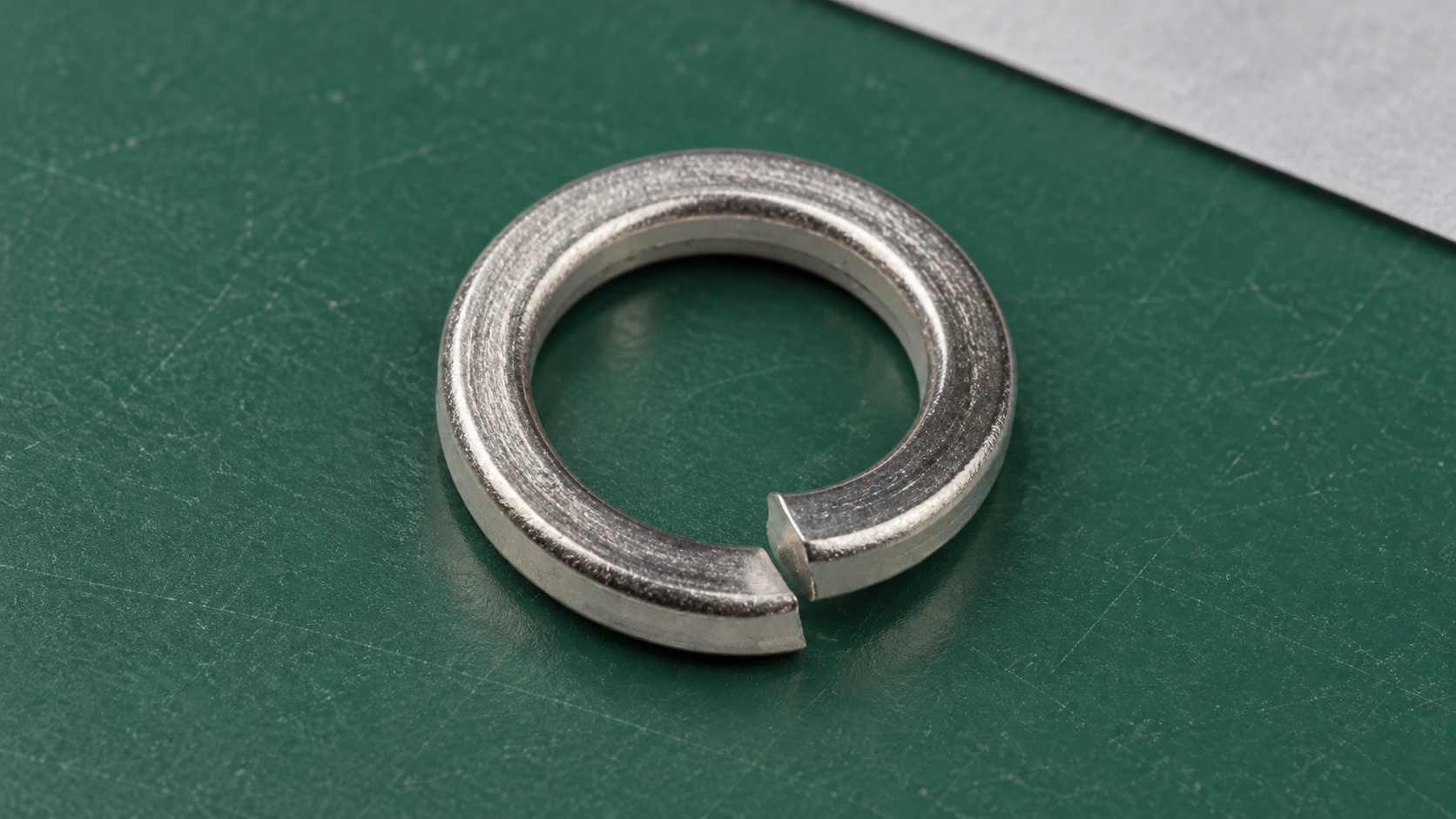
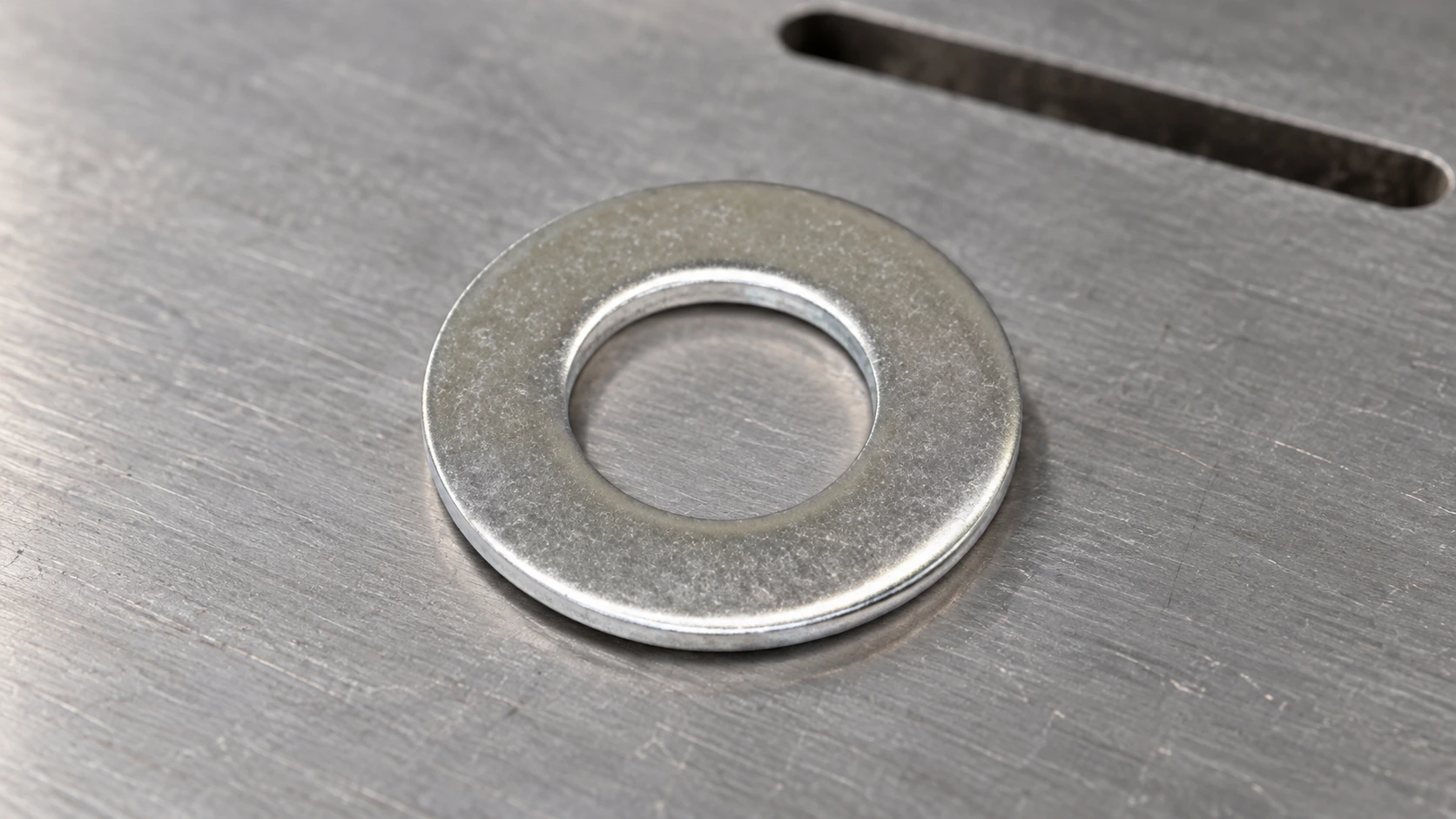 Flat washer bearing-face review. Select the actual thickness, hardness, and dimensions from the approved specification; the image does not establish a load rating.
What changes when a hex flange nut has serrations?
A hex flange nut can have a smooth or serrated bearing face, and these versions should not be treated as interchangeable. Smooth faces primarily provide an integral bearing area. Serrations are intended to interact with a particular mating surface; their suitability depends on surface hardness, finish, coating, and the specified joint design.
Adding a plain washer creates 2 contact interfaces instead of direct contact with the part. Serrations may act on the washer while the washer moves against the substrate, changing the intended mechanism. Bolt Science also notes that washers can rotate during tightening and affect the torque-tension relationship. Adding a washer therefore requires more than checking that its bore clears the thread.
Coated surfaces introduce another trade-off. Direct serrated contact may damage a protective finish, while a washer may protect the part but change friction or engagement. Do not assume either choice preserves corrosion performance or loosening resistance. The required contact surface and coating allowance belong in the assembly specification.
Neither a serrated face nor a separate split washer justifies a universal anti-vibration claim. Where loosening has safety or downtime consequences, use the specified retention strategy and an application-appropriate validation program. Reuse must also follow the approved procedure; previous serration marks are not evidence that the next installation will reproduce the original behavior.
Why does a flange bolt specification affect washer thickness and preload?
Washer decisions should consider the complete connection, including the bolt-head side. In a sourcing review, a flange bolt specification is one item to distinguish from the washer specification, not evidence that a supplier offers every fastener discussed. A connection can require different bearing provisions at its two ends.
An illustrative 2 mm washer added beneath a nut increases that side’s axial stack by 2 mm. With unchanged bolt length, the change reduces available thread protrusion by the same nominal amount. Whether engagement remains acceptable depends on the drawing, thread form, nut geometry, tolerances, and bolt length; there is no universal protrusion rule to substitute here.
NASA RP-1228 explains the importance of friction and preload in threaded assemblies. Changing the bearing surface, coating, lubrication, or washer arrangement can change the clamp load produced by the same torque. Reusing a torque value from a different stack is therefore not a verified installation method.
The commercial consequence is assembly variation: one operator may turn the washer, another may hold it stationary, and both may reach the same tool setting with different results. Define the stack and tightening procedure together, then validate the actual materials and finishes. Avoid publishing a universal torque value or assuming an added washer improves reliability automatically.
Frequently Asked Questions
What is the difference between a hex nut and a flange nut?
A hex nut has a hexagonal wrenching body; a flanged version adds an integral widened bearing face. That face can provide load distribution without a separate plain washer in a qualified joint. Washer requirements still depend on the drawing, surface, and hole support.
What is the difference between a flange bolt and a hex bolt?
A flanged bolt has an integral enlarged bearing face beneath its head, while a conventional hex-head bolt does not have that same integral flange. Either arrangement may still require a specified washer. Compare the actual head geometry and bearing requirements, not just the names.
References
- Bolt Science: Frequently Asked Questions
- NASA: Fastener Design Manual, RP-1228
- ASTM International: Committee F16 on Fasteners
While a flange can simplify the component list, it cannot simplify away the bearing-surface requirements.
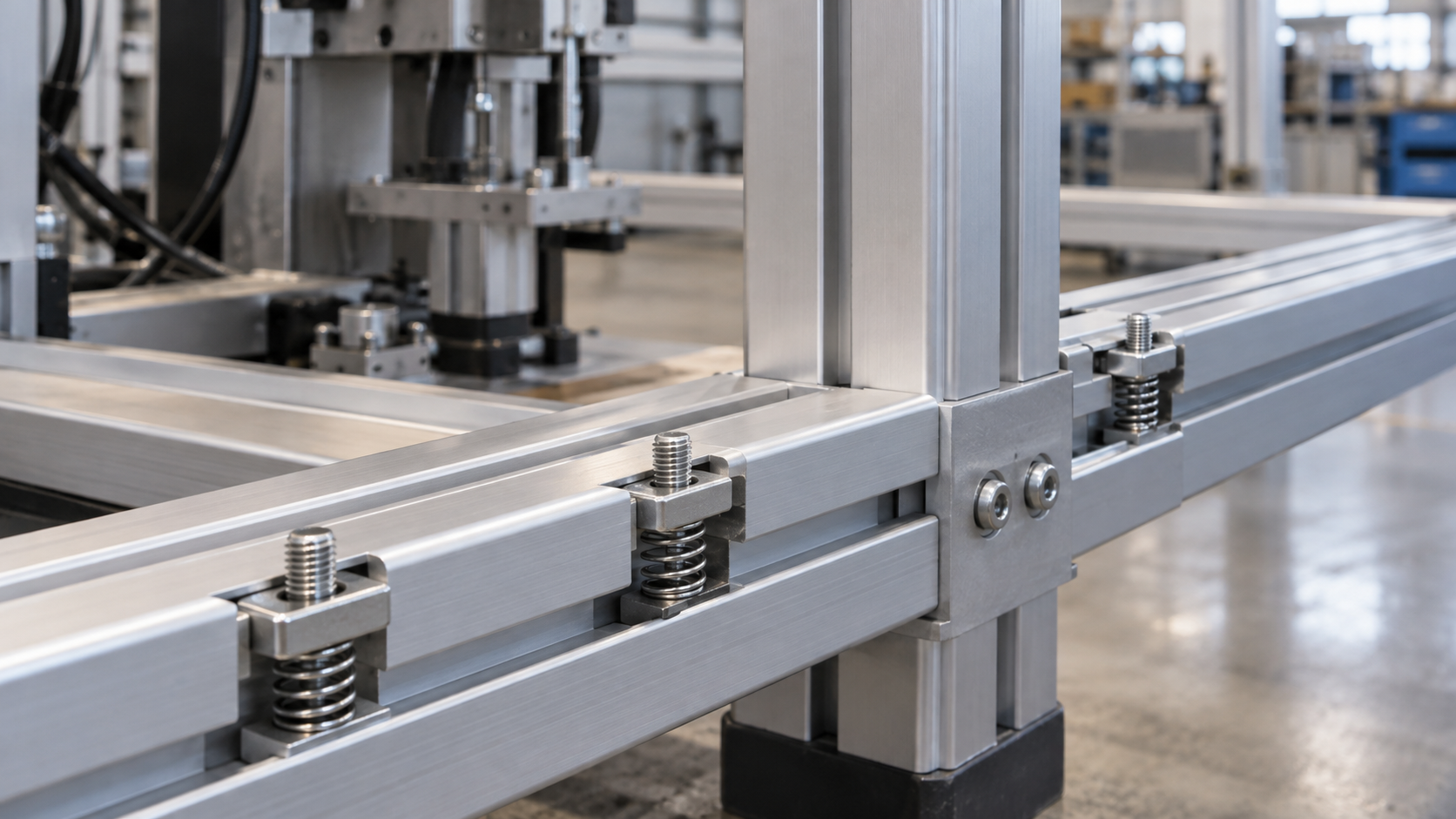
If your project involves aluminum extrusion frames or strut channel systems rather than flat surfaces, a flange nut may not be the right fit. For T-slots and channel applications, spring-loaded T-nuts (with ball or leaf springs) are designed to drop directly into the slot, hold position, and allow repeated assembly — no separate washer or flange required.
Browse Qiyi’s spring nut and T-nut range, or contact us with your drawing and application requirements for a fastener recommendation.