Thread galling is adhesive wear in which mating metal threads stick locally and transfer material as they slide against each other. In a severe case, a nut can seize on a bolt before the joint is properly tightened. Unexpectedly increasing resistance is a reason to stop and investigate, not to apply more force. Prevention requires attention to the mating threads, installation method, lubrication and material pairing.
Stainless steel is a familiar setting for this problem, but the label “stainless” does not identify the whole assembly. A useful investigation records which bolt and female thread were used, their condition, and what happened during installation.
What happens during thread galling?
Galling starts at the contacting surfaces. TWI describes how pressure and sliding can disrupt a protective oxide film, allowing exposed metal at small contact points to adhere. Continued movement can tear these junctions and move material from one surface to the other. This is often called cold welding; it does not mean that the entire fastener has melted.
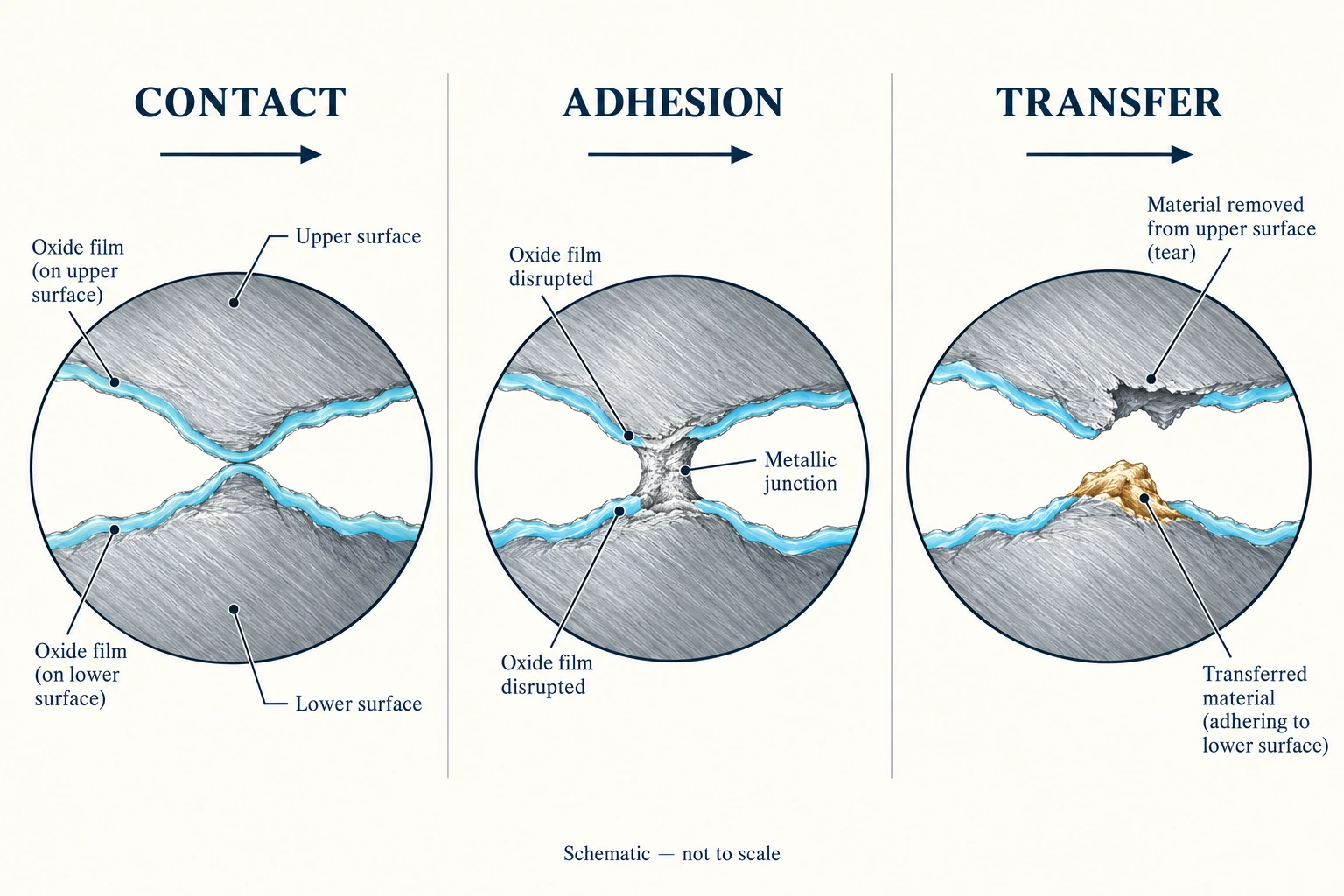
Nord-Lock explains that transferred material can accumulate and intensify the damage. Severe seizure may leave the threads unable to move normally. Forcing the assembly can then strip threads or break the fastener. The useful distinction is between a suspected cause and the immediate response: you do not need a confirmed failure diagnosis to stop an abnormal tightening operation.
This form of metal wear also occurs beyond stainless steel. TWI identifies aluminum and titanium among susceptible materials. A seized fastener, however, is not by itself proof of adhesive wear; the contact surfaces and assembly history still need examination.
Check what happened before changing the fastener
Record when the resistance appeared and check the mating parts before deciding that a different alloy is the answer. The following sequence is an inspection aid, not a way to diagnose galling from torque or feel alone.
| Observation | Next check | Avoid this assumption |
|---|---|---|
| The threads are difficult to start. | Confirm the intended diameter, pitch, alignment and visible thread condition. | Any resistance must be galling. |
| Resistance rises unexpectedly during run-down. | Stop. Preserve the parts and note the tool, lubricant and point at which the change occurred. | Extra torque will complete the joint correctly. |
| A prevailing-torque nut resists rotation. | Check the specified nut design and installation procedure before interpreting the resistance. | Every suitable nut should spin freely through its full travel. |
| The lubricant or coating has changed. | Confirm that the tightening specification covers the new surface condition. | The old torque setting remains valid. |
Keep the bolt and its mating nut or insert identified as a pair. A record that says only “stainless bolt seized” leaves the next person unable to distinguish an unchanged assembly from a trial involving a different nut, finish or installation method. Photographs and part identifiers are more useful than a general description of how tight it felt.
Prevent galling through a controlled installation procedure
Fastenal notes that individual fasteners can pass inspection and still gall as a pair. Inspect mating threads and follow the specified installation procedure.
Check the pair and the run-down method
Inspect for damage and contamination, and confirm that the thread specifications match. Use the specified alignment and starting method. Fastenal identifies installation speed as a contributor because faster run-down can increase heat; a controlled, slower operation can help reduce that contributor. Slower run-down does not correct an incompatible or damaged mating part.
Prevailing-torque nuts deserve separate attention. Their intended resistance introduces additional friction during installation. Follow the nut and assembly instructions rather than transferring a procedure from a free-running nut. Neither a universal speed limit nor a generic torque value can be supplied from the phrase “stainless fastener.”
Select lubrication together with the tightening specification
An appropriate lubricant can reduce the tendency of contacting surfaces to adhere, but it must be compatible with the service environment. TWI specifically calls out restrictions in applications such as food processing. Select a documented product and application method rather than treating all oils and anti-seize compounds as equivalent.
ASSDA emphasizes that lubrication also changes the relationship between tightening torque and clamp load. Do not add lubricant and automatically retain a dry-assembly torque setting. Obtain a tightening specification for the actual fastener, finish and lubrication condition; this guide does not prescribe a universal percentage reduction.
For a repeat assembly, make the installation record reproducible: identify the lubricant, where it is applied, the tool setup and the procedure revision. If one of these changes, flag it for review instead of leaving the next shift to infer what “assemble as usual” means.
Will using different stainless grades prevent galling?
A different grade name does not guarantee a galling-resistant pair. ASSDA cautions that pairing a 304 bolt with a 316 nut may not provide enough hardness difference to prevent galling. Those two grade labels are not a complete specification for the mechanical properties of the finished fasteners.
Material or surface changes must also preserve the required strength and corrosion performance. A harder or differently treated mating component should be assessed as part of the complete joint. Avoid replacing a specified nut solely because another material is described as less prone to galling.
If the proposed change concerns thread pitch, use the separate coarse versus fine thread selection guide to frame that choice. Do not substitute a new pitch into an existing female thread. The purchasing question remains specific: which complete bolt-and-nut or bolt-and-insert combination is being proposed for this application?
Give the supplier an assembly record, not just a grade request
A useful inquiry lets the supplier review the same combination that caused the problem. Organize the information into three short records:
- The mating parts: bolt and female-thread part numbers, thread callouts, specified material or property class, finish, and any available drawing revision.
- The installation: lubricant and application method, tool and run-down setting, tightening specification, and whether the nut has a prevailing-torque feature.
- The observation: when resistance changed, which parts were affected, photographs, and the identity of any comparison assembly that behaved differently.
Ask for the proposed change and its basis in writing. If the recommendation changes the nut, coating or lubricant, have the responsible engineer approve the complete combination and its assembly procedure before production use. A replacement should resolve the identified problem without leaving its thread fit, tightening condition or service compatibility unspecified.
References
- TWI — What is galling? Mechanism and lubricant compatibility.
- Nord-Lock — Preventing bolt thread galling and seizing. Material transfer and damage progression.
- Fastenal — Thread Galling. Installation and mating-pair considerations.
- ASSDA — Galling and its Control. Materials, lubrication and tightening dependencies.