Illustrative scenario: When Elena, a procurement engineer in Monterrey, approved a replacement nut for a conveyor guard, the line passed incoming inspection and began vibrating loose during the first shift. The visible failure looked like a bad batch, but the reversal came from the specification: the drawing called for a plain nut on a joint exposed to vibration, and the replacement had the wrong thread pitch. Correcting the lock strategy and thread designation restored the assembly without simply buying a larger fastener.
Summary: A hex nut is a six-sided internally threaded fastener used with a mating bolt or stud. A plain nut clamps through thread tension and bearing; a hex lock nut adds a prevailing-torque or other anti-rotation feature. A hexagonal nut is the same basic six-flat form described by many catalogs. Start with the mating thread, joint load, vibration, environment, and applicable standard; then verify material, finish, installation torque, and inspection evidence before placing a production order.
What does a hex nut do in a bolted joint?
A hex nut provides the female thread that receives a bolt or stud. Its six external flats give a wrench access and make it practical to apply controlled torque in confined industrial assemblies. The nut does not create strength by itself: clamp load depends on the bolt, thread engagement, friction, bearing surfaces, joint stiffness, and the installation procedure.
Thread identification is the first fit check. An inch thread is normally described by nominal diameter and threads per inch under ASME B1.1, while a metric thread is identified by nominal diameter and pitch. For example, M8 x 1.25 and M8 x 1.0 share an 8 mm nominal diameter but do not mate correctly. A gauge, approved mating bolt, or drawing review should confirm pitch before assembly; visual similarity is not evidence of compatibility.
During installation, start the nut square to the bolt and verify the specified thread engagement and protrusion. For a screw fitted into a tapped blind hole, separately check that the tip does not bottom out before the joint is clamped. Lubrication, coating and finish change friction, so use the equipment owner’s tightening procedure rather than an unrelated generic torque chart.

How does a hex lock nut resist loosening?
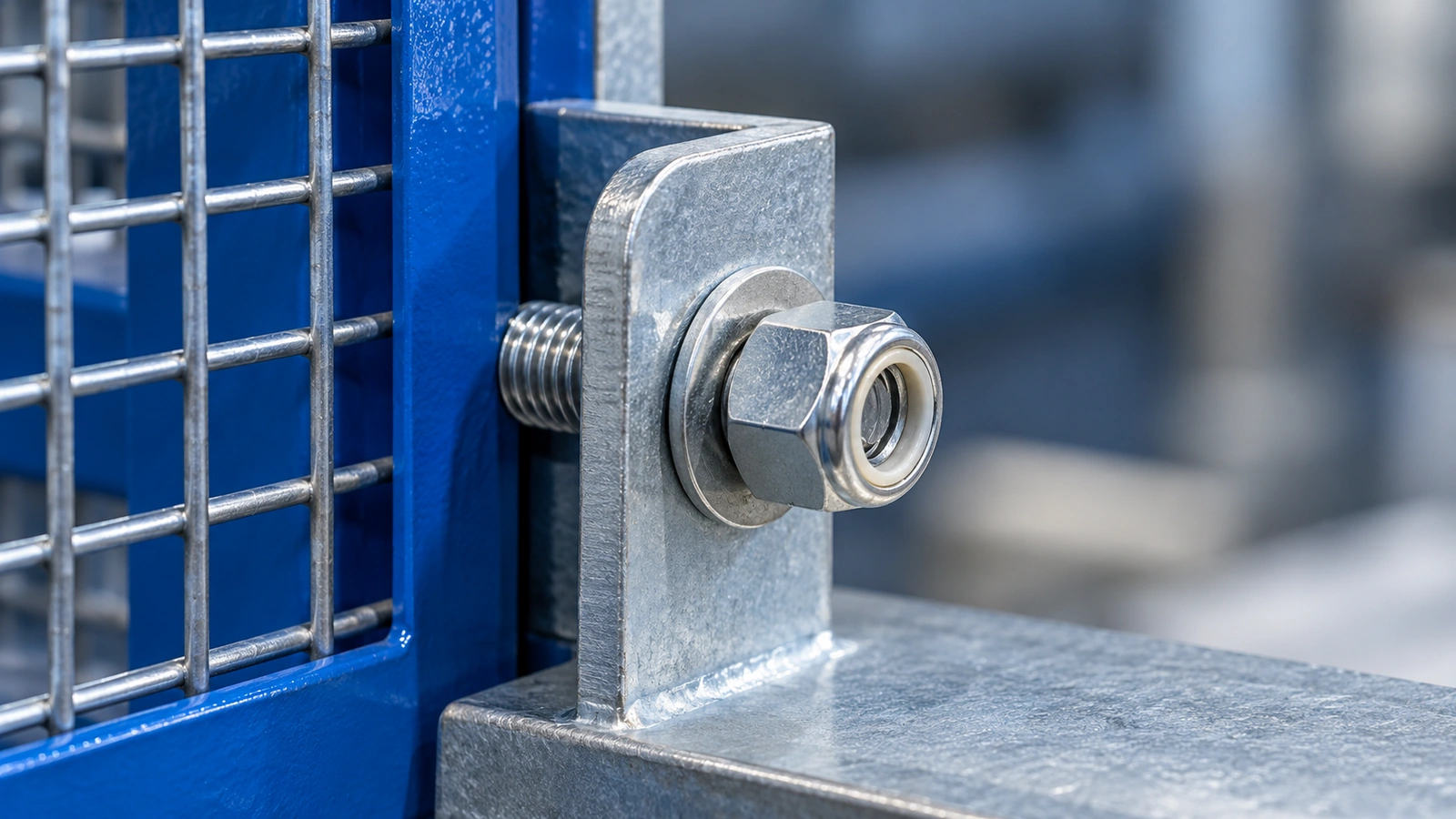
A hex lock nut is a hex-form nut with a feature that increases resistance to rotation after tightening. Common designs include a nylon insert, an all-metal distorted thread, or a prevailing-torque element. The feature resists relative motion; it does not replace correct bolt preload, adequate thread engagement, or a joint design that manages transverse loads.
ISO 2320 addresses prevailing-torque type steel nuts and defines test concepts for prevailing torque and reuse. A nylon-insert design may be unsuitable for temperatures or chemicals that affect the insert, while an all-metal design may be selected where a non-metallic element is not permitted. The precise temperature, reuse limit, and torque requirement belong in the product specification rather than being inferred from the word “lock.”
Do not confuse a lock nut with a jam nut, lock washer, thread adhesive, or castellated nut with a cotter pin. Those solutions change the joint in different ways. For a safety-related connection, the design authority should state the required anti-rotation method and any prevailing-torque or vibration test. A lock feature can be consumed during installation, so repeated service cycles should be part of the maintenance plan.
Which hexagonal nut dimensions and materials should procurement specify?
A hexagonal nut should be specified by more than nominal thread size. Record the thread designation and tolerance class, across-flats dimension, nut thickness, bearing face, chamfer, and any special geometry. If a washer is part of the joint, verify that the washer inner diameter and outside diameter suit the bolt and bearing surface. A dimensional inspection should use calibrated gauges or a coordinate measurement method defined by the drawing.
Material selection follows the environment and required mechanical properties. Carbon steel can support common industrial joints when protected from corrosion; stainless steel can help in corrosive environments but may increase galling risk with a matching stainless bolt. Brass, aluminum, and specialty alloys can be appropriate for electrical, weight-sensitive, or chemical applications, but the designer must verify strength, compatibility, and temperature limits.
ISO 898-2 covers mechanical properties for specified carbon-steel and alloy-steel nuts. Its property classes are not universal ratings for stainless or non-metallic products, and they do not certify an assembled joint. Ask the supplier to state the material designation, property class where applicable, heat treatment or condition, and finish. Salt-spray hours or a plating color alone should not be treated as a complete corrosion qualification.
Finish also affects fit and friction. Zinc, nickel, black oxide, and passivated stainless surfaces can change thread feel, corrosion behavior, and torque-tension results. If a coating is specified, include thickness or process requirements when relevant, and verify that the finished thread still meets the dimensional tolerance.
When should a hex nut be compared by total cost and application?
Unit price is only one part of the purchase decision. A plain nut may be economical for a protected, low-vibration joint that is easy to inspect. A lock nut can cost more per piece but reduce rework when loosening would stop a line. The correct comparison includes installation time, inspection frequency, replacement access, corrosion exposure, and the consequences of a loose joint.
Illustrative calculation: 500 assemblies at an additional 20 seconds each require 10,000 seconds, or about 2.8 labour hours. Six two-minute rechecks add 12 minutes per shift. Compare those activities over the same production period and add the actual labour rate, hardware cost and downtime exposure before claiming a saving. These are planning assumptions, not measured customer results.
| Option | Loosening strategy | Assembly efficiency | Compatibility and limits | Total-cost considerations |
|---|---|---|---|---|
| Plain hex nut | Relies on preload, friction, and joint design | Fast installation with a standard wrench | Suitable when the drawing permits it; sensitive to vibration and poor preload | Low unit-cost tendency; reinspection or downtime may dominate |
| Nylon-insert hex lock nut | Non-metallic insert adds prevailing torque | Requires additional driving torque | Check temperature, chemical exposure, and reuse policy | May reduce service loosening; replacement is usually planned after removal |
| All-metal hex lock nut | Distorted thread or metal locking element | Installation torque varies by design | Useful where nylon is unsuitable; confirm bolt and coating compatibility | Can support harsh environments; verify prevailing torque and service cycles |
| Plain nut plus separate locking method | Washer, adhesive, pin, or secondary nut changes the joint | More parts or process steps | Requires a documented assembly sequence and access for the added method | Evaluate inventory, training, and inspection burden as well as piece price |
Which hexagonal nut application checks prevent a specification mismatch?
| Application | Record before ordering | Verification to request |
|---|---|---|
| Guard, bracket, or machine frame | Thread system and pitch, bolt length, across-flats clearance, vibration level | Thread gauge or mating-bolt fit; dimensional report; installation procedure |
| Outdoor or washdown equipment | Base materials, moisture or chemical exposure, finish, service temperature | Material and finish statement; corrosion evaluation defined by the project |
| High-cycle service joint | Locking type, removal frequency, access, required prevailing torque | Applicable ISO 2320 test evidence or a customer-defined functional test |
| Safety-relevant assembly | Load case, property class, traceability, inspection and torque records | Conformance documents tied to the drawing and approved change process |
The table is a starting checklist, not a substitute for joint calculation. A fastener may fit geometrically while failing the load path, corrosion pairing, or service requirement. Keep the bolt, nut, washer, substrate, and installation method under one controlled specification.
Which hex lock nut standards and compliance checks apply?
Use standards according to their scope. ASME B1.1 defines unified inch screw-thread forms and designations; it does not certify a nut’s material or locking performance. ISO 898-2 addresses mechanical properties for specified steel nuts, while ISO 2320 covers prevailing-torque type steel nuts and related test concepts. A test report is evidence for the tested configuration, not a blanket approval for every size, coating, or batch.
On the purchase order, identify the standard edition, thread system, size, material, property class when applicable, finish, and inspection basis. State whether the requirement is dimensional conformity, proof-load performance, prevailing torque, corrosion resistance, or a complete assembled-joint test. This separation prevents a supplier’s general “compliant” statement from being mistaken for evidence against a specific drawing.
Destination-market rules and customer requirements may add traceability, restricted-substance, or safety obligations. Ask which documents accompany the shipment and how lot identification is retained. Unsupported claims can cause rejection, rework, or liability, especially when a lock feature is used in a safety-critical application.
How should buyers select a hex nut for production?
- Define the joint first: load direction, vibration, temperature, chemicals, access, and planned service cycles.
- Lock the interface: thread diameter and pitch, tolerance, engagement length, across-flats clearance, washer use, and bolt length.
- Choose the locking method deliberately: plain, nylon insert, all-metal, or a documented secondary method; state why it is suitable.
- Specify evidence: material and finish documents, dimensional inspection, prevailing-torque data when relevant, and lot traceability.
- Compare total cost: include tool time, rechecks, replacement access, downtime exposure, and inventory complexity.
Qiyi Fastener can be considered during this sourcing stage when a buyer needs a defined nut configuration and supporting procurement discussion. Review the flange nut product specifications and the broader fastener product catalog against the drawing rather than selecting by appearance. Confirm the required thread, material, finish, locking function, quantity, and documentation before approval.
Which hex nut questions should a procurement team answer?
What is a lock nut vs. hex nut?
A plain hex nut relies mainly on clamp load and thread friction, while a lock nut adds a feature intended to resist rotation. The term “hex nut” describes the six-sided external form; “lock nut” describes the anti-rotation function. Confirm the exact locking design, material, temperature range, and reuse policy before substituting one for the other.
What is a hexagonal nut?
A hexagonal nut is a nut with six external flats and an internal thread, commonly used with a matching bolt or stud. In general trade language it is usually the same basic form as a hex nut. Its performance still depends on thread, material, grade, finish, and the complete joint design.
What is a 6-sided nut called?
It is commonly called a hex nut or hexagonal nut. Catalogs may add terms such as heavy hex, thin, jam, flange, or lock to describe thickness, bearing geometry, or locking function. Use the dimensional designation and standard on the drawing because the name alone does not define fit or strength.
Is a stop nut the same thing as a lock nut?
“Stop nut” is not a single globally consistent product designation; some suppliers use it for a lock nut, jam nut, or another end-stop component. Treat the term as ambiguous until the supplier identifies the thread, geometry, locking method, and applicable standard. Request a drawing or data sheet before approving a substitute.
Which hex lock nut references should buyers verify before ordering?
- NASA Fastener Design Manual — Engineering guidance on threads, preload, washers and joint design.
- ASME codes and standards catalogue — Look up the named B1 and B18 standard and specify the required edition; the catalogue is not a product certificate.
- NASA-STD-5020, Requirements for Threaded Fastening Systems in Spaceflight Hardware — Spaceflight-specific design and analysis requirements; contextual engineering reference, not a requirement for ordinary industrial fasteners.
A nut succeeds when its geometry, thread, material, locking method, and installation process agree with the joint; six flats alone do not make a specification complete.
For a drawing review or sourcing discussion, contact Qiyi Fastener with the thread designation, application, environment, finish, quantity, and required documentation.