Summary: A dependable T-nut purchase starts with thread size, slot geometry, alloy, mating hardware and exposure—not a stainless label alone. M6 is 6 mm; M8 is 8 mm—neither is interchangeable without checking profile and load path. ISO 3506 frames stainless fastener property classes; salt-spray is a test, not a service-life guarantee. Send a section drawing, environment description and required evidence with every quote.
Stainless T Nuts Start with the Slot, Thread, and Substrate
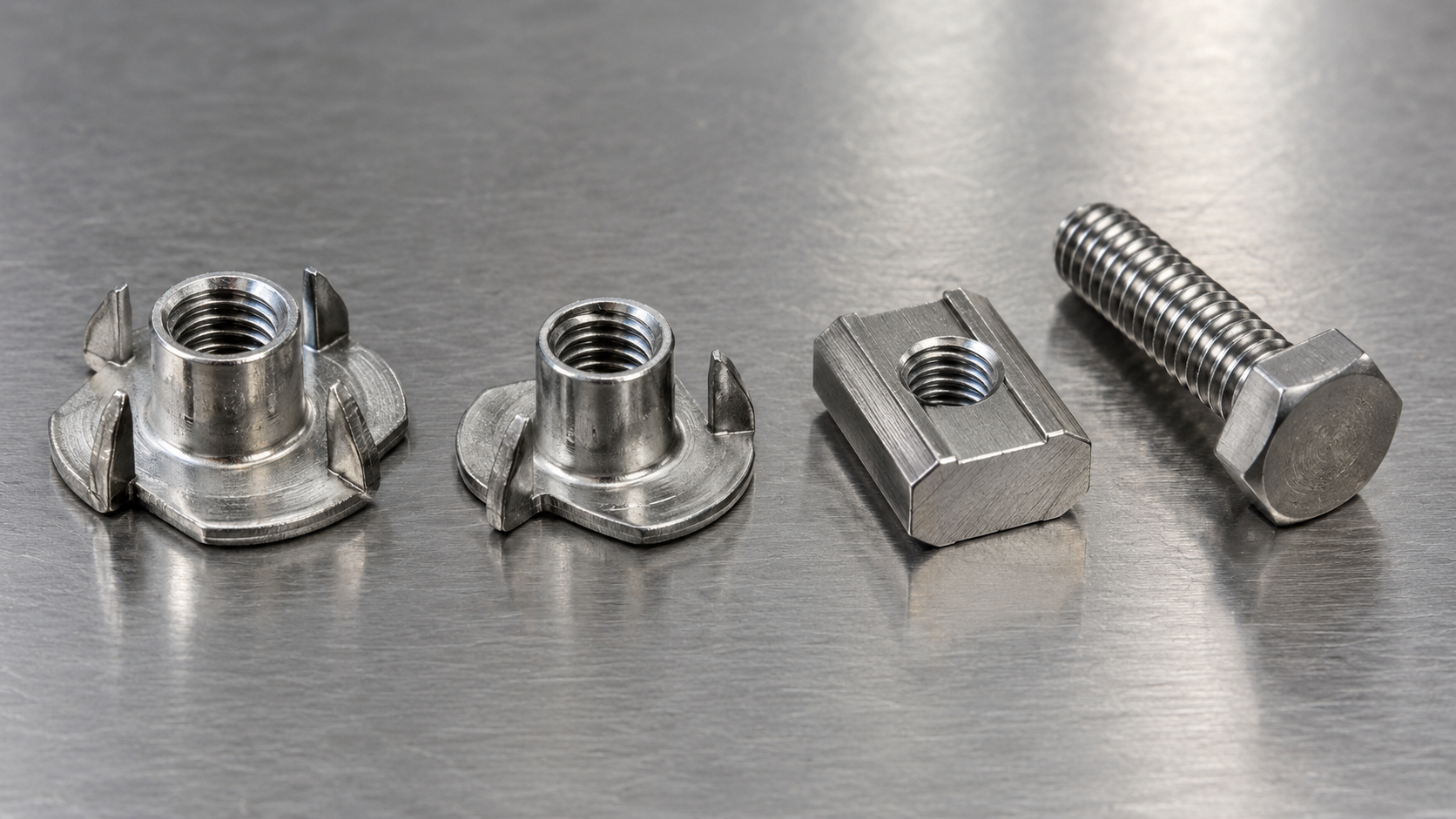
T-nuts provide a captive or repositionable threaded point in slotted aluminum profiles, wood panels, composites, fixtures, and modular frames. The form can be a sliding block, a spring-retained nut, a pronged tee nut, or a square nut that turns into a slot. For a broad overview of stainless t nuts types and common uses, start with the actual substrate and access direction, then narrow the choice by thread, material, and inspection requirement.
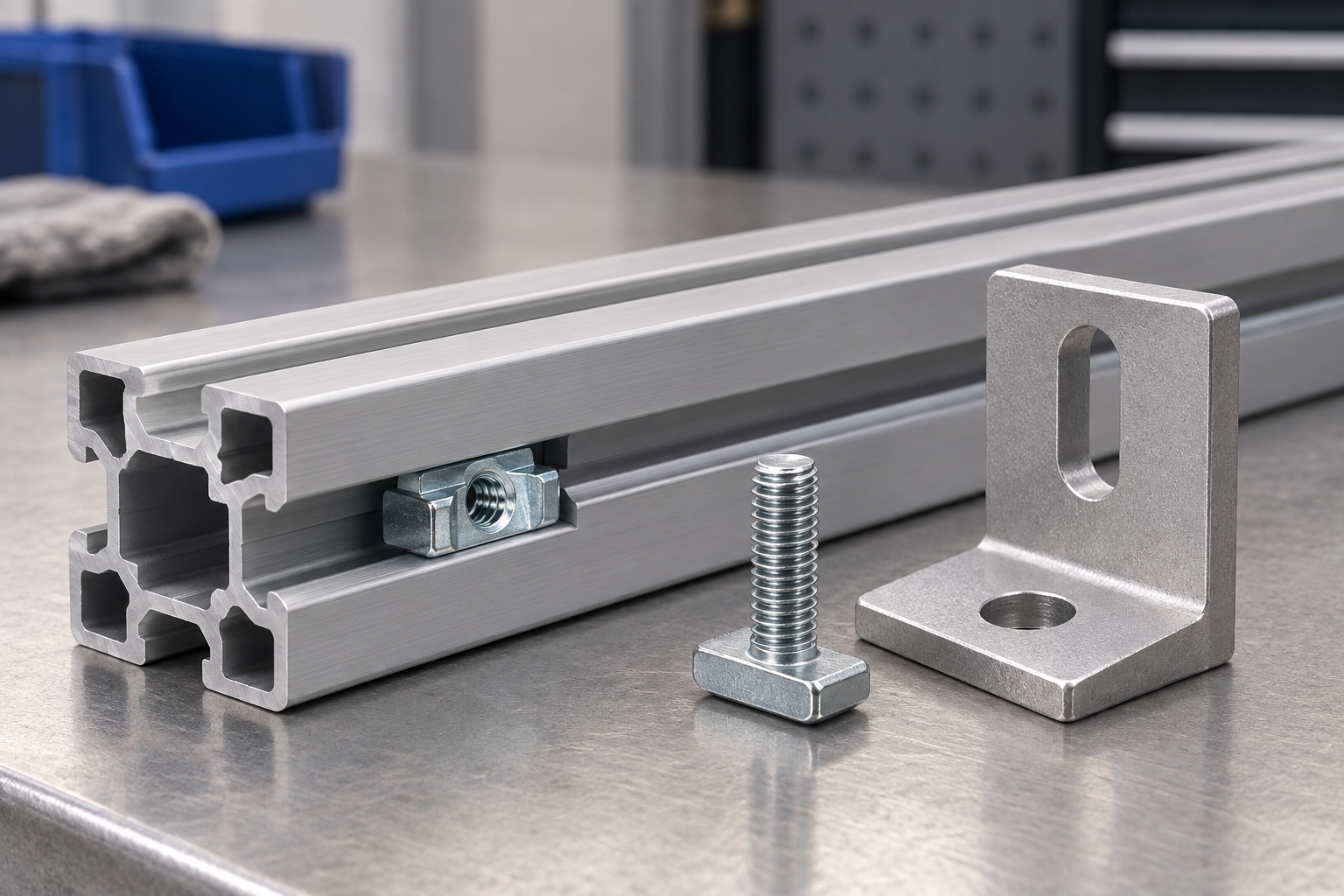
The phrase stainless t nuts covers several geometries, so a nominal thread is only the beginning of the specification. In an ISO metric coarse thread, M6 commonly uses a 1.0 mm pitch and M8 commonly uses a 1.25 mm pitch; the mating screw, nut length, and available engagement must agree. Measure the slot opening, neck width, internal depth, and insertion path from the profile drawing instead of assuming that parts with the same M-size will fit.
Sliding T-nuts are inserted from a profile end or dropped into an open slot, then moved to the joint location. Spring or ball retainers can hold the nut during assembly, but retention is not clamp load. A pronged tee nut for wood or composite panels depends on tooth engagement, panel density, edge distance, and a square installation hole; it should not be substituted for an extrusion nut simply because both accept an M6 screw.
Use a go/no-go slot gauge or a calibrated caliper for incoming checks, and record the measured profile in the drawing. For adjustable framing, our guide to sliding T-nuts for extrusion profiles explains why insertion direction and slot clearance can matter more than a catalogue photograph.
Stainless Steel T Nuts Need an Exposure-Based Material Decision
Grade 304 is often considered for general indoor and ordinary outdoor assemblies; grade 316 is commonly evaluated where chlorides from coastal air, de-icing salt, or process cleaners raise localized-pitting risk. The molybdenum in typical 316 chemistry can improve pitting resistance, but no grade is immune to a wet crevice, retained chemical, or contamination from carbon-steel tools. The term stainless steel t nuts therefore needs an alloy or material designation, not just a finish description.
Ask how the part was formed and cleaned. Iron transfer from a punch, wire brush, or storage rack can produce surface staining that is mistaken for alloy failure. A suitable cleaning and passivation process may be part of the purchase specification, while the final joint still needs drainage, compatible washers, and a plan for salt or chemical deposits.
ASTM G48 is a laboratory method used to evaluate localized corrosion resistance under specified ferric-chloride conditions; it does not translate directly into years of field service. If the assembly is washed down, document the cleaner concentration, contact time, temperature, and drying cycle before asking a supplier to recommend 304 or 316.
Stainless Steel Nuts and Mating Hardware Must Be Reviewed Together
Stainless steel nuts can gall when mating threads slide under high pressure, especially during dry, high-speed installation. ISO 16047 describes a torque-and-clamp-force test approach for threaded fasteners; it helps compare an agreed lubricant and tightening process, but it is not a universal torque table for every T-nut geometry. Record the screw grade, lubricant, tightening speed, washer, and target preload as one assembly instruction.
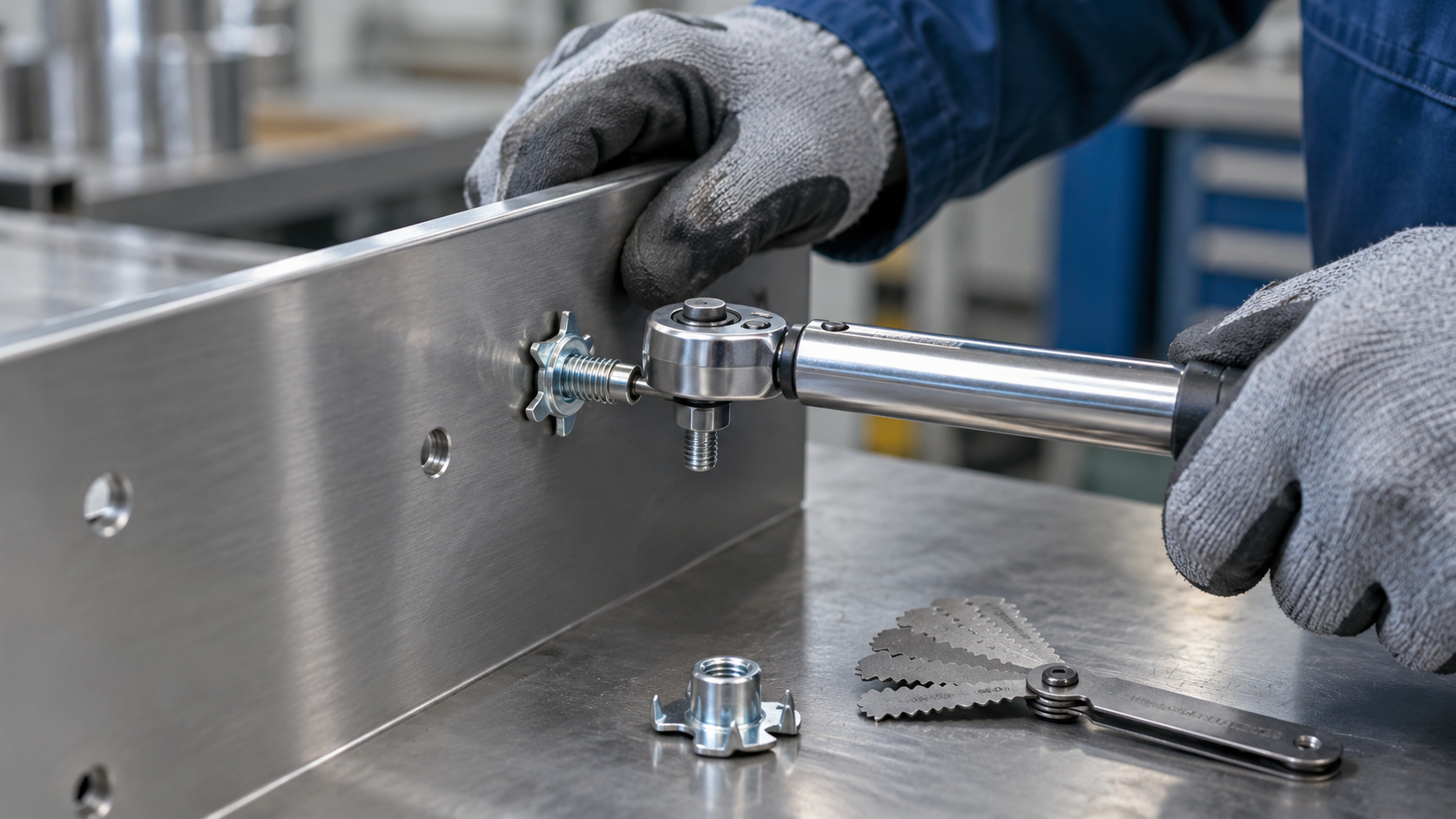
Thread engagement is another hidden cost. An M8 coarse thread has a 1.25 mm pitch, so a damaged first thread or a nut that bottoms in a shallow profile can remove several effective turns at once. A torque wrench reading alone cannot show whether the flange has seated, whether the profile wall has yielded, or whether a pronged nut has crushed a panel. Use a representative first-article installation and inspect witness marks before releasing a batch.
Galvanic exposure depends on the complete joint: stainless hardware connected to aluminum, zinc-plated steel, or a coated panel can behave differently in an electrolyte. Isolation washers, drainage, compatible finishes, and periodic rinsing may reduce risk. The correct response is an interface review, not an unsupported claim that one stainless component prevents corrosion everywhere.
Stainless T Nuts Deliver Better Value When Installation Is Controlled
The comparison below uses seven decision factors and is intentionally qualitative because dimensions, order volume, inspection, and documentation change the commercial result; ISO 3506 can frame applicable material and property evidence, but it cannot set a unit price or guarantee service life.
| Decision factor | 304 stainless option | 316 stainless option | Plated carbon-steel option |
|---|---|---|---|
| General corrosion performance | Often suitable for dry indoor and mild outdoor exposure. | Often considered for higher chloride or chemical exposure. | Depends strongly on coating, damage, and maintenance. |
| Localized-pitting concern | Review salt, crevices, and deposits carefully. | Molybdenum may improve chloride-pitting resistance; crevices still matter. | Coating defects can expose the base steel. |
| Compatibility | Check mating screw, washer, profile, and galvanic pair. | Check the same interfaces; a higher alloy does not correct a poor joint. | Check coating damage and contact with dissimilar metals. |
| Installation efficiency | Profile-specific form and access determine changeover time. | Same geometry choices; material alone does not speed installation. | May be efficient where coating and environment are controlled. |
| Unit-cost tendency | Relative cost varies with grade, geometry, and quantity. | Often a higher material-cost direction; verify the business case. | Often lower material cost, with coating and replacement risk to assess. |
| Maintenance and returns | Document cleaning and surface condition. | Document exposure and inspection criteria. | Plan coating inspection and corrosion touch-up or replacement. |
| Total-cost question | Will grade 304 meet the access and exposure requirement? | Does difficult access justify the added alloy margin? | Will coating control and service frequency outweigh the initial saving? |
Qiyi Fastener can be considered at this stage when a buyer needs a defined T-nut configuration, dimensional discussion, and sourcing communication tied to the intended assembly. The appropriate alloy, finish, and test evidence still belong in the purchase specification; the brand should not replace that engineering work.
Frequently Asked Questions
What are the different types of T nuts?
Common types include sliding or drop-in nuts for extrusion slots, spring- or ball-retained nuts for temporary positioning, and pronged tee nuts for wood or composite panels. Square nuts and flange forms vary in slot entry and rotation resistance. Choose by substrate, slot/hole geometry, access direction and load path—not by name alone.
What are the different types of stainless steel nuts?
Stainless steel nuts include hex, flange, prevailing-torque, square, and application-specific T-nuts or insert nuts. Their alloy, thread class, geometry and locking feature can differ independently. Confirm material designation and mating screw before treating two as interchangeable.
What is the difference between an M6 and an M8 T-nut?
M6 and M8 identify nominal metric thread diameters of about 6 mm and 8 mm; coarse pitches are 1.0 mm and 1.25 mm respectively. The larger thread does not guarantee a stronger joint—slot fit, flange bearing, substrate and preload still control performance. Check the profile drawing and required engagement before changing size.
Are all T nuts the same size?
No. T-nuts differ in thread size, pitch, flange width, body height, prong layout, spring or ball retention, and the slot or panel they fit. Two M8 nuts may accept the same screw but fail to seat in the same extrusion. Match the complete dimensional envelope and installation method to the host component.
References
- ASTM International Committee F16 on Fasteners
- NASA Fastener Design Manual
- worldstainless technical resources
When your drawing is ready for review, Qiyi Fastener can help align the T-nut configuration with the mating hardware and sourcing requirement. Contact Qiyi Fastener with the profile or panel details, exposure description, and requested documentation.