
Plastic Hinges Operate Smoothly and Quietly–Plastic Hinges for Doors Applications
Plastic hinges are appreciated for their ability to operate very smoothly and quietly. The smooth motions of plastic hinges reduce the friction (noise) created when moving the door (or cabinet) while opening and closing the doors (or cabinets), thereby enhancing the user’s overall experience.
There are advantages of using plastic hinges that have very little friction (noise) when opening and closing, especially in applications such as office equipment, cabinets in the home, display cases, and similar types of products where quiet operation is preferred.

| Size | Mass(g) | PartNo |
| 3030 | 26.3 | PH-52-30-30 |

| Size | Mass(g) | PartNo |
| 4040 | 45 | PH-60-40-40 |
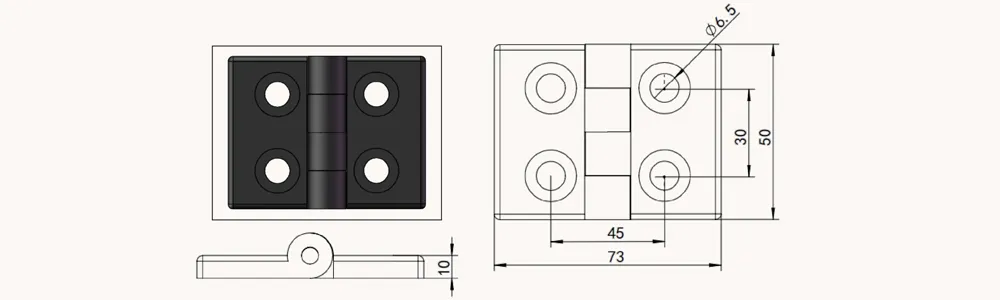
| Size | Mass(g) | PartNo |
| 4545 | 52.3 | PH-73-45-45 |
Lightweight Design for Easy Installation
Lightweight design is one of the major benefits of utilizing these types of plastic door hinges. Because they have a much lighter design compared to metal alternatives, plastic door hinges reduce the total weight of your doors, panels, and covers. This is particularly beneficial when working on projects requiring weight control such as compact devices and small cabinets, as well as lightweight access doors.
In addition to weight advantages, lightweight hinges are also easier to install and enable easier handling at the time of assembly. For manufacturers, using lightweight plastic hinges may help them to produce their products quickly and more intelligently when designing and manufacturing a product. For end users, a plastic hinge that is lightweight will enhance the movement of door(s) while reducing the force needed to operate the door.
Corrosion and Moisture Resistant
Plastic hinges are commonly selected for applications where moisture, humidity, or wetness will impact the performance of hardware. These hinges do not corrode as some metal hinges do, which makes them an excellent option for wet areas. This can help maintain both the appearance and function of products using plastic door hinges over time.
For products that can be found in the kitchen, storage shelves, utility cabinets, or industrial enclosures, corrosion-resistant properties will make a plastic door hinge an excellent choice for applications where moisture will constantly be exposed to the hinge for long periods of time.
Reliable Chemical Resistance
In addition to moisture, one more important characteristic of our plastic door hinges is their ability to resist corrosion due to common household cleaning chemicals. Plastic hinges can be used in many applications where substances such as oils and/or detergents come in contact with the door or cabinetry surface(s), depending on what type of material was used to create the hinge.
Therefore, they are an ideal solution when designing and manufacturing cabinets, protective housings, as well as enclosure doors in work environments that commonly require frequent cleaning or are exposed to light chemicals. Furthermore, the added stability provided by plastic hinges greatly extends the service life of many items, which would increase reliability during their daily use.
Safe for Use in Electrical and Insulated Environments
Plastic hinges are made of non-conductive material and can therefore be used in many instances where electrical insulation is needed. Applications where non-metallic parts provide additional safety include electrical boxes, enclosures for various types of equipment, and control panel housings.
This property of plastic hinges lends itself well to usage in technical and industrial applications. A plastic hinge is a good design option when there is a need for insulation and separation of parts.
Durable for Repeated Daily Use
Although most plastic hinges are lightweight, they can last through frequent use because they are built for ruggedness. When circumstances dictate, plastic hinges can offer users stable operational performance throughout an extended period of time because the structure of the components will hold together due to the factors associated with weight or distance. All these features contribute to them being used in areas that have constant use due to being opened and closed frequently in daily operation.
Plastic hinges are well-suited to light-duty or medium-duty applications in regards to achieving the balance between the performance and convenience of the hardware. Also, they resist rust and require minimal maintenance, even though they can continue to operate for prolonged periods of time regardless of their industry.
Low Maintenance and Easy Cleaning
Plastic hinges require very little maintenance compared to metallic counterparts. Many plastic hinges do not require anti-rust treatments, there are no painting required with a metal hinge, and they do not have regular repeat lubrication; thus reducing maintenance time and making managing use in daily situations more straightforward.
Cleaning is simple and can be easily accomplished in locations that have hygiene, equipment presentation, or routine maintenance as priority. For both manufacturers of plastic hinges and those who purchase them, reduced ongoing maintenance and associated labor have resulted in lower long-term operating costs.
Suitable for a Wide Range of Applications
Plastic hinges are isolated as being versatile because they are useful across multiple applications. Hinges made of plastic have a wide application range; they are ideal for use in cabinet doors, equipment panels, electrical boxes, enclosures, lightweight access doors, storage compartments.
Due to the variety of applications, they are a practical solution in many industries. Whether the requirement is for commercial equipment, industrial housing, functional storage, or hunting, plastic door hinges are flexible enough to suit a wide range of designs. This versatility makes them popular with buyers and product developers alike.
Frequently Asked Questions
What are plastic hinges used for?
Plastic hinges can be used in many light- to medium-duty applications such as cabinet doors, equipment enclosures, access panels, electrical boxes, storage compartments, and lightweight doors. Plastic hinges are preferred in environments requiring low weight, resist corrosion, operate quietly, and require low maintenance. Plastic hinges are economical and practical hardware solutions in commercial and industrial products.
What is a flexible hinge?
A flexible hinge allows bending or smooth movement without complex mechanical parts, enabling it to be used in multiple applications, e.g., the use of highly elastic and durable plastic materials is common with flexible hinges. Products that require lightweight design, simplicity in design, and predictable opening and closing performance often use flexible hinges.
What types of plastic hinges are available?
There are several plastic hinge options for different applications: Standard molded hinges, plastic butt hinges, lift-off, living, concealed hinges, or custom hinges for specialized equipment/enclosures. The appropriate hinge will be determined by several considerations, i.e., door weight, angle of opening, installation process, and total design of the product.
What is the most used door hinge?
Butt hinges are the most common type of door hinge. They are commonly used with doors/cabinets/general access panels. Butt hinges are preferred for their simple construction, ease of installation, and reliable performance. Plastic butt hinges are often used on lightweight products and/or when corrosion resistance, reduced weight, or electrical insulation are required instead of using a metal hinge.